

GEOG 1300 Final
Study online at https://quizlet.com/_d77kpx
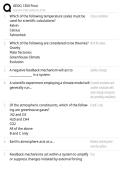
1. Which of the following temperature scales must be Celsius and Kelvin
used for scientific calculations?
Kelvin
Celsius
Fahrenheit
2. Which of the following are considered to be theories? All of the above
Gravity
Plate Tectonics
Greenhouse Climate
Evolution
3. A negative feedback mechanism will act to stabilize changes
________________ in a system.
4. A scientific experiment employing a climate model will A control simulation and
generally run... another simulation with
some change incorporat-
ed (sensitivity simulation)
5. Of the atmospheric constituents, which of the follow- B and C only
ing are greenhouse gases?
.N2 and O2
H20 and CH4
CO2
All of the above
B and C only
6. Earth's atmosphere acts as a... Blanket, retaining heat
near the surface
7. Feedback mechanisms act within a system to amplify True
or suppress changes initiated by external forcing
1/7
, GEOG 1300 Final
Study online at https://quizlet.com/_d77kpx
8. Earth's albedo refers to Sunlight that is reflected to
space
9. The _____________ , because of a larger heat capacity, oceans
requires more time to warm up and cool down and lag
further behind the timing of peak the insolation.
10. Earth's obliquity is the cause of the seasons. true
11. Water vapor is a greenhouse gas, and acts To amplify the warming
caused by carbon dioxide
12. How does energy from the sun cross the vacuum of Via electromagnetic radia-
space, and arrive at earth? tion
13. Earth spins on its axis of rotation every ________________ 24 hours/365.25 days
and completes one orbit around the sun every
_______________________.
14. There is an observed (empirical) relationship be- Vapor/increasing
tween temperature and atmospheric water vapor:
as temperature increases water prefers to be in its
________________ phase, thus _______________ saturation
vapor pressure.
15. A 2-dimensional plane that slices through the center of The ecliptic
both the earth and the sun is
16. The Greenhouse Effect refers to Longwave radiation that is
emitted downward from
the atmosphere
17.
2/7
Study online at https://quizlet.com/_d77kpx
1. Which of the following temperature scales must be Celsius and Kelvin
used for scientific calculations?
Kelvin
Celsius
Fahrenheit
2. Which of the following are considered to be theories? All of the above
Gravity
Plate Tectonics
Greenhouse Climate
Evolution
3. A negative feedback mechanism will act to stabilize changes
________________ in a system.
4. A scientific experiment employing a climate model will A control simulation and
generally run... another simulation with
some change incorporat-
ed (sensitivity simulation)
5. Of the atmospheric constituents, which of the follow- B and C only
ing are greenhouse gases?
.N2 and O2
H20 and CH4
CO2
All of the above
B and C only
6. Earth's atmosphere acts as a... Blanket, retaining heat
near the surface
7. Feedback mechanisms act within a system to amplify True
or suppress changes initiated by external forcing
1/7
, GEOG 1300 Final
Study online at https://quizlet.com/_d77kpx
8. Earth's albedo refers to Sunlight that is reflected to
space
9. The _____________ , because of a larger heat capacity, oceans
requires more time to warm up and cool down and lag
further behind the timing of peak the insolation.
10. Earth's obliquity is the cause of the seasons. true
11. Water vapor is a greenhouse gas, and acts To amplify the warming
caused by carbon dioxide
12. How does energy from the sun cross the vacuum of Via electromagnetic radia-
space, and arrive at earth? tion
13. Earth spins on its axis of rotation every ________________ 24 hours/365.25 days
and completes one orbit around the sun every
_______________________.
14. There is an observed (empirical) relationship be- Vapor/increasing
tween temperature and atmospheric water vapor:
as temperature increases water prefers to be in its
________________ phase, thus _______________ saturation
vapor pressure.
15. A 2-dimensional plane that slices through the center of The ecliptic
both the earth and the sun is
16. The Greenhouse Effect refers to Longwave radiation that is
emitted downward from
the atmosphere
17.
2/7


