
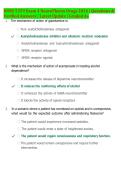
NURS 5359 Exam 4 NeuroPharm Drugs 2026 | Questions &
Verified Answers | Latest Update | Graded A+
1. The mechanism of action of galantamine is:
Pure acetylcholinesterase antagonist
Acetylcholinesterase inhibitor and allosteric nicotinic modulator
Acetylcholinesterase and butyrylcholinesterase antagonist
NMDA receptor antagonist
NMDA receptor agonist
2. What is the mechanism of action of acamprosate in treating alcohol
dependence?
It increases the release of dopamine neurotransmitter
It reduces the reinforcing effects of alcohol
It enhances the activity of GABA neurotransmitter
It blocks the activity of opioid receptors
3. In a scenario where a patient has overdosed on opioids and is unresponsive,
what would be the expected outcome after administering Naloxone?
The patient would experience increased sedation.
The patient would enter a state of heightened anxiety.
The patient would regain consciousness and respiratory function.
The patient would remain unresponsive and require further
intervention.
,4. Which of the following stimulants used to treat ADHD is the prodrug of
dextroamphetamine?
lisdexamfetamine
methylphenidate
amphetamine
dextroamphetamine
5. Describe how Naloxone functions in the context of opioid overdose.
Naloxone enhances the effects of opioids, leading to increased
sedation.
Naloxone functions by blocking the effects of opioids at the
receptor sites, reversing the overdose.
Naloxone increases the production of opioids in the brain.
Naloxone acts as a stimulant to counteract opioid effects.
6. What type of enzyme does Donepezil inhibit in the treatment of cognitive
disorders?
Acetylcholinesterase
Cyclooxygenase
Dipeptidyl peptidase
Monoamine oxidase
7. The primary mechanism of rivastigmine is
decreased breakdown of acetylcholine
increased acetylcholine production
, increased release of acetylcholine
decreased pre-synpatic reuptake of acetylcholine
8. Next, they ask how the drug donepezil can work to help his disease. How
should you answer?
It promotes release of acetylcholine, so more is available for
transmitting nerve impulses.
It increases natural acetylcholine production, so more is available for
transmitting nerve impulses.
It prevents the breakdown of acetylcholine, so more is available for
transmitting nerve impulses.
It alters the effects of glutamate at NMDA receptors, which play a role
in learning and memory.
9. The mechanism of action of memantine is:
NMDA receptor antagonist
Acetylcholinesterase antagonist and allosteric nicotinic modulator
NMDA receptor agonist
Acetylcholinesterase antagonist
Acetylcholinesterase and butyrylcholinesterase antagonists
10. The clinical use of disulfiram depends on its ability to inhibit this enzyme:
alcohol dehydrogenase
aldehyde dehydrogenase
cytochrome P450
adenylyl cyclase
Verified Answers | Latest Update | Graded A+
1. The mechanism of action of galantamine is:
Pure acetylcholinesterase antagonist
Acetylcholinesterase inhibitor and allosteric nicotinic modulator
Acetylcholinesterase and butyrylcholinesterase antagonist
NMDA receptor antagonist
NMDA receptor agonist
2. What is the mechanism of action of acamprosate in treating alcohol
dependence?
It increases the release of dopamine neurotransmitter
It reduces the reinforcing effects of alcohol
It enhances the activity of GABA neurotransmitter
It blocks the activity of opioid receptors
3. In a scenario where a patient has overdosed on opioids and is unresponsive,
what would be the expected outcome after administering Naloxone?
The patient would experience increased sedation.
The patient would enter a state of heightened anxiety.
The patient would regain consciousness and respiratory function.
The patient would remain unresponsive and require further
intervention.
,4. Which of the following stimulants used to treat ADHD is the prodrug of
dextroamphetamine?
lisdexamfetamine
methylphenidate
amphetamine
dextroamphetamine
5. Describe how Naloxone functions in the context of opioid overdose.
Naloxone enhances the effects of opioids, leading to increased
sedation.
Naloxone functions by blocking the effects of opioids at the
receptor sites, reversing the overdose.
Naloxone increases the production of opioids in the brain.
Naloxone acts as a stimulant to counteract opioid effects.
6. What type of enzyme does Donepezil inhibit in the treatment of cognitive
disorders?
Acetylcholinesterase
Cyclooxygenase
Dipeptidyl peptidase
Monoamine oxidase
7. The primary mechanism of rivastigmine is
decreased breakdown of acetylcholine
increased acetylcholine production
, increased release of acetylcholine
decreased pre-synpatic reuptake of acetylcholine
8. Next, they ask how the drug donepezil can work to help his disease. How
should you answer?
It promotes release of acetylcholine, so more is available for
transmitting nerve impulses.
It increases natural acetylcholine production, so more is available for
transmitting nerve impulses.
It prevents the breakdown of acetylcholine, so more is available for
transmitting nerve impulses.
It alters the effects of glutamate at NMDA receptors, which play a role
in learning and memory.
9. The mechanism of action of memantine is:
NMDA receptor antagonist
Acetylcholinesterase antagonist and allosteric nicotinic modulator
NMDA receptor agonist
Acetylcholinesterase antagonist
Acetylcholinesterase and butyrylcholinesterase antagonists
10. The clinical use of disulfiram depends on its ability to inhibit this enzyme:
alcohol dehydrogenase
aldehyde dehydrogenase
cytochrome P450
adenylyl cyclase


