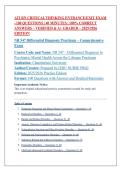
ATI RN CRITICAL THINKING ENTRANCE/EXIT EXAM
–100 QUESTIONS | 40 MINUTES | 100% CORRECT
ANSWERS – VERIFIED & A+ GRADED – 2025/2026
EDITION
NR 547 Differential Diagnosis Practicum – Comprehensive
Exam
Course Code and Name: NR 547 – Differential Diagnosis in
Psychiatric-Mental Health Across the Lifespan Practicum
Institution: Chamberlain University
Author/Creator: Prepared by [EDU NURSE PRO]
Edition: 2025/2026 Practice Edition
Format: 100 Questions with Answers and Detailed Rationales
Important Academic Notice:
This is an original educational practice examination created for study and
preparation.
Table of Contents
1. Diagnostic Reasoning and Mental Status Examination — Questions 1–10
2. Depressive Disorders — Questions 11–20
3. Bipolar and Related Disorders — Questions 21–30
4. Anxiety, Obsessive-Compulsive, and Trauma-Related Disorders — Questions 31–40
5. Schizophrenia Spectrum and Other Psychotic Disorders — Questions 41–50
6. Delirium and Neurocognitive Disorders — Questions 51–60
7. Substance-Related and Addictive Disorders — Questions 61–70
8. Personality Disorders — Questions 71–80
9. Child and Adolescent Psychiatric Disorders — Questions 81–90
, 10. Safety, Culture, Screening, and Special Diagnostic Considerations — Questions 91–100
Section I — Diagnostic Reasoning and Mental Status Examination
Question 1
A patient presents with depressed mood, insomnia, poor concentration, and fatigue. Which
assessment finding is most important when establishing the differential diagnosis?
A. Favorite leisure activity
B. Duration and functional impact of symptoms
C. Preferred type of music
D. Number of siblings
Correct Answer: B. Duration and functional impact of symptoms
Rationale:
Psychiatric diagnosis depends heavily on symptom duration, severity, associated features, and
impairment in social or occupational functioning. Duration helps distinguish disorders with
overlapping symptoms. Personal preferences and family size may provide background
information but do not establish the primary diagnosis.
Question 2
During a mental status examination, a patient states, “The government implanted a transmitter in
my tooth.” The patient has no evidence supporting this belief. Which finding is most consistent
with this statement?
A. Obsession
B. Delusion
C. Illusion
D. Hallucination
Correct Answer: B. Delusion
Rationale:
A delusion is a fixed false belief that persists despite evidence to the contrary. An obsession is an
intrusive thought recognized as unwanted, an illusion is a misinterpretation of an actual external
stimulus, and a hallucination occurs without an external sensory stimulus.
Question 3
,A patient reports hearing voices when no one is present. Which mental-status domain is primarily
affected?
A. Perception
B. Judgment
C. Insight
D. Orientation
Correct Answer: A. Perception
Rationale:
Hallucinations are disturbances of perception because the patient experiences sensory
phenomena without an external stimulus. Orientation concerns awareness of person, place, time,
and situation; insight concerns awareness of illness; judgment concerns decision-making.
Question 4
A patient answers questions appropriately but demonstrates a rapidly shifting emotional state,
laughing and then suddenly becoming tearful. Which mental-status finding should the clinician
document?
A. Restricted affect
B. Labile affect
C. Flat affect
D. Blunted affect
Correct Answer: B. Labile affect
Rationale:
Labile affect involves rapid and marked shifts in emotional expression. Flat or blunted affect
describes reduced emotional expression, while restricted affect represents a narrower-than-
normal range.
Question 5
Which finding most strongly suggests impaired insight?
A. “I know I have been sleeping poorly.”
B. “I realize alcohol is causing problems for me.”
C. “I am not ill; everyone else is conspiring against me.”
D. “I am worried about losing my job.”
Correct Answer: C. “I am not ill; everyone else is conspiring against me.”
, Rationale:
Insight refers to recognition and understanding of one's illness or condition. A patient who
completely rejects the possibility of illness despite significant symptoms demonstrates impaired
insight.
Question 6
A clinician asks a patient to explain how they would obtain help if they smelled smoke in a
crowded theater. Which cognitive ability is primarily being assessed?
A. Abstract reasoning
B. Orientation
C. Remote memory
D. Registration
Correct Answer: A. Abstract reasoning
Rationale:
Questions involving interpretation of hypothetical situations, similarities, proverbs, or practical
problem-solving can assess abstract reasoning. Registration concerns immediate encoding of
information, while orientation concerns awareness of time, place, person, and situation.
Question 7
A patient describes a series of unrelated topics but eventually returns to the original question and
provides an appropriate answer. Which thought-process finding is most likely?
A. Circumstantiality
B. Flight of ideas
C. Loose associations
D. Thought blocking
Correct Answer: A. Circumstantiality
Rationale:
Circumstantial speech includes excessive detail and tangential information but eventually returns
to the point. Loose associations involve weak or absent connections between ideas, while
thought blocking involves sudden interruption of thought.
Question 8
Which statement best demonstrates a patient-centered diagnostic interview?
–100 QUESTIONS | 40 MINUTES | 100% CORRECT
ANSWERS – VERIFIED & A+ GRADED – 2025/2026
EDITION
NR 547 Differential Diagnosis Practicum – Comprehensive
Exam
Course Code and Name: NR 547 – Differential Diagnosis in
Psychiatric-Mental Health Across the Lifespan Practicum
Institution: Chamberlain University
Author/Creator: Prepared by [EDU NURSE PRO]
Edition: 2025/2026 Practice Edition
Format: 100 Questions with Answers and Detailed Rationales
Important Academic Notice:
This is an original educational practice examination created for study and
preparation.
Table of Contents
1. Diagnostic Reasoning and Mental Status Examination — Questions 1–10
2. Depressive Disorders — Questions 11–20
3. Bipolar and Related Disorders — Questions 21–30
4. Anxiety, Obsessive-Compulsive, and Trauma-Related Disorders — Questions 31–40
5. Schizophrenia Spectrum and Other Psychotic Disorders — Questions 41–50
6. Delirium and Neurocognitive Disorders — Questions 51–60
7. Substance-Related and Addictive Disorders — Questions 61–70
8. Personality Disorders — Questions 71–80
9. Child and Adolescent Psychiatric Disorders — Questions 81–90
, 10. Safety, Culture, Screening, and Special Diagnostic Considerations — Questions 91–100
Section I — Diagnostic Reasoning and Mental Status Examination
Question 1
A patient presents with depressed mood, insomnia, poor concentration, and fatigue. Which
assessment finding is most important when establishing the differential diagnosis?
A. Favorite leisure activity
B. Duration and functional impact of symptoms
C. Preferred type of music
D. Number of siblings
Correct Answer: B. Duration and functional impact of symptoms
Rationale:
Psychiatric diagnosis depends heavily on symptom duration, severity, associated features, and
impairment in social or occupational functioning. Duration helps distinguish disorders with
overlapping symptoms. Personal preferences and family size may provide background
information but do not establish the primary diagnosis.
Question 2
During a mental status examination, a patient states, “The government implanted a transmitter in
my tooth.” The patient has no evidence supporting this belief. Which finding is most consistent
with this statement?
A. Obsession
B. Delusion
C. Illusion
D. Hallucination
Correct Answer: B. Delusion
Rationale:
A delusion is a fixed false belief that persists despite evidence to the contrary. An obsession is an
intrusive thought recognized as unwanted, an illusion is a misinterpretation of an actual external
stimulus, and a hallucination occurs without an external sensory stimulus.
Question 3
,A patient reports hearing voices when no one is present. Which mental-status domain is primarily
affected?
A. Perception
B. Judgment
C. Insight
D. Orientation
Correct Answer: A. Perception
Rationale:
Hallucinations are disturbances of perception because the patient experiences sensory
phenomena without an external stimulus. Orientation concerns awareness of person, place, time,
and situation; insight concerns awareness of illness; judgment concerns decision-making.
Question 4
A patient answers questions appropriately but demonstrates a rapidly shifting emotional state,
laughing and then suddenly becoming tearful. Which mental-status finding should the clinician
document?
A. Restricted affect
B. Labile affect
C. Flat affect
D. Blunted affect
Correct Answer: B. Labile affect
Rationale:
Labile affect involves rapid and marked shifts in emotional expression. Flat or blunted affect
describes reduced emotional expression, while restricted affect represents a narrower-than-
normal range.
Question 5
Which finding most strongly suggests impaired insight?
A. “I know I have been sleeping poorly.”
B. “I realize alcohol is causing problems for me.”
C. “I am not ill; everyone else is conspiring against me.”
D. “I am worried about losing my job.”
Correct Answer: C. “I am not ill; everyone else is conspiring against me.”
, Rationale:
Insight refers to recognition and understanding of one's illness or condition. A patient who
completely rejects the possibility of illness despite significant symptoms demonstrates impaired
insight.
Question 6
A clinician asks a patient to explain how they would obtain help if they smelled smoke in a
crowded theater. Which cognitive ability is primarily being assessed?
A. Abstract reasoning
B. Orientation
C. Remote memory
D. Registration
Correct Answer: A. Abstract reasoning
Rationale:
Questions involving interpretation of hypothetical situations, similarities, proverbs, or practical
problem-solving can assess abstract reasoning. Registration concerns immediate encoding of
information, while orientation concerns awareness of time, place, person, and situation.
Question 7
A patient describes a series of unrelated topics but eventually returns to the original question and
provides an appropriate answer. Which thought-process finding is most likely?
A. Circumstantiality
B. Flight of ideas
C. Loose associations
D. Thought blocking
Correct Answer: A. Circumstantiality
Rationale:
Circumstantial speech includes excessive detail and tangential information but eventually returns
to the point. Loose associations involve weak or absent connections between ideas, while
thought blocking involves sudden interruption of thought.
Question 8
Which statement best demonstrates a patient-centered diagnostic interview?