
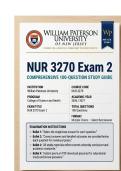
,NUR 3270 Exam 2 – Comprehensive Health
Assessment – Q&A (2026) | William Paterson
1. Which statement best defines health promotion?
A) The process of enabling people to increase control over and improve their
health
B) The absence of disease or illness
C) A functional disturbance that results when adaptive mechanisms fail
D) The physical manifestations and subjective experience of an individual
Correct Answer: A) The process of enabling people to increase control over and
improve their health
Rationale: Health promotion is the process of enabling people to increase
control over and improve their health. It is not simply the absence of disease or
a functional disturbance. This definition emphasizes empowerment, prevention,
and wellness, guiding nurses to support patients in achieving better health
outcomes.
2. Which statement accurately distinguishes illness from disease?
A) Disease is always accompanied by illness
B) Illness is the physical manifestations and subjective experience, and can
occur without disease
C) Disease is a positive state of health
D) Illness is defined only by laboratory abnormalities
,Correct Answer: B) Illness is the physical manifestations and subjective
experience, and can occur without disease
Rationale: Illness is the physical manifestation and subjective experience of the
individual, and it can occur without a diagnosable disease. Conversely, a person
may have disease without feeling ill. This distinction helps nurses assess both
objective findings and the patient's lived experience of health.
3. Which example illustrates high-level wellness in the presence of illness?
A) A person who has no chronic conditions
B) A person who avoids all health screenings
C) A person with type 2 diabetes who manages the condition and participates in
exercise and healthy eating
D) A person who ignores symptoms of disease
Correct Answer: C) A person with type 2 diabetes who manages the condition
and participates in exercise and healthy eating
Rationale: High-level wellness can exist in the presence of illness when a person
actively manages a chronic condition and engages in healthy behaviors. A
person with type 2 diabetes who exercises and eats well demonstrates wellness
despite disease. Avoiding screenings or ignoring symptoms does not reflect
high-level wellness.
4. Which intervention is an example of primary prevention?
A) Blood pressure screening
B) Mammogram
, C) Cardiac rehabilitation
D) Immunization against influenza
Correct Answer: D) Immunization against influenza
Rationale: Primary prevention focuses on optimizing health and preventing
disease before it occurs. Immunization against influenza prevents infection and
is a classic primary prevention strategy. Blood pressure screening and
mammography are secondary prevention, while cardiac rehabilitation is tertiary
prevention.
5. A nurse is providing a screening test for early detection of colon cancer.
Which level of prevention is this?
A) Primary prevention
B) Secondary prevention
C) Tertiary prevention
D) Quaternary prevention
Correct Answer: B) Secondary prevention
Rationale: Secondary prevention involves screening tests and early detection of
disease for early treatment. A colon cancer screening test identifies disease
before symptoms appear. Primary prevention prevents disease onset, and
tertiary prevention manages established conditions to minimize complications.
6. Which action is an example of tertiary prevention?
A) Cardiac rehabilitation after myocardial infarction
Assessment – Q&A (2026) | William Paterson
1. Which statement best defines health promotion?
A) The process of enabling people to increase control over and improve their
health
B) The absence of disease or illness
C) A functional disturbance that results when adaptive mechanisms fail
D) The physical manifestations and subjective experience of an individual
Correct Answer: A) The process of enabling people to increase control over and
improve their health
Rationale: Health promotion is the process of enabling people to increase
control over and improve their health. It is not simply the absence of disease or
a functional disturbance. This definition emphasizes empowerment, prevention,
and wellness, guiding nurses to support patients in achieving better health
outcomes.
2. Which statement accurately distinguishes illness from disease?
A) Disease is always accompanied by illness
B) Illness is the physical manifestations and subjective experience, and can
occur without disease
C) Disease is a positive state of health
D) Illness is defined only by laboratory abnormalities
,Correct Answer: B) Illness is the physical manifestations and subjective
experience, and can occur without disease
Rationale: Illness is the physical manifestation and subjective experience of the
individual, and it can occur without a diagnosable disease. Conversely, a person
may have disease without feeling ill. This distinction helps nurses assess both
objective findings and the patient's lived experience of health.
3. Which example illustrates high-level wellness in the presence of illness?
A) A person who has no chronic conditions
B) A person who avoids all health screenings
C) A person with type 2 diabetes who manages the condition and participates in
exercise and healthy eating
D) A person who ignores symptoms of disease
Correct Answer: C) A person with type 2 diabetes who manages the condition
and participates in exercise and healthy eating
Rationale: High-level wellness can exist in the presence of illness when a person
actively manages a chronic condition and engages in healthy behaviors. A
person with type 2 diabetes who exercises and eats well demonstrates wellness
despite disease. Avoiding screenings or ignoring symptoms does not reflect
high-level wellness.
4. Which intervention is an example of primary prevention?
A) Blood pressure screening
B) Mammogram
, C) Cardiac rehabilitation
D) Immunization against influenza
Correct Answer: D) Immunization against influenza
Rationale: Primary prevention focuses on optimizing health and preventing
disease before it occurs. Immunization against influenza prevents infection and
is a classic primary prevention strategy. Blood pressure screening and
mammography are secondary prevention, while cardiac rehabilitation is tertiary
prevention.
5. A nurse is providing a screening test for early detection of colon cancer.
Which level of prevention is this?
A) Primary prevention
B) Secondary prevention
C) Tertiary prevention
D) Quaternary prevention
Correct Answer: B) Secondary prevention
Rationale: Secondary prevention involves screening tests and early detection of
disease for early treatment. A colon cancer screening test identifies disease
before symptoms appear. Primary prevention prevents disease onset, and
tertiary prevention manages established conditions to minimize complications.
6. Which action is an example of tertiary prevention?
A) Cardiac rehabilitation after myocardial infarction


