

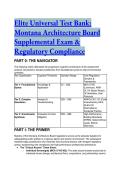
Elite Universal Test Bank:
Montana Architecture Board
Supplemental Exam &
Regulatory Compliance
PART 0: THE NAVIGATOR
The following matrix delineates the progressive cognitive architecture of the assessment
protocol, structured to elevate practitioners from foundational syntax to elite environmental
synthesis.
Tier Classification Cognitive Threshold Question Range Core Regulatory
Domains &
Frameworks
Tier 1: Foundational Knowledge & Q1 – Q28 MCA 37-65
Syntax Application (Licensure), ARM
24.114 (Board Rules),
CE Mandates, Seal
Protocols
Tier 2: Complex Analysis & Q29 – Q58 ARM 24.301.131 (Code
Simulation Troubleshooting Amendments), MCA
50-60-102
(Exemptions),
Incidental Practice
Tier 3: Grandmaster Evaluation & Crisis Q59 – Q88 High-Performance
Synthesis Mitigation Building Standards
(HPBS), Seismic/Snow
Loads, Ethical
Dilemmas
PART I: THE PRIMER
Mastery of the Montana Architecture Board regulations serves as the absolute baseline for
safeguarding public welfare in a rigorous alpine and seismic environment. The subsequent
material forges practitioners who intuitively fuse structural physics with stringent regulatory
syntax, transforming rote compliance into high-performance professional architecture.
● The "Critical Axioms" Cheat Sheet:
○ Individual Sovereignty (MCA 37-65-302): The state issues licenses exclusively to
individual human beings; architectural firms, corporations, and partnerships cannot
, be licensed entities.
○ The Exemption Rule (MCA 50-60-102): State building codes exempt residential
construction of fewer than five dwelling units, as well as specific agricultural and
mining structures, leaving enforcement to certified local jurisdictions or the
architect's standard of care.
○ Incidental Boundaries (ARM 24.114.301): Cross-disciplinary practice is strictly
governed; an architect may perform engineering (and vice versa) only if the work is
purely incidental, subordinate to the primary scope, and executed with proven
competence.
○ Environmental Baselines (ARM 24.301.131): The absolute minimum design roof
snow load is 30 psf, and the default baseline seismic design category is D0, unless
specifically justified by site-specific geotechnical engineering.
○ A&E Division Mandate (HPBS): State-funded projects exceeding $10,000,000
must achieve a minimum LEED Silver or Green Globes Two Globes certification
and must exceed IECC baseline energy efficiency by 20%.
PART II: THE ELITE TEST BANK
Q1: An international architecture firm prepares to open a branch office in Bozeman. Based on
the principles of Montana licensure (MCA 37-65-302), which administrative action is MOST
ACCURATE for the firm to legally offer services? A) The firm must apply for a Montana
Professional Corporation (PC) architecture license. B) The firm must submit a Certificate of
Authorization and pay a $180 credentialing fee. C) The firm must ensure all architectural work is
directly overseen and sealed by an individually licensed Montana architect, as firm licenses are
not issued. D) The firm must register as an Architect-in-Training entity.
● The Answer: C (The firm must ensure all architectural work is directly overseen and
sealed by an individually licensed Montana architect, as firm licenses are not issued.)
● Distractor Analysis:
○ A is incorrect: Montana explicitly prohibits the licensure of firms, companies, or
corporations.
○ B is incorrect: The $180 credentialing fee applies to individual reciprocal licensure,
not firms.
○ D is incorrect: The Architect-in-Training designation was repealed and does not
apply to firms.
The Mentor's Analysis: Corporate shields do not design buildings; human minds do. The legal
burden of practice rests entirely on the individual practitioner. Professional Intuition: The state
licenses the individual, never the firm.
Q2: A licensed architect in Montana executes a license renewal on June 20th. Based on the
principles of ARM 24.114.2105, which continuing education declaration is the MOST
ACCURATE requirement? A) 12 hours of general architecture continuing education every two
years. B) 24 hours of Health, Safety, and Welfare (HSW) continuing education per calendar
year. C) 12 hours of Health, Safety, and Welfare (HSW) continuing education per calendar year.
D) 8 hours of HSW and 4 hours of jurisprudence per calendar year.
● The Answer: C (12 hours of Health, Safety, and Welfare (HSW) continuing education per
calendar year.)
● Distractor Analysis:
○ A is incorrect: The cycle is annual, not biennial, and must be strictly HSW-focused. *
, B is incorrect: 24 hours represents a common error based on other state board
metrics.
○ D is incorrect: Montana does not mandate specific jurisprudence CE hours natively
within the 12-hour requirement.
The Mentor's Analysis: Elite practice requires relentless, focused updating of life-safety
knowledge. The Board restricts acceptable CE strictly to HSW to ensure public protection.
Professional Intuition: Always default to 12 HSW hours annually; ancillary courses do not
qualify.
Q3: Effective July 1, 2025, an architect notices a new $5 fee on their renewal invoice. Based on
the principles of HB 227, which conclusion regarding this fee is the MOST ACCURATE? A) It
funds the National Council of Architectural Registration Boards (NCARB) membership dues. B)
It establishes a contingent litigation fund to offset compliance and disciplinary legal costs for
licensing boards. C) It finances the Architecture & Engineering (A&E) Division's
High-Performance Building program. D) It subsidizes continuing education audits for the
Department of Labor and Industry.
● The Answer: B (It establishes a contingent litigation fund to offset compliance and
disciplinary legal costs for licensing boards.)
● Distractor Analysis:
○ A is incorrect: NCARB dues are paid directly to the national council, not through
state renewal fees.
○ C is incorrect: The A&E Division is a separate entity under the Department of
Administration.
○ D is incorrect: CE audits are an administrative function funded by baseline renewal
fees, not the HB 227 litigation fund.
The Mentor's Analysis: Legislative amendments frequently introduce micro-fees to insulate state
boards from crippling legal costs during disciplinary actions. Professional Intuition: The HB 227
contingent litigation fund is a mandatory, non-negotiable statutory assessment.
Q4: An architect applies their professional seal to commercial blueprints. Based on the
principles of MCA 37-65-308, which specific typographical phrase MUST be included on the
seal? A) "Registered Design Professional, Montana" B) "Board Certified Architect, MT" C)
"Licensed Architect, State of Montana" D) "Architect of Record, State of Montana"
● The Answer: C ("Licensed Architect, State of Montana")
● Distractor Analysis:
○ A is incorrect: "Registered Design Professional" is IBC terminology, not the statutory
requirement for the physical seal.
○ B is incorrect: "Board Certified" is a medical designation not recognized by Montana
architecture statutes.
○ D is incorrect: "Architect of Record" is a contractual designation, not the legally
mandated seal text.
The Mentor's Analysis: The seal operates as the ultimate emblem of legal liability. Variations in
syntax invalidate the stamp's legal standing. Professional Intuition: Memorize the exact
statutory syntax: "Licensed Architect, State of Montana."
Q5: A structural engineer designs a minor aesthetic canopy over a doorway on a commercial
building they are engineering. Based on the principles of MCA 37-65-103, which
action/conclusion is the MOST ACCURATE? A) The action is prohibited; any aesthetic exterior
modification requires an architect's seal. B) The action is permitted, provided it qualifies as
incidental architectural services safely performed within their engineering practice. C) The action
is prohibited; the engineer must obtain an architect's co-signature for building envelope
, changes. D) The action is permitted, but only if the canopy area measures under 120 square
feet.
● The Answer: B (The action is permitted, provided it qualifies as incidental architectural
services safely performed within their engineering practice.)
● Distractor Analysis:
○ A is incorrect: Montana explicitly allows incidental practice across the
architecture/engineering threshold.
○ C is incorrect: Co-signatures are not required for genuinely incidental work within
the professional's competence.
○ D is incorrect: The statute does not define incidental practice by a rigid
square-footage metric.
The Mentor's Analysis: Interdisciplinary reality dictates that strict silos fail. Professionals may
cross lines exclusively if the work is minor, subordinate to the main project, and within their
competent grasp. Professional Intuition: Incidental practice is determined by proportion and
competence, not absolute boundaries.
Q6: A practitioner designs a 4-unit residential townhome in a rural Montana county lacking local
building code enforcement. Based on the principles of MCA 50-60-102, which conclusion
regarding state enforcement is the MOST ACCURATE? A) The State of Montana Building
Codes Bureau will enforce the code. B) The County Sheriff's Office assumes building code
jurisdiction. C) The structure is exempt from state building code enforcement. D) The State Fire
Marshal must issue a specific residential variance.
● The Answer: C (The structure is exempt from state building code enforcement.)
● Distractor Analysis:
○ A is incorrect: The State Bureau's jurisdiction explicitly excludes residential
buildings with fewer than 5 units.
○ B is incorrect: Law enforcement agencies do not conduct structural plan reviews.
○ D is incorrect: The Fire Marshal reviews commercial and high-occupancy
structures, not exempt 4-unit residences.
The Mentor's Analysis: Montana's regulatory geography is highly specific. Small residential
structures outside certified local jurisdictions operate in a statutory exemption zone.
Professional Intuition: Fewer than 5 units dictates state code exemption; liability rests
entirely on the architect's standard of care.
Q7: An architect designs an equipment storage building on an active, state-regulated mining
property. Based on the principles of MCA 50-60-102, which conclusion is the MOST
ACCURATE? A) The structure requires a full state commercial building permit. B) The structure
is exempt from the state building code. C) The structure requires a permit exclusively if
classified for agricultural use. D) The structure is exempt only if completely unoccupied.
● The Answer: B (The structure is exempt from the state building code.)
● Distractor Analysis:
○ A is incorrect: The premise fails to account for the specific heavy-industry
exemption granted to mining operations.
○ C is incorrect: Agricultural exemptions operate separately from distinct mining
exemptions.
○ D is incorrect: Occupancy does not trigger the code; the location on a regulated
mine property dictates the exemption.
The Mentor's Analysis: Elite compliance requires knowing jurisdictional limits. Mining facilities
are regulated by specialized state mining laws, deliberately bypassing standard building code
bureaucracy. Professional Intuition: Verify the macro-jurisdiction before applying standard
Montana Architecture Board
Supplemental Exam &
Regulatory Compliance
PART 0: THE NAVIGATOR
The following matrix delineates the progressive cognitive architecture of the assessment
protocol, structured to elevate practitioners from foundational syntax to elite environmental
synthesis.
Tier Classification Cognitive Threshold Question Range Core Regulatory
Domains &
Frameworks
Tier 1: Foundational Knowledge & Q1 – Q28 MCA 37-65
Syntax Application (Licensure), ARM
24.114 (Board Rules),
CE Mandates, Seal
Protocols
Tier 2: Complex Analysis & Q29 – Q58 ARM 24.301.131 (Code
Simulation Troubleshooting Amendments), MCA
50-60-102
(Exemptions),
Incidental Practice
Tier 3: Grandmaster Evaluation & Crisis Q59 – Q88 High-Performance
Synthesis Mitigation Building Standards
(HPBS), Seismic/Snow
Loads, Ethical
Dilemmas
PART I: THE PRIMER
Mastery of the Montana Architecture Board regulations serves as the absolute baseline for
safeguarding public welfare in a rigorous alpine and seismic environment. The subsequent
material forges practitioners who intuitively fuse structural physics with stringent regulatory
syntax, transforming rote compliance into high-performance professional architecture.
● The "Critical Axioms" Cheat Sheet:
○ Individual Sovereignty (MCA 37-65-302): The state issues licenses exclusively to
individual human beings; architectural firms, corporations, and partnerships cannot
, be licensed entities.
○ The Exemption Rule (MCA 50-60-102): State building codes exempt residential
construction of fewer than five dwelling units, as well as specific agricultural and
mining structures, leaving enforcement to certified local jurisdictions or the
architect's standard of care.
○ Incidental Boundaries (ARM 24.114.301): Cross-disciplinary practice is strictly
governed; an architect may perform engineering (and vice versa) only if the work is
purely incidental, subordinate to the primary scope, and executed with proven
competence.
○ Environmental Baselines (ARM 24.301.131): The absolute minimum design roof
snow load is 30 psf, and the default baseline seismic design category is D0, unless
specifically justified by site-specific geotechnical engineering.
○ A&E Division Mandate (HPBS): State-funded projects exceeding $10,000,000
must achieve a minimum LEED Silver or Green Globes Two Globes certification
and must exceed IECC baseline energy efficiency by 20%.
PART II: THE ELITE TEST BANK
Q1: An international architecture firm prepares to open a branch office in Bozeman. Based on
the principles of Montana licensure (MCA 37-65-302), which administrative action is MOST
ACCURATE for the firm to legally offer services? A) The firm must apply for a Montana
Professional Corporation (PC) architecture license. B) The firm must submit a Certificate of
Authorization and pay a $180 credentialing fee. C) The firm must ensure all architectural work is
directly overseen and sealed by an individually licensed Montana architect, as firm licenses are
not issued. D) The firm must register as an Architect-in-Training entity.
● The Answer: C (The firm must ensure all architectural work is directly overseen and
sealed by an individually licensed Montana architect, as firm licenses are not issued.)
● Distractor Analysis:
○ A is incorrect: Montana explicitly prohibits the licensure of firms, companies, or
corporations.
○ B is incorrect: The $180 credentialing fee applies to individual reciprocal licensure,
not firms.
○ D is incorrect: The Architect-in-Training designation was repealed and does not
apply to firms.
The Mentor's Analysis: Corporate shields do not design buildings; human minds do. The legal
burden of practice rests entirely on the individual practitioner. Professional Intuition: The state
licenses the individual, never the firm.
Q2: A licensed architect in Montana executes a license renewal on June 20th. Based on the
principles of ARM 24.114.2105, which continuing education declaration is the MOST
ACCURATE requirement? A) 12 hours of general architecture continuing education every two
years. B) 24 hours of Health, Safety, and Welfare (HSW) continuing education per calendar
year. C) 12 hours of Health, Safety, and Welfare (HSW) continuing education per calendar year.
D) 8 hours of HSW and 4 hours of jurisprudence per calendar year.
● The Answer: C (12 hours of Health, Safety, and Welfare (HSW) continuing education per
calendar year.)
● Distractor Analysis:
○ A is incorrect: The cycle is annual, not biennial, and must be strictly HSW-focused. *
, B is incorrect: 24 hours represents a common error based on other state board
metrics.
○ D is incorrect: Montana does not mandate specific jurisprudence CE hours natively
within the 12-hour requirement.
The Mentor's Analysis: Elite practice requires relentless, focused updating of life-safety
knowledge. The Board restricts acceptable CE strictly to HSW to ensure public protection.
Professional Intuition: Always default to 12 HSW hours annually; ancillary courses do not
qualify.
Q3: Effective July 1, 2025, an architect notices a new $5 fee on their renewal invoice. Based on
the principles of HB 227, which conclusion regarding this fee is the MOST ACCURATE? A) It
funds the National Council of Architectural Registration Boards (NCARB) membership dues. B)
It establishes a contingent litigation fund to offset compliance and disciplinary legal costs for
licensing boards. C) It finances the Architecture & Engineering (A&E) Division's
High-Performance Building program. D) It subsidizes continuing education audits for the
Department of Labor and Industry.
● The Answer: B (It establishes a contingent litigation fund to offset compliance and
disciplinary legal costs for licensing boards.)
● Distractor Analysis:
○ A is incorrect: NCARB dues are paid directly to the national council, not through
state renewal fees.
○ C is incorrect: The A&E Division is a separate entity under the Department of
Administration.
○ D is incorrect: CE audits are an administrative function funded by baseline renewal
fees, not the HB 227 litigation fund.
The Mentor's Analysis: Legislative amendments frequently introduce micro-fees to insulate state
boards from crippling legal costs during disciplinary actions. Professional Intuition: The HB 227
contingent litigation fund is a mandatory, non-negotiable statutory assessment.
Q4: An architect applies their professional seal to commercial blueprints. Based on the
principles of MCA 37-65-308, which specific typographical phrase MUST be included on the
seal? A) "Registered Design Professional, Montana" B) "Board Certified Architect, MT" C)
"Licensed Architect, State of Montana" D) "Architect of Record, State of Montana"
● The Answer: C ("Licensed Architect, State of Montana")
● Distractor Analysis:
○ A is incorrect: "Registered Design Professional" is IBC terminology, not the statutory
requirement for the physical seal.
○ B is incorrect: "Board Certified" is a medical designation not recognized by Montana
architecture statutes.
○ D is incorrect: "Architect of Record" is a contractual designation, not the legally
mandated seal text.
The Mentor's Analysis: The seal operates as the ultimate emblem of legal liability. Variations in
syntax invalidate the stamp's legal standing. Professional Intuition: Memorize the exact
statutory syntax: "Licensed Architect, State of Montana."
Q5: A structural engineer designs a minor aesthetic canopy over a doorway on a commercial
building they are engineering. Based on the principles of MCA 37-65-103, which
action/conclusion is the MOST ACCURATE? A) The action is prohibited; any aesthetic exterior
modification requires an architect's seal. B) The action is permitted, provided it qualifies as
incidental architectural services safely performed within their engineering practice. C) The action
is prohibited; the engineer must obtain an architect's co-signature for building envelope
, changes. D) The action is permitted, but only if the canopy area measures under 120 square
feet.
● The Answer: B (The action is permitted, provided it qualifies as incidental architectural
services safely performed within their engineering practice.)
● Distractor Analysis:
○ A is incorrect: Montana explicitly allows incidental practice across the
architecture/engineering threshold.
○ C is incorrect: Co-signatures are not required for genuinely incidental work within
the professional's competence.
○ D is incorrect: The statute does not define incidental practice by a rigid
square-footage metric.
The Mentor's Analysis: Interdisciplinary reality dictates that strict silos fail. Professionals may
cross lines exclusively if the work is minor, subordinate to the main project, and within their
competent grasp. Professional Intuition: Incidental practice is determined by proportion and
competence, not absolute boundaries.
Q6: A practitioner designs a 4-unit residential townhome in a rural Montana county lacking local
building code enforcement. Based on the principles of MCA 50-60-102, which conclusion
regarding state enforcement is the MOST ACCURATE? A) The State of Montana Building
Codes Bureau will enforce the code. B) The County Sheriff's Office assumes building code
jurisdiction. C) The structure is exempt from state building code enforcement. D) The State Fire
Marshal must issue a specific residential variance.
● The Answer: C (The structure is exempt from state building code enforcement.)
● Distractor Analysis:
○ A is incorrect: The State Bureau's jurisdiction explicitly excludes residential
buildings with fewer than 5 units.
○ B is incorrect: Law enforcement agencies do not conduct structural plan reviews.
○ D is incorrect: The Fire Marshal reviews commercial and high-occupancy
structures, not exempt 4-unit residences.
The Mentor's Analysis: Montana's regulatory geography is highly specific. Small residential
structures outside certified local jurisdictions operate in a statutory exemption zone.
Professional Intuition: Fewer than 5 units dictates state code exemption; liability rests
entirely on the architect's standard of care.
Q7: An architect designs an equipment storage building on an active, state-regulated mining
property. Based on the principles of MCA 50-60-102, which conclusion is the MOST
ACCURATE? A) The structure requires a full state commercial building permit. B) The structure
is exempt from the state building code. C) The structure requires a permit exclusively if
classified for agricultural use. D) The structure is exempt only if completely unoccupied.
● The Answer: B (The structure is exempt from the state building code.)
● Distractor Analysis:
○ A is incorrect: The premise fails to account for the specific heavy-industry
exemption granted to mining operations.
○ C is incorrect: Agricultural exemptions operate separately from distinct mining
exemptions.
○ D is incorrect: Occupancy does not trigger the code; the location on a regulated
mine property dictates the exemption.
The Mentor's Analysis: Elite compliance requires knowing jurisdictional limits. Mining facilities
are regulated by specialized state mining laws, deliberately bypassing standard building code
bureaucracy. Professional Intuition: Verify the macro-jurisdiction before applying standard


