

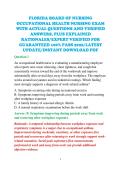
FLORIDA BOARD OF NURSING
OCCUPATIONAL HEALTH NURSING EXAM
WITH ACTUAL QUESTIONS AND VERIFIED
ANSWERS, PLUS EXPLAINED
RATIONALES/EXPERT VERIFIED FOR
GUARANTEED 100% PASS 2026/LATEST
UPDATE/INSTANT DOWNLOAD PDF
Question 1
An occupational health nurse is evaluating a manufacturing employee
who reports new-onset wheezing, chest tightness, and cough that
consistently worsen toward the end of the workweek and improve
substantially after several days away from the workplace. The employee
works around isocyanates used in industrial coatings. Which finding
most strongly supports a diagnosis of work-related asthma?
A. Symptoms occurring only during recreational exercise
B. Symptoms improving during periods away from work and recurring
after workplace exposure
C. A family history of seasonal allergic rhinitis
D. A normal respiratory examination before the work shift
Answer: B. Symptoms improving during periods away from work
and recurring after workplace exposure
Rationale: A temporal relationship between workplace exposure and
respiratory symptoms is a major clue to occupational asthma.
Improvement during weekends, vacations, or other exposure-free
periods and recurrence after returning to work strongly support work-
related causation. Serial peak expiratory-flow measurements
performed at work and away from work can provide additional
objective evidence.
1
,Question 2
An occupational health nurse is developing a respiratory protection
program for employees who may be exposed to airborne contaminants.
Which intervention represents the highest priority according to the
hierarchy of controls?
A. Providing annual respiratory protection training
B. Requiring employees to wear respirators
C. Installing local exhaust ventilation to remove contaminants at the
source
D. Conducting post-exposure medical evaluations
Answer: C. Installing local exhaust ventilation to remove
contaminants at the source
Rationale: Engineering controls are preferred because they control or
eliminate the hazard before it reaches the worker. The hierarchy of
controls generally prioritizes elimination, substitution, engineering
controls, administrative/work-practice controls, and finally personal
protective equipment. Respirators remain important when hazards
cannot be adequately controlled by higher-level interventions.
Question 3
A nurse is assessing a worker who has sustained a needlestick injury
from a hollow-bore needle contaminated with blood. What should the
nurse instruct the worker to do immediately?
A. Apply a tourniquet above the puncture site
B. Wash the affected area promptly with soap and water
C. Cover the puncture with an occlusive dressing and continue working
D. Attempt to express large amounts of blood from the wound
2
,Answer: B. Wash the affected area promptly with soap and water
Rationale: Immediate washing with soap and water is appropriate
following a percutaneous occupational exposure. The exposure should
then be promptly reported and medically evaluated so that the risk of
bloodborne pathogen transmission can be assessed and indicated post-
exposure management initiated. Forceful squeezing or caustic agents
should not be used.
Question 4
An employee experiences a splash of potentially infectious blood into
the eye. Which action is most appropriate?
A. Irrigate the eye immediately with water or saline
B. Apply an alcohol-based disinfectant to the conjunctiva
C. Patch the eye for 24 hours
D. Wait for symptoms before reporting the exposure
Answer: A. Irrigate the eye immediately with water or saline
Rationale: Mucous-membrane exposures require immediate irrigation.
The eye should be flushed thoroughly with water or saline, followed by
prompt occupational exposure reporting and medical evaluation.
Alcohol, bleach, or other caustic substances should never be applied to
the eye.
Question 5
A worker exposed to excessive occupational noise has progressive
difficulty understanding speech, particularly in crowded environments.
Which audiometric pattern is most characteristic of noise-induced
hearing loss?
3
, A. Conductive hearing loss with an air-bone gap
B. Sensorineural loss with a characteristic notch around 3,000–6,000 Hz
C. Isolated low-frequency conductive loss
D. Unilateral hearing loss caused exclusively by cerumen
Answer: B. Sensorineural loss with a characteristic notch around
3,000–6,000 Hz
Rationale: Occupational noise exposure classically produces
sensorineural hearing loss, often beginning with a notch in the 3,000-,
4,000-, or 6,000-Hz range. Continued exposure can cause progression
into lower frequencies, eventually affecting speech discrimination.
Appropriate hearing conservation programs are essential for workers
exposed to hazardous noise.
Question 6
An occupational health nurse is evaluating a worker after a chemical
splash to the skin. Which intervention should generally occur first?
A. Apply a neutralizing chemical
B. Remove contaminated clothing and flush the affected area with water
C. Cover the area with petroleum jelly
D. Obtain a detailed occupational history before treatment
Answer: B. Remove contaminated clothing and flush the affected
area with water
Rationale: Immediate decontamination is the priority after many
chemical skin exposures. Contaminated clothing should be removed
carefully and the affected skin flushed with appropriate amounts of
water according to the chemical's emergency procedures and safety
information. Delaying decontamination to complete paperwork or
history-taking can increase tissue injury.
4
OCCUPATIONAL HEALTH NURSING EXAM
WITH ACTUAL QUESTIONS AND VERIFIED
ANSWERS, PLUS EXPLAINED
RATIONALES/EXPERT VERIFIED FOR
GUARANTEED 100% PASS 2026/LATEST
UPDATE/INSTANT DOWNLOAD PDF
Question 1
An occupational health nurse is evaluating a manufacturing employee
who reports new-onset wheezing, chest tightness, and cough that
consistently worsen toward the end of the workweek and improve
substantially after several days away from the workplace. The employee
works around isocyanates used in industrial coatings. Which finding
most strongly supports a diagnosis of work-related asthma?
A. Symptoms occurring only during recreational exercise
B. Symptoms improving during periods away from work and recurring
after workplace exposure
C. A family history of seasonal allergic rhinitis
D. A normal respiratory examination before the work shift
Answer: B. Symptoms improving during periods away from work
and recurring after workplace exposure
Rationale: A temporal relationship between workplace exposure and
respiratory symptoms is a major clue to occupational asthma.
Improvement during weekends, vacations, or other exposure-free
periods and recurrence after returning to work strongly support work-
related causation. Serial peak expiratory-flow measurements
performed at work and away from work can provide additional
objective evidence.
1
,Question 2
An occupational health nurse is developing a respiratory protection
program for employees who may be exposed to airborne contaminants.
Which intervention represents the highest priority according to the
hierarchy of controls?
A. Providing annual respiratory protection training
B. Requiring employees to wear respirators
C. Installing local exhaust ventilation to remove contaminants at the
source
D. Conducting post-exposure medical evaluations
Answer: C. Installing local exhaust ventilation to remove
contaminants at the source
Rationale: Engineering controls are preferred because they control or
eliminate the hazard before it reaches the worker. The hierarchy of
controls generally prioritizes elimination, substitution, engineering
controls, administrative/work-practice controls, and finally personal
protective equipment. Respirators remain important when hazards
cannot be adequately controlled by higher-level interventions.
Question 3
A nurse is assessing a worker who has sustained a needlestick injury
from a hollow-bore needle contaminated with blood. What should the
nurse instruct the worker to do immediately?
A. Apply a tourniquet above the puncture site
B. Wash the affected area promptly with soap and water
C. Cover the puncture with an occlusive dressing and continue working
D. Attempt to express large amounts of blood from the wound
2
,Answer: B. Wash the affected area promptly with soap and water
Rationale: Immediate washing with soap and water is appropriate
following a percutaneous occupational exposure. The exposure should
then be promptly reported and medically evaluated so that the risk of
bloodborne pathogen transmission can be assessed and indicated post-
exposure management initiated. Forceful squeezing or caustic agents
should not be used.
Question 4
An employee experiences a splash of potentially infectious blood into
the eye. Which action is most appropriate?
A. Irrigate the eye immediately with water or saline
B. Apply an alcohol-based disinfectant to the conjunctiva
C. Patch the eye for 24 hours
D. Wait for symptoms before reporting the exposure
Answer: A. Irrigate the eye immediately with water or saline
Rationale: Mucous-membrane exposures require immediate irrigation.
The eye should be flushed thoroughly with water or saline, followed by
prompt occupational exposure reporting and medical evaluation.
Alcohol, bleach, or other caustic substances should never be applied to
the eye.
Question 5
A worker exposed to excessive occupational noise has progressive
difficulty understanding speech, particularly in crowded environments.
Which audiometric pattern is most characteristic of noise-induced
hearing loss?
3
, A. Conductive hearing loss with an air-bone gap
B. Sensorineural loss with a characteristic notch around 3,000–6,000 Hz
C. Isolated low-frequency conductive loss
D. Unilateral hearing loss caused exclusively by cerumen
Answer: B. Sensorineural loss with a characteristic notch around
3,000–6,000 Hz
Rationale: Occupational noise exposure classically produces
sensorineural hearing loss, often beginning with a notch in the 3,000-,
4,000-, or 6,000-Hz range. Continued exposure can cause progression
into lower frequencies, eventually affecting speech discrimination.
Appropriate hearing conservation programs are essential for workers
exposed to hazardous noise.
Question 6
An occupational health nurse is evaluating a worker after a chemical
splash to the skin. Which intervention should generally occur first?
A. Apply a neutralizing chemical
B. Remove contaminated clothing and flush the affected area with water
C. Cover the area with petroleum jelly
D. Obtain a detailed occupational history before treatment
Answer: B. Remove contaminated clothing and flush the affected
area with water
Rationale: Immediate decontamination is the priority after many
chemical skin exposures. Contaminated clothing should be removed
carefully and the affected skin flushed with appropriate amounts of
water according to the chemical's emergency procedures and safety
information. Delaying decontamination to complete paperwork or
history-taking can increase tissue injury.
4


