

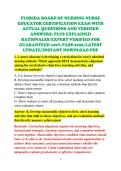
FLORIDA BOARD OF NURSING NURSE
EDUCATOR CERTIFICATION EXAM WITH
ACTUAL QUESTIONS AND VERIFIED
ANSWERS, PLUS EXPLAINED
RATIONALES/EXPERT VERIFIED FOR
GUARANTEED 100% PASS 2026/LATEST
UPDATE/INSTANT DOWNLOAD PDF
1. A nurse educator is developing a curriculum for newly admitted
nursing students. Which approach BEST demonstrates alignment
among the curriculum's objectives, learning activities, and
evaluation methods?
A. Use lecture for every objective and administer one final examination
B. Develop measurable objectives first, select learning activities that
address those objectives, and use evaluation methods that directly
measure achievement
C. Select clinical experiences first and develop objectives after students
complete them
D. Allow students to select all learning activities and determine their
own evaluation criteria
Answer: B. Develop measurable objectives first, select learning
activities that address those objectives, and use evaluation methods
that directly measure achievement
Rationale: Curriculum alignment requires the learning objectives,
instructional strategies, learning experiences, and evaluation methods
to work together. Measurable objectives establish what students should
know or be able to do; instructional activities provide opportunities to
achieve those outcomes; and assessment determines whether the
outcomes were achieved. A final examination alone may not
adequately evaluate psychomotor or affective competencies.
1
,2. A nurse educator writes the objective: "Students will understand
medication administration." Why is this objective inadequate?
A. It contains too much clinical terminology
B. It addresses only the affective domain
C. "Understand" is difficult to observe and measure objectively
D. Medication administration cannot be included in learning objectives
Answer: C. "Understand" is difficult to observe and measure
objectively
Rationale: Effective learning objectives use observable and
measurable verbs such as identify, calculate, demonstrate, administer,
analyze, compare, or evaluate. "Understand" describes an internal
cognitive state that cannot be directly observed. A stronger objective
would be: "By the end of the laboratory session, the student will safely
demonstrate medication administration using the institution's
medication-safety procedure with 100% accuracy on critical safety
steps."
3. A nurse educator wants to assess whether students can correctly
perform sterile wound dressing changes. Which assessment method
is MOST appropriate?
A. Multiple-choice examination
B. Essay examination
C. Objective structured clinical examination or skills demonstration
D. Student self-reflection journal only
Answer: C. Objective structured clinical examination or skills
demonstration
Rationale: Psychomotor competencies are best assessed through direct
observation of performance. An objective structured clinical
2
,examination allows the educator to evaluate whether the student can
perform specific steps according to predetermined criteria. A written
examination can assess knowledge about sterile technique but cannot
independently establish that the student can safely perform the
procedure.
4. A nurse educator uses Bloom's taxonomy when constructing
examination questions. Which question BEST represents the
analysis level?
A. "Define hypoglycemia."
B. "List three signs of hypoglycemia."
C. "Demonstrate how to administer glucagon."
D. "A patient receiving insulin becomes confused and diaphoretic.
Which findings support hypoglycemia rather than hyperglycemia?"
Answer: D. A patient receiving insulin becomes confused and
diaphoretic. Which findings support hypoglycemia rather than
hyperglycemia?
Rationale: Analysis requires learners to break information into
components, identify relationships, distinguish relevant from
irrelevant information, and interpret data. Definition and recall
questions primarily address lower cognitive levels. Demonstration
assesses psychomotor performance. The clinical comparison requires
the learner to examine findings and distinguish between competing
conditions.
5. A faculty member notices that examination scores are consistently
high, but students perform poorly during clinical simulations. What
is the MOST likely concern?
3
, A. The examination may emphasize recall while failing to assess
application and clinical judgment
B. Students should receive fewer clinical experiences
C. Simulation should replace all written examinations
D. The students have necessarily cheated on the examination
Answer: A. The examination may emphasize recall while failing to
assess application and clinical judgment
Rationale: Assessment should reflect the competencies students are
expected to demonstrate. If examinations primarily test memorization,
students may achieve high written scores without developing clinical
reasoning or psychomotor competence. A balanced evaluation system
should include appropriately designed application questions,
simulations, skills assessments, and clinical evaluation.
6. During a lecture, a student repeatedly interrupts the educator
with questions unrelated to the lesson. What is the BEST initial
response?
A. Ignore the student throughout the course
B. Publicly reprimand the student
C. Acknowledge the question, redirect to the lesson, and establish an
appropriate mechanism for unrelated questions
D. Immediately remove the student from the classroom
Answer: C. Acknowledge the question, redirect to the lesson, and
establish an appropriate mechanism for unrelated questions
Rationale: Effective classroom management is respectful, consistent,
and focused on maintaining the learning environment. The educator
can acknowledge the student's interest while establishing boundaries.
Public humiliation or immediate punitive action is generally
4
EDUCATOR CERTIFICATION EXAM WITH
ACTUAL QUESTIONS AND VERIFIED
ANSWERS, PLUS EXPLAINED
RATIONALES/EXPERT VERIFIED FOR
GUARANTEED 100% PASS 2026/LATEST
UPDATE/INSTANT DOWNLOAD PDF
1. A nurse educator is developing a curriculum for newly admitted
nursing students. Which approach BEST demonstrates alignment
among the curriculum's objectives, learning activities, and
evaluation methods?
A. Use lecture for every objective and administer one final examination
B. Develop measurable objectives first, select learning activities that
address those objectives, and use evaluation methods that directly
measure achievement
C. Select clinical experiences first and develop objectives after students
complete them
D. Allow students to select all learning activities and determine their
own evaluation criteria
Answer: B. Develop measurable objectives first, select learning
activities that address those objectives, and use evaluation methods
that directly measure achievement
Rationale: Curriculum alignment requires the learning objectives,
instructional strategies, learning experiences, and evaluation methods
to work together. Measurable objectives establish what students should
know or be able to do; instructional activities provide opportunities to
achieve those outcomes; and assessment determines whether the
outcomes were achieved. A final examination alone may not
adequately evaluate psychomotor or affective competencies.
1
,2. A nurse educator writes the objective: "Students will understand
medication administration." Why is this objective inadequate?
A. It contains too much clinical terminology
B. It addresses only the affective domain
C. "Understand" is difficult to observe and measure objectively
D. Medication administration cannot be included in learning objectives
Answer: C. "Understand" is difficult to observe and measure
objectively
Rationale: Effective learning objectives use observable and
measurable verbs such as identify, calculate, demonstrate, administer,
analyze, compare, or evaluate. "Understand" describes an internal
cognitive state that cannot be directly observed. A stronger objective
would be: "By the end of the laboratory session, the student will safely
demonstrate medication administration using the institution's
medication-safety procedure with 100% accuracy on critical safety
steps."
3. A nurse educator wants to assess whether students can correctly
perform sterile wound dressing changes. Which assessment method
is MOST appropriate?
A. Multiple-choice examination
B. Essay examination
C. Objective structured clinical examination or skills demonstration
D. Student self-reflection journal only
Answer: C. Objective structured clinical examination or skills
demonstration
Rationale: Psychomotor competencies are best assessed through direct
observation of performance. An objective structured clinical
2
,examination allows the educator to evaluate whether the student can
perform specific steps according to predetermined criteria. A written
examination can assess knowledge about sterile technique but cannot
independently establish that the student can safely perform the
procedure.
4. A nurse educator uses Bloom's taxonomy when constructing
examination questions. Which question BEST represents the
analysis level?
A. "Define hypoglycemia."
B. "List three signs of hypoglycemia."
C. "Demonstrate how to administer glucagon."
D. "A patient receiving insulin becomes confused and diaphoretic.
Which findings support hypoglycemia rather than hyperglycemia?"
Answer: D. A patient receiving insulin becomes confused and
diaphoretic. Which findings support hypoglycemia rather than
hyperglycemia?
Rationale: Analysis requires learners to break information into
components, identify relationships, distinguish relevant from
irrelevant information, and interpret data. Definition and recall
questions primarily address lower cognitive levels. Demonstration
assesses psychomotor performance. The clinical comparison requires
the learner to examine findings and distinguish between competing
conditions.
5. A faculty member notices that examination scores are consistently
high, but students perform poorly during clinical simulations. What
is the MOST likely concern?
3
, A. The examination may emphasize recall while failing to assess
application and clinical judgment
B. Students should receive fewer clinical experiences
C. Simulation should replace all written examinations
D. The students have necessarily cheated on the examination
Answer: A. The examination may emphasize recall while failing to
assess application and clinical judgment
Rationale: Assessment should reflect the competencies students are
expected to demonstrate. If examinations primarily test memorization,
students may achieve high written scores without developing clinical
reasoning or psychomotor competence. A balanced evaluation system
should include appropriately designed application questions,
simulations, skills assessments, and clinical evaluation.
6. During a lecture, a student repeatedly interrupts the educator
with questions unrelated to the lesson. What is the BEST initial
response?
A. Ignore the student throughout the course
B. Publicly reprimand the student
C. Acknowledge the question, redirect to the lesson, and establish an
appropriate mechanism for unrelated questions
D. Immediately remove the student from the classroom
Answer: C. Acknowledge the question, redirect to the lesson, and
establish an appropriate mechanism for unrelated questions
Rationale: Effective classroom management is respectful, consistent,
and focused on maintaining the learning environment. The educator
can acknowledge the student's interest while establishing boundaries.
Public humiliation or immediate punitive action is generally
4


