
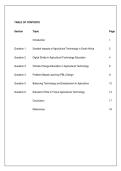
TABLE OF CONTENTS
Section Topic Page
Introduction 1
Question 1 Societal Impacts of Agricultural Technology in South Africa 2
Question 2 Digital Divide in Agricultural Technology Education 4
Question 3 Climate Change Education in Agricultural Technology 6
Question 4 Problem-Based Learning (PBL) Design 9
Question 5 Balancing Technology and Employment in Agriculture 12
Question 6 Educator's Role in Future Agricultural Technology 14
Conclusion 17
References 18
,INTRODUCTION
Agriculture is very important in South Africa because it provides food and jobs,
especially in rural areas. However, farmers face many challenges, such as droughts,
floods, climate change, and the high cost of new technology. Machines can make
farming faster and easier, but they may also reduce jobs for farm workers. Education
can help people understand these changes and find better solutions. Agricultural
technology can help farmers produce more food, save water, protect the soil, and work
more efficiently. However, not all farmers and learners have access to technology or the
internet. This creates a digital gap between people who have technology and those who
do not. Teachers can help by giving all learners a fair chance to learn and use
technology.
Climate change is also a serious problem for farming. Learners can be taught how
technology can help farmers deal with drought, water shortages, soil damage, and other
environmental problems. They can also work together to solve real farming problems.
This helps them develop useful skills and think of new ideas. Machines are helpful, but
people still need jobs. Farmers can use technology while also training workers to learn
new skills. This can help technology create new opportunities instead of only taking
away jobs. Agricultural Science teachers have an important role in preparing young
people for the future. They can teach learners about farming, technology, climate
change, and protecting the environment. With good education, useful technology, and
the right skills, South Africa can improve farming, protect nature, produce enough food,
and create better opportunities for future generations.
, QUESTION 1: Societal Impacts of Agricultural Technology in South Africa (20
marks)
Agricultural technology has brought about significant changes in South African society,
affecting the economy, social structures, and the environment in various ways. When
we look at the economic impacts, we can see both positive and negative effects. On the
positive side, technology has helped many small farmers to improve their production
and earn more money. The Seriti Institute is a great example of this, as they provided
training and equipment like irrigation systems and shade nets to 312 small farmers
across four provinces including KwaZulu-Natal, Limpopo, North West, and
Mpumalanga. These farmers were able to move from growing food just for their own
families to becoming real farming businesses that sell their vegetables to big
supermarkets like Spar and Boxer. This shows clearly how technology can help farmers
make a proper living and contribute to the country's economy. However, there is also a
negative side to this economic story because agricultural technology can be very
expensive. Many small farmers simply cannot afford to buy the advanced tools, apps,
and equipment that would help them. This means that richer farmers benefit much more
from technology while poorer farmers are left behind, which creates an even bigger gap
between the wealthy and the poor in rural areas.
When we consider the social impacts of agricultural technology, we find that it can help
bring people together and empower groups that have often been left out. The Seriti
project is a wonderful example because more than sixty percent of the farmers who
received help were women and young people. Women-led groups like the Ladies First
in Agriculture cooperative received support to improve their farming, which helped
women become more independent and earn their own money. This is very important in
South Africa where many women in rural areas depend on men for financial support.
However, technology can also create social problems because many farmers do not
have the skills to use new digital tools. This creates a gap between farmers who can
use technology and those who cannot, which can cause frustration and division in


