

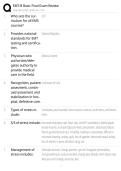
EMT-B Basic Final Exam Review
Study online at https://quizlet.com/_715ik
1. Who sets the cur- DOT
riculum for all EMS
courses?
2. Provides national National Registery
standards for EMT
testing and certifica-
tion.
3. Physician who Medical Control
authorizes/dele-
gates authority to
provide medical
care in the field.
4. Recognition, patient Continuum of Care
assesment, contin-
ued assesment and
stabilization in hos-
pital, definitive care.
5. Types of stress in- Cumulative, post-traumatic stress reaction, eustruss, acute stress, and chronic
clude: stress
6. S/S of stress include: Increased respiratory rate, heart rate, and B/P, vasodilation, dialted pupils,
tensed muscles, increased glucose levels, perspiration, deacreased blood
flow to gastrointestinal tract, irritability, inability to concentrate, difficult or
increased sleeping, anxiety, guilt, loss of appetite, decreased sexual activity,
loss of interest in work, alcholism, drug use.
7. Management of Eliminate stressors, change partners, get rid of negative personalities,
stress includes: change work hours, reduce overtime, change your attitude, don't obsess over
what you can't change, excercise, diet.
, EMT-B Basic Final Exam Review
Study online at https://quizlet.com/_715ik
8. Fight or Flight re- During an acute stress response, the autonomic nervous system is activated
sponse: and the body increases level of cotricol, adrenilen, and other hormones that
produce an increased heart rate, quick breathing, and higher BP. Blood is
shunted from extremities to the big muscles to "fight or flight".
9. Routes of transmis- Direct - touch or droplets
sion include: Indirect - spread by inanimate objects
Mechanical (vector born) - by insects
Biological - Transmissions by which the germs live or grow
Airborne - sneezes, coughs
Dust - may carry pores, may remain for long periods.
10. Control and preven- Hand washing, gloves, eye protection, gowns, masks, mask, respirators, bar-
tion of contamina- rier devices, and immunizations.
tion include?
11. Duty to Act is? An obligation to provide care.
12. Duties include: Duty to:
-Respond
-Obey laws and regulations
-Operate an emergerncy vehicle reasonably and prudently
-Provide care and transportation to expected standard
-Provide care and transport consistent with the scope of practice and local
medicine protocol
-Continue and transport through to its appropriate conclusion
13. The scope of prac- Descriptionof what assessment and treatment skills and EMT may legally
tice is? perform.
14. Implied consent is? Consent in which a patient is unable to give consent and is provided treatment
under the implication they would want treament.
Study online at https://quizlet.com/_715ik
1. Who sets the cur- DOT
riculum for all EMS
courses?
2. Provides national National Registery
standards for EMT
testing and certifica-
tion.
3. Physician who Medical Control
authorizes/dele-
gates authority to
provide medical
care in the field.
4. Recognition, patient Continuum of Care
assesment, contin-
ued assesment and
stabilization in hos-
pital, definitive care.
5. Types of stress in- Cumulative, post-traumatic stress reaction, eustruss, acute stress, and chronic
clude: stress
6. S/S of stress include: Increased respiratory rate, heart rate, and B/P, vasodilation, dialted pupils,
tensed muscles, increased glucose levels, perspiration, deacreased blood
flow to gastrointestinal tract, irritability, inability to concentrate, difficult or
increased sleeping, anxiety, guilt, loss of appetite, decreased sexual activity,
loss of interest in work, alcholism, drug use.
7. Management of Eliminate stressors, change partners, get rid of negative personalities,
stress includes: change work hours, reduce overtime, change your attitude, don't obsess over
what you can't change, excercise, diet.
, EMT-B Basic Final Exam Review
Study online at https://quizlet.com/_715ik
8. Fight or Flight re- During an acute stress response, the autonomic nervous system is activated
sponse: and the body increases level of cotricol, adrenilen, and other hormones that
produce an increased heart rate, quick breathing, and higher BP. Blood is
shunted from extremities to the big muscles to "fight or flight".
9. Routes of transmis- Direct - touch or droplets
sion include: Indirect - spread by inanimate objects
Mechanical (vector born) - by insects
Biological - Transmissions by which the germs live or grow
Airborne - sneezes, coughs
Dust - may carry pores, may remain for long periods.
10. Control and preven- Hand washing, gloves, eye protection, gowns, masks, mask, respirators, bar-
tion of contamina- rier devices, and immunizations.
tion include?
11. Duty to Act is? An obligation to provide care.
12. Duties include: Duty to:
-Respond
-Obey laws and regulations
-Operate an emergerncy vehicle reasonably and prudently
-Provide care and transportation to expected standard
-Provide care and transport consistent with the scope of practice and local
medicine protocol
-Continue and transport through to its appropriate conclusion
13. The scope of prac- Descriptionof what assessment and treatment skills and EMT may legally
tice is? perform.
14. Implied consent is? Consent in which a patient is unable to give consent and is provided treatment
under the implication they would want treament.


