

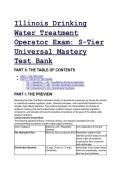
Illinois Drinking
Water Treatment
Operator Exam: S-Tier
Universal Mastery
Test Bank
PART 0: THE TABLE OF CONTENTS
● PART I: THE PREVIEW
● PART II: THE ELITE TEST BANK
○ Tier 1 (Questions 1–10) - Foundational Syntax & Application
○ Tier 2 (Questions 11–20) - Complex Application & Simulation
○ Tier 3 (Questions 21–30) - Grandmaster Synthesis
PART I: THE PREVIEW
Mastering this Elite Test Bank translates directly to operational supremacy by forcing the scholar
to synthesize isolated regulatory codes, chemical principles, and mechanical limitations into
singular, high-stakes decisions. This material bypasses rote memorization and forges an
academic mastery that averts catastrophic systemic failures, ensures absolute regulatory
compliance, and elevates clinical and analytical competence to the apex of the global water
treatment industry.
Critical Axioms Cheat Sheet
The following operational floors, chemical ceilings, and statutory mandates form the
uncompromising foundation of public water supply protection.
Axiom Category Statutory Limit / Regulatory Core Application & Context
Standard
The Hydraulic Floor Minimum 20 psi at ground level Distribution systems must
maintain positive pressure at all
points under all conditions,
including fire flow, to prevent
back-siphonage.
Disinfection Baseline 0.5 mg/L (Free) or 1.0 mg/L Active grids must sustain these
(Combined) minimums perpetually; sources
with free and combined
,Axiom Category Statutory Limit / Regulatory Core Application & Context
Standard
residuals must never be mixed.
LSLRNA Mandate 30 Days (Standard) / 120 Days Partial lead service line
(Weather) replacements are strictly
prohibited; emergency repairs
mandate point-of-use filters and
complete line replacement.
Sequestration Ceiling Polyphosphate < 1.0 mg/L (Fe Polyphosphate fails when the
+ Mn) combined concentration of iron
and manganese exceeds 1.0
mg/L, risking severe red/black
water events.
AWWA C651 (Continuous) 25 mg/L Dose \rightarrow 10 The Continuous-Feed method
mg/L Residual for new mains requires a
24-hour contact period ending
with a 10 mg/L verification
residual.
Piping Identification Olive Green (Raw), Aqua Strict visual hierarchies prevent
(Settled), Dark Blue (Finished) lethal cross-connections within
the plant infrastructure.
PART II: THE ELITE TEST BANK
Tier 1 (Questions 1–10) - Foundational Syntax & Application
Q1: A municipal water supply intends to upgrade its primary treatment process from simple
aeration and filtration to a system utilizing ultraviolet (UV) disinfection and lime softening.
According to Illinois EPA operator certification standards, which classification of certified
operator is REQUIRED to oversee this upgraded facility? A) Class D B) Class C C) Class B D)
Class A
● Answer/Respuesta/Réponse: D (Class A)
● Distractor Analysis:
○ A is incorrect: Class D certification is strictly restricted to facilities limited to
pumpage, storage, or distribution without chemical treatment processes.
○ B is incorrect: Class C certification governs facilities where treatment is limited
exclusively to chemical feeding, rendering it invalid for filtration processes.
○ C is incorrect: While Class B covers aeration and non-membrane filtration, the
introduction of lime softening and UV disinfection mathematically elevates the
system complexity beyond Class B constraints.
The Mentor's Analysis: Plant classification is dictated by the most complex treatment process
in the operational train. When facing plant upgrades that introduce coagulation, sedimentation,
lime softening, UV disinfection, or membrane filtration, the immediate priority is securing a Class
A operator. By utilizing Class A regulatory thresholds, the analyst bypasses the common trap of
assuming filtration upgrades only necessitate Class B certification. Professional/Academic
Intuition: The presence of lime softening, coagulation, or UV disinfection universally
dictates a Class A facility.
Q2: During peak summer demand, an operator notes a significant pressure drop across a
, residential subdivision at the furthest edge of the distribution grid. To comply with Illinois design
and operation criteria, what is the ABSOLUTE MINIMUM pressure that must be maintained at
the ground surface in this active part of the system under any operational condition? A) 15 psi
B) 20 psi C) 30 psi D) 35 psi
● Answer/Respuesta/Réponse: B (20 psi)
● Distractor Analysis:
○ A is incorrect: 15 psi represents a failure state that drastically increases the risk of
back-siphonage and catastrophic pathogen intrusion.
○ C is incorrect: 30 psi is a standard operational target for normal service to maintain
consumer satisfaction but is not the statutory regulatory floor.
○ D is incorrect: 35 psi is commonly required by internal municipal codes for optimal
fixture performance but is technically higher than the state-mandated emergency
minimum.
The Mentor's Analysis: Hydraulic integrity is the primary physical barrier against
cross-contamination in a distribution grid. When facing peak demand or fire-flow scenarios, the
immediate priority is maintaining positive outward pressure. By utilizing the 20 psi Hard Deck,
the practitioner bypasses the common trap of allowing localized low-pressure zones to invite
systemic backflow. Professional/Academic Intuition: 20 psi is the non-negotiable threshold
separating safe distribution from a mandatory boil water advisory.
Q3: A Class C facility operating on groundwater adds sodium hypochlorite for disinfection. The
operator is conducting daily distribution system testing. Which of the following readings
represents the LOWEST legally permissible concentration for free chlorine residual in an active
part of the Illinois distribution system? A) 0.2 mg/L B) 0.5 mg/L C) 1.0 mg/L D) 4.0 mg/L
● Answer/Respuesta/Réponse: B (0.5 mg/L)
● Distractor Analysis:
○ A is incorrect: 0.2 mg/L is a common standard in other jurisdictions and legacy
AWWA texts, but falls dangerously below the stringent Illinois statutory requirement.
○ C is incorrect: 1.0 mg/L is the minimum requirement for combined chlorine
(chloramines), not free chlorine.
○ D is incorrect: 4.0 mg/L is the Maximum Residual Disinfectant Level (MRDL),
representing the regulatory ceiling, not the floor.
The Mentor's Analysis: Disinfectant decay is inevitable as water ages in the distribution grid,
driven by organic interaction and pipe wall demand. When facing distant dead-ends, the
immediate priority is sustaining chemical inactivation capabilities. By utilizing the 0.5 mg/L free
chlorine baseline, the scholar bypasses the common trap of conflating federal generalized
minimums with state-specific mandates. Professional/Academic Intuition: Free chlorine
floors at 0.5 mg/L; combined chlorine floors at 1.0 mg/L. Never mix the two.
Q4: A conventional surface water treatment plant is optimizing its rapid sand filtration process.
Under primary drinking water standards, what is the maximum allowable turbidity level that 95%
of the filtered water measurements must NOT EXCEED in a given month? A) 0.1 NTU B) 0.3
NTU C) 0.5 NTU D) 1.0 NTU
● Answer/Respuesta/Réponse: C (0.5 NTU)
● Distractor Analysis:
○ A is incorrect: 0.1 NTU is an elite operational optimization goal for modern
membrane plants, but is not the statutory compliance limit for conventional filtration.
○ B is incorrect: 0.3 NTU is a federal enhanced surface water treatment rule target in
some contexts, but the specific Illinois code text defaults to 0.5 NTU unless altered
by a Special Exception Permit.
Water Treatment
Operator Exam: S-Tier
Universal Mastery
Test Bank
PART 0: THE TABLE OF CONTENTS
● PART I: THE PREVIEW
● PART II: THE ELITE TEST BANK
○ Tier 1 (Questions 1–10) - Foundational Syntax & Application
○ Tier 2 (Questions 11–20) - Complex Application & Simulation
○ Tier 3 (Questions 21–30) - Grandmaster Synthesis
PART I: THE PREVIEW
Mastering this Elite Test Bank translates directly to operational supremacy by forcing the scholar
to synthesize isolated regulatory codes, chemical principles, and mechanical limitations into
singular, high-stakes decisions. This material bypasses rote memorization and forges an
academic mastery that averts catastrophic systemic failures, ensures absolute regulatory
compliance, and elevates clinical and analytical competence to the apex of the global water
treatment industry.
Critical Axioms Cheat Sheet
The following operational floors, chemical ceilings, and statutory mandates form the
uncompromising foundation of public water supply protection.
Axiom Category Statutory Limit / Regulatory Core Application & Context
Standard
The Hydraulic Floor Minimum 20 psi at ground level Distribution systems must
maintain positive pressure at all
points under all conditions,
including fire flow, to prevent
back-siphonage.
Disinfection Baseline 0.5 mg/L (Free) or 1.0 mg/L Active grids must sustain these
(Combined) minimums perpetually; sources
with free and combined
,Axiom Category Statutory Limit / Regulatory Core Application & Context
Standard
residuals must never be mixed.
LSLRNA Mandate 30 Days (Standard) / 120 Days Partial lead service line
(Weather) replacements are strictly
prohibited; emergency repairs
mandate point-of-use filters and
complete line replacement.
Sequestration Ceiling Polyphosphate < 1.0 mg/L (Fe Polyphosphate fails when the
+ Mn) combined concentration of iron
and manganese exceeds 1.0
mg/L, risking severe red/black
water events.
AWWA C651 (Continuous) 25 mg/L Dose \rightarrow 10 The Continuous-Feed method
mg/L Residual for new mains requires a
24-hour contact period ending
with a 10 mg/L verification
residual.
Piping Identification Olive Green (Raw), Aqua Strict visual hierarchies prevent
(Settled), Dark Blue (Finished) lethal cross-connections within
the plant infrastructure.
PART II: THE ELITE TEST BANK
Tier 1 (Questions 1–10) - Foundational Syntax & Application
Q1: A municipal water supply intends to upgrade its primary treatment process from simple
aeration and filtration to a system utilizing ultraviolet (UV) disinfection and lime softening.
According to Illinois EPA operator certification standards, which classification of certified
operator is REQUIRED to oversee this upgraded facility? A) Class D B) Class C C) Class B D)
Class A
● Answer/Respuesta/Réponse: D (Class A)
● Distractor Analysis:
○ A is incorrect: Class D certification is strictly restricted to facilities limited to
pumpage, storage, or distribution without chemical treatment processes.
○ B is incorrect: Class C certification governs facilities where treatment is limited
exclusively to chemical feeding, rendering it invalid for filtration processes.
○ C is incorrect: While Class B covers aeration and non-membrane filtration, the
introduction of lime softening and UV disinfection mathematically elevates the
system complexity beyond Class B constraints.
The Mentor's Analysis: Plant classification is dictated by the most complex treatment process
in the operational train. When facing plant upgrades that introduce coagulation, sedimentation,
lime softening, UV disinfection, or membrane filtration, the immediate priority is securing a Class
A operator. By utilizing Class A regulatory thresholds, the analyst bypasses the common trap of
assuming filtration upgrades only necessitate Class B certification. Professional/Academic
Intuition: The presence of lime softening, coagulation, or UV disinfection universally
dictates a Class A facility.
Q2: During peak summer demand, an operator notes a significant pressure drop across a
, residential subdivision at the furthest edge of the distribution grid. To comply with Illinois design
and operation criteria, what is the ABSOLUTE MINIMUM pressure that must be maintained at
the ground surface in this active part of the system under any operational condition? A) 15 psi
B) 20 psi C) 30 psi D) 35 psi
● Answer/Respuesta/Réponse: B (20 psi)
● Distractor Analysis:
○ A is incorrect: 15 psi represents a failure state that drastically increases the risk of
back-siphonage and catastrophic pathogen intrusion.
○ C is incorrect: 30 psi is a standard operational target for normal service to maintain
consumer satisfaction but is not the statutory regulatory floor.
○ D is incorrect: 35 psi is commonly required by internal municipal codes for optimal
fixture performance but is technically higher than the state-mandated emergency
minimum.
The Mentor's Analysis: Hydraulic integrity is the primary physical barrier against
cross-contamination in a distribution grid. When facing peak demand or fire-flow scenarios, the
immediate priority is maintaining positive outward pressure. By utilizing the 20 psi Hard Deck,
the practitioner bypasses the common trap of allowing localized low-pressure zones to invite
systemic backflow. Professional/Academic Intuition: 20 psi is the non-negotiable threshold
separating safe distribution from a mandatory boil water advisory.
Q3: A Class C facility operating on groundwater adds sodium hypochlorite for disinfection. The
operator is conducting daily distribution system testing. Which of the following readings
represents the LOWEST legally permissible concentration for free chlorine residual in an active
part of the Illinois distribution system? A) 0.2 mg/L B) 0.5 mg/L C) 1.0 mg/L D) 4.0 mg/L
● Answer/Respuesta/Réponse: B (0.5 mg/L)
● Distractor Analysis:
○ A is incorrect: 0.2 mg/L is a common standard in other jurisdictions and legacy
AWWA texts, but falls dangerously below the stringent Illinois statutory requirement.
○ C is incorrect: 1.0 mg/L is the minimum requirement for combined chlorine
(chloramines), not free chlorine.
○ D is incorrect: 4.0 mg/L is the Maximum Residual Disinfectant Level (MRDL),
representing the regulatory ceiling, not the floor.
The Mentor's Analysis: Disinfectant decay is inevitable as water ages in the distribution grid,
driven by organic interaction and pipe wall demand. When facing distant dead-ends, the
immediate priority is sustaining chemical inactivation capabilities. By utilizing the 0.5 mg/L free
chlorine baseline, the scholar bypasses the common trap of conflating federal generalized
minimums with state-specific mandates. Professional/Academic Intuition: Free chlorine
floors at 0.5 mg/L; combined chlorine floors at 1.0 mg/L. Never mix the two.
Q4: A conventional surface water treatment plant is optimizing its rapid sand filtration process.
Under primary drinking water standards, what is the maximum allowable turbidity level that 95%
of the filtered water measurements must NOT EXCEED in a given month? A) 0.1 NTU B) 0.3
NTU C) 0.5 NTU D) 1.0 NTU
● Answer/Respuesta/Réponse: C (0.5 NTU)
● Distractor Analysis:
○ A is incorrect: 0.1 NTU is an elite operational optimization goal for modern
membrane plants, but is not the statutory compliance limit for conventional filtration.
○ B is incorrect: 0.3 NTU is a federal enhanced surface water treatment rule target in
some contexts, but the specific Illinois code text defaults to 0.5 NTU unless altered
by a Special Exception Permit.


