PROTYMERA
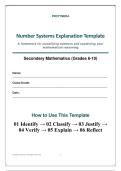
Number Systems Explanation Template
A framework for classifying numbers and explaining your
mathematical reasoning
Secondary Mathematics (Grades 6-10)
Name:
____________________________________________________________
Class/Grade:
____________________________________________________________
Date:
____________________________________________________________
How to Use This Template
01 Identify → 02 Classify → 03 Justify →
04 Verify → 05 Explain → 06 Reflect
© 2026 Protymera. All rights reserved. 1
, Number or Expression to Classify
Write the number or expression given in this task below.
Number System Convention
Definitions
Natural Numbers (N): positive counting numbers 1, 2, 3, 4, and so on.
Zero is NOT included in this template's convention.
Whole Numbers: all Natural Numbers plus zero 0, 1, 2, 3, and so on.
Integers (Z): all Whole Numbers plus their negatives ..., -3, -2, -1, 0, 1,
2, 3, ...
Rational Numbers (Q): any number that can be written as a/b, where a
and b are integers and b is not 0. Includes terminating and repeating
decimals.
Irrational Numbers: real numbers that cannot be written as a/b for any
integers a and b. Their decimals never terminate and never repeat.
Real Numbers (R): every Rational Number and every Irrational Number
combined.
© 2026 Protymera. All rights reserved. 2
, Number-System Hierarchy
Natural Numbers ⊂ Whole Numbers ⊂ Integers ⊂ Rational Numbers ⊂
Real Numbers
Real Numbers = Rational Numbers ∪ Irrational Numbers
Rational Numbers ∩ Irrational Numbers = ∅
Irrational Numbers are also part of the Real Numbers system, but do not
overlap with Rational Numbers.
Optional Advanced Extension: Complex Numbers
If Complex Numbers are included in your course, extend the hierarchy
beyond the Real Numbers. Every Real Number is also a Complex Number
because any real number can be written in the form a + 0i. Complex Numbers
also include numbers with a non-zero imaginary part.
☐ Complex Numbers (C) - only if covered in your course
For this template, use Complex Numbers only when they are part of your
course or assigned task.
★ Classify the value of the number or expression, not merely the way it
𝟏 𝟔
is written. For example: √25 = 5, 0.50 = , and = 2. Simplify or evaluate
𝟐 𝟑
first, then classify.
Classification Strategy
Step 1: Simplify or evaluate the number or expression, if possible.
Step 2: Is it a positive counting number (1, 2, 3, ...)? If yes, it is Natural
(and also Whole, Integer, Rational, Real).
Step 3: Is it zero or a positive whole value? If yes, it is at least Whole (and
also Integer, Rational, Real).
© 2026 Protymera. All rights reserved. 3
Number Systems Explanation Template
A framework for classifying numbers and explaining your
mathematical reasoning
Secondary Mathematics (Grades 6-10)
Name:
____________________________________________________________
Class/Grade:
____________________________________________________________
Date:
____________________________________________________________
How to Use This Template
01 Identify → 02 Classify → 03 Justify →
04 Verify → 05 Explain → 06 Reflect
© 2026 Protymera. All rights reserved. 1
, Number or Expression to Classify
Write the number or expression given in this task below.
Number System Convention
Definitions
Natural Numbers (N): positive counting numbers 1, 2, 3, 4, and so on.
Zero is NOT included in this template's convention.
Whole Numbers: all Natural Numbers plus zero 0, 1, 2, 3, and so on.
Integers (Z): all Whole Numbers plus their negatives ..., -3, -2, -1, 0, 1,
2, 3, ...
Rational Numbers (Q): any number that can be written as a/b, where a
and b are integers and b is not 0. Includes terminating and repeating
decimals.
Irrational Numbers: real numbers that cannot be written as a/b for any
integers a and b. Their decimals never terminate and never repeat.
Real Numbers (R): every Rational Number and every Irrational Number
combined.
© 2026 Protymera. All rights reserved. 2
, Number-System Hierarchy
Natural Numbers ⊂ Whole Numbers ⊂ Integers ⊂ Rational Numbers ⊂
Real Numbers
Real Numbers = Rational Numbers ∪ Irrational Numbers
Rational Numbers ∩ Irrational Numbers = ∅
Irrational Numbers are also part of the Real Numbers system, but do not
overlap with Rational Numbers.
Optional Advanced Extension: Complex Numbers
If Complex Numbers are included in your course, extend the hierarchy
beyond the Real Numbers. Every Real Number is also a Complex Number
because any real number can be written in the form a + 0i. Complex Numbers
also include numbers with a non-zero imaginary part.
☐ Complex Numbers (C) - only if covered in your course
For this template, use Complex Numbers only when they are part of your
course or assigned task.
★ Classify the value of the number or expression, not merely the way it
𝟏 𝟔
is written. For example: √25 = 5, 0.50 = , and = 2. Simplify or evaluate
𝟐 𝟑
first, then classify.
Classification Strategy
Step 1: Simplify or evaluate the number or expression, if possible.
Step 2: Is it a positive counting number (1, 2, 3, ...)? If yes, it is Natural
(and also Whole, Integer, Rational, Real).
Step 3: Is it zero or a positive whole value? If yes, it is at least Whole (and
also Integer, Rational, Real).
© 2026 Protymera. All rights reserved. 3