Nevada Concrete Contractor (C-5) Contractor Practice Exam
250-question practice bank • Original questions aligned to publicly available exam scope, syllabus, classification or certification information. These are not
leaked or reproduced actual exam questions.
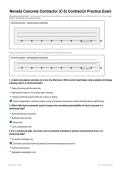
Concrete section / reinforcement schematic
bottom steel
Original technical schematic for orientation. It is not a reproduction of a proprietary exam image.
Concrete section / reinforcement schematic
bottom steel
1. A slab crew places concrete on a hot, dry afternoon. Which action best helps reduce plastic-shrinkage
cracking risk in a reinforced slab?
• Delay all curing until the next day
• Add random water to the surface after finishing
• Increase finishing passes while the surface is drying
■ Control evaporation, maintain proper curing, and avoid unnecessary surface finishing during rapid drying
2. Which field test is primarily used to assess the consistency/workability of fresh concrete in a
reinforced slab?
• Schmidt rebound correction
• Rebound hammer test
■ Slump test
• Core compression test
3. For a reinforced slab, concrete cover is primarily intended to protect reinforcement from: in a
reinforced slab?
• Concrete shrinkage only
■ Corrosion and loss of bond caused by environmental exposure and fire
• Surface dusting only
• Aggregate segregation only
Practice bank • Page 1 Correct choice marked ✓
, 4. A cold joint is most likely to develop when:
• The slab is over-reinforced
• The concrete is air-entrained
• Aggregate is too rounded
■ A previous lift sets enough that the next placement cannot integrate properly
5. Which sequence is most appropriate after placing a conventional exterior slab in a reinforced slab?
• Vibrate after final troweling
■ Screed, bull-float as appropriate, finish when bleed water has dissipated, then cure
• Cure first, then place concrete
• Finish immediately, then add water and screed
6. If a batch design calls for 1.0 yd³ and the project needs 18 yd³, the nominal number of cubic yards is:
in a typical CCTA workflow?
• 12 yd³
■ 18 yd³
• 16 yd³
• 24 yd³
7. Why are construction joints intentionally located in a typical CCTA workflow?
• To eliminate all reinforcement
• To make concrete set faster
■ To provide a planned location for interruption of concrete placement and movement control
• To replace curing
8. A vibrator is being used on a heavily reinforced wall. The best practice is to: in a typical CCTA
workflow?
■ Insert the vibrator systematically and avoid using it to move concrete laterally
• Drag concrete long distances with the vibrator
• Use it only after the concrete has set
• Hold it continuously against form faces
9. The principal purpose of curing concrete is to: in a reinforced slab?
• Remove all moisture as quickly as possible
■ Maintain conditions that support hydration and development of desired properties
• Prevent all thermal movement
• Increase aggregate size
Practice bank • Page 2 Correct choice marked ✓
, 10. Which condition most directly increases the risk of reinforcement corrosion in a typical CCTA
workflow?
• A smooth form surface
■ Chloride ingress into concrete that reaches reinforcing steel
• A properly cured interior slab
• Low aggregate absorption
11. A slab crew places concrete on a hot, dry afternoon. Which action best helps reduce
plastic-shrinkage cracking risk on a commercial placement?
■ Control evaporation, maintain proper curing, and avoid unnecessary surface finishing during rapid drying
• Delay all curing until the next day
• Add random water to the surface after finishing
• Increase finishing passes while the surface is drying
12. Which field test is primarily used to assess the consistency/workability of fresh concrete on a
commercial placement?
• Rebound hammer test
■ Slump test
• Core compression test
• Schmidt rebound correction
13. For a reinforced slab, concrete cover is primarily intended to protect reinforcement from: on a
commercial placement?
■ Corrosion and loss of bond caused by environmental exposure and fire
• Concrete shrinkage only
• Aggregate segregation only
• Surface dusting only
Focus: Verify the governing edition, project specification and AHJ requirements before applying this concept.
14. A cold joint is most likely to develop when:
• The slab is over-reinforced
• Aggregate is too rounded
• The concrete is air-entrained
■ A previous lift sets enough that the next placement cannot integrate properly
15. Which sequence is most appropriate after placing a conventional exterior slab on a commercial
placement?
■ Screed, bull-float as appropriate, finish when bleed water has dissipated, then cure
• Finish immediately, then add water and screed
• Cure first, then place concrete
• Vibrate after final troweling
Practice bank • Page 3 Correct choice marked ✓
, 16. If a batch design calls for 1.0 yd³ and the project needs 18 yd³, the nominal number of cubic yards is:
when image quality is limited?
• 24 yd³
• 16 yd³
■ 18 yd³
• 12 yd³
17. Why are construction joints intentionally located when image quality is limited?
Concrete section / reinforcement schematic
bottom steel
• To make concrete set faster
• To eliminate all reinforcement
■ To provide a planned location for interruption of concrete placement and movement control
• To replace curing
18. A vibrator is being used on a heavily reinforced wall. The best practice is to: when image quality is
limited?
■ Insert the vibrator systematically and avoid using it to move concrete laterally
• Drag concrete long distances with the vibrator
• Hold it continuously against form faces
• Use it only after the concrete has set
19. The principal purpose of curing concrete is to: on a commercial placement?
• Remove all moisture as quickly as possible
■ Maintain conditions that support hydration and development of desired properties
• Prevent all thermal movement
• Increase aggregate size
20. Which condition most directly increases the risk of reinforcement corrosion when image quality is
limited?
• A smooth form surface
• Low aggregate absorption
■ Chloride ingress into concrete that reaches reinforcing steel
• A properly cured interior slab
Practice bank • Page 4 Correct choice marked ✓
250-question practice bank • Original questions aligned to publicly available exam scope, syllabus, classification or certification information. These are not
leaked or reproduced actual exam questions.
Concrete section / reinforcement schematic
bottom steel
Original technical schematic for orientation. It is not a reproduction of a proprietary exam image.
Concrete section / reinforcement schematic
bottom steel
1. A slab crew places concrete on a hot, dry afternoon. Which action best helps reduce plastic-shrinkage
cracking risk in a reinforced slab?
• Delay all curing until the next day
• Add random water to the surface after finishing
• Increase finishing passes while the surface is drying
■ Control evaporation, maintain proper curing, and avoid unnecessary surface finishing during rapid drying
2. Which field test is primarily used to assess the consistency/workability of fresh concrete in a
reinforced slab?
• Schmidt rebound correction
• Rebound hammer test
■ Slump test
• Core compression test
3. For a reinforced slab, concrete cover is primarily intended to protect reinforcement from: in a
reinforced slab?
• Concrete shrinkage only
■ Corrosion and loss of bond caused by environmental exposure and fire
• Surface dusting only
• Aggregate segregation only
Practice bank • Page 1 Correct choice marked ✓
, 4. A cold joint is most likely to develop when:
• The slab is over-reinforced
• The concrete is air-entrained
• Aggregate is too rounded
■ A previous lift sets enough that the next placement cannot integrate properly
5. Which sequence is most appropriate after placing a conventional exterior slab in a reinforced slab?
• Vibrate after final troweling
■ Screed, bull-float as appropriate, finish when bleed water has dissipated, then cure
• Cure first, then place concrete
• Finish immediately, then add water and screed
6. If a batch design calls for 1.0 yd³ and the project needs 18 yd³, the nominal number of cubic yards is:
in a typical CCTA workflow?
• 12 yd³
■ 18 yd³
• 16 yd³
• 24 yd³
7. Why are construction joints intentionally located in a typical CCTA workflow?
• To eliminate all reinforcement
• To make concrete set faster
■ To provide a planned location for interruption of concrete placement and movement control
• To replace curing
8. A vibrator is being used on a heavily reinforced wall. The best practice is to: in a typical CCTA
workflow?
■ Insert the vibrator systematically and avoid using it to move concrete laterally
• Drag concrete long distances with the vibrator
• Use it only after the concrete has set
• Hold it continuously against form faces
9. The principal purpose of curing concrete is to: in a reinforced slab?
• Remove all moisture as quickly as possible
■ Maintain conditions that support hydration and development of desired properties
• Prevent all thermal movement
• Increase aggregate size
Practice bank • Page 2 Correct choice marked ✓
, 10. Which condition most directly increases the risk of reinforcement corrosion in a typical CCTA
workflow?
• A smooth form surface
■ Chloride ingress into concrete that reaches reinforcing steel
• A properly cured interior slab
• Low aggregate absorption
11. A slab crew places concrete on a hot, dry afternoon. Which action best helps reduce
plastic-shrinkage cracking risk on a commercial placement?
■ Control evaporation, maintain proper curing, and avoid unnecessary surface finishing during rapid drying
• Delay all curing until the next day
• Add random water to the surface after finishing
• Increase finishing passes while the surface is drying
12. Which field test is primarily used to assess the consistency/workability of fresh concrete on a
commercial placement?
• Rebound hammer test
■ Slump test
• Core compression test
• Schmidt rebound correction
13. For a reinforced slab, concrete cover is primarily intended to protect reinforcement from: on a
commercial placement?
■ Corrosion and loss of bond caused by environmental exposure and fire
• Concrete shrinkage only
• Aggregate segregation only
• Surface dusting only
Focus: Verify the governing edition, project specification and AHJ requirements before applying this concept.
14. A cold joint is most likely to develop when:
• The slab is over-reinforced
• Aggregate is too rounded
• The concrete is air-entrained
■ A previous lift sets enough that the next placement cannot integrate properly
15. Which sequence is most appropriate after placing a conventional exterior slab on a commercial
placement?
■ Screed, bull-float as appropriate, finish when bleed water has dissipated, then cure
• Finish immediately, then add water and screed
• Cure first, then place concrete
• Vibrate after final troweling
Practice bank • Page 3 Correct choice marked ✓
, 16. If a batch design calls for 1.0 yd³ and the project needs 18 yd³, the nominal number of cubic yards is:
when image quality is limited?
• 24 yd³
• 16 yd³
■ 18 yd³
• 12 yd³
17. Why are construction joints intentionally located when image quality is limited?
Concrete section / reinforcement schematic
bottom steel
• To make concrete set faster
• To eliminate all reinforcement
■ To provide a planned location for interruption of concrete placement and movement control
• To replace curing
18. A vibrator is being used on a heavily reinforced wall. The best practice is to: when image quality is
limited?
■ Insert the vibrator systematically and avoid using it to move concrete laterally
• Drag concrete long distances with the vibrator
• Hold it continuously against form faces
• Use it only after the concrete has set
19. The principal purpose of curing concrete is to: on a commercial placement?
• Remove all moisture as quickly as possible
■ Maintain conditions that support hydration and development of desired properties
• Prevent all thermal movement
• Increase aggregate size
20. Which condition most directly increases the risk of reinforcement corrosion when image quality is
limited?
• A smooth form surface
• Low aggregate absorption
■ Chloride ingress into concrete that reaches reinforcing steel
• A properly cured interior slab
Practice bank • Page 4 Correct choice marked ✓