Pharmacology, 12th Edition
McCuistion et al.
PRACTICE TEST BANK | 1,000 QUESTIONS | 58 CHAPTERS
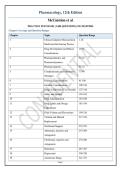
Chapter Coverage and Question Ranges
Chapter Topic Question Range
1 Clinical Judgment Measurement 1-18
Model and the Nursing Process
2 Drug Development and Ethical 19-36
Considerations
3 Pharmacokinetics and 37-54
Pharmacodynamics
4 Pharmacogenetics 55-72
5 Complementary and Alternative 73-90
Therapies
6 Pediatric Considerations 91-108
7 Geriatric Considerations 109-126
8 Drugs in Substance Use Disorder 127-144
9 Safety and Quality 145-162
10 Drug Administration 163-180
11 Drug Labels and Dosage 181-198
Calculations
12 Fluid Volume and Electrolytes 199-216
13 Vitamin and Mineral 217-234
Replacement
14 Nutritional Support 235-252
15 Adrenergic Agonists and 253-269
Antagonists
16 Cholinergic Agonists and 270-286
Antagonists
17 Stimulants 287-303
18 Depressants 304-320
19 Antiseizure Drugs 321-337
Page 1
,Chapter Topic Question Range
20 Drugs for Parkinsonism and 338-354
Alzheimer's Disease
21 Drugs for Neuromuscular 355-371
Disorders and Muscle Spasms
22 Antipsychotics and Anxiolytics 372-388
23 Antidepressants and Mood 389-405
Stabilizers
24 Antiinflammatories 406-422
25 Analgesics 423-439
26 Penicillins, Other Beta-Lactams, 440-456
and Cephalosporins
27 Macrolides, Oxazolidinones, 457-473
Lincosamides, Glycopeptides,
Ketolides, and Lipopeptides
28 Tetracyclines, Glycylcyclines, 474-490
Aminoglycosides, and
Fluoroquinolones
29 Sulfonamides and 491-507
Nitroimidazoles Antibiotics
30 Antituberculars, Antifungals, and 508-524
Antivirals
31 Antimalarials, Anthelmintics, and 525-541
Peptides
32 HIV- and AIDS-Related Drugs 542-558
33 Transplant Drugs 559-575
34 Vaccines 576-592
35 Anticancer Drugs 593-609
36 Targeted Therapies to Treat 610-626
Cancer
37 Biologic Response Modifiers 627-643
38 Upper Respiratory Disorders 644-660
39 Lower Respiratory Disorders 661-677
Page 2
,Chapter Topic Question Range
40 Cardiac Glycosides, Antianginals, 678-694
and Antidysrhythmics
41 Diuretics 695-711
42 Antihypertensives 712-728
43 Anticoagulants, Antiplatelets, and 729-745
Thrombolytics
44 Antihyperlipidemics and Drugs to 746-762
Improve Peripheral Blood Flow
45 Gastrointestinal Tract Disorders 763-779
46 Antiulcer Drugs 780-796
47 Eye and Ear Disorders 797-813
48 Dermatologic Disorders 814-830
49 Pituitary, Thyroid, Parathyroid, 831-847
and Adrenal Disorders
50 Antidiabetics 848-864
51 Urinary Disorders 865-881
52 Pregnancy and Preterm Labor 882-898
53 Labor, Delivery, and Postpartum 899-915
54 Neonatal and Newborn 916-932
55 Women's Reproductive Health 933-949
56 Men's Reproductive Disorders 950-966
57 Sexually Transmitted Infections 967-983
58 Adult and Pediatric Emergency 984-1000
Drugs
Page 3
, Chapter 1: Clinical Judgment Measurement Model and the Nursing Process | Questions 1-18
1. In the context of this chapter, which statement best describes a drug's therapeutic effect?
A. The intended beneficial response
B. The trade name assigned by a manufacturer
C. Any unexpected harmful response
D. The rate of renal excretion
Correct Answer: A | Rationale: A therapeutic effect is the intended beneficial clinical response to a
medication. Option A is the best answer because “The intended beneficial response” directly applies the
concept, priority, or action tested in the stem. The other choices either address a different concept or are less
appropriate for this specific situation. Applying this distinction helps connect pharmacologic knowledge with
safe medication administration, monitoring, and patient education.
2. A medication with a narrow therapeutic index generally requires which approach?
A. Automatic doubling of the first dose
B. Administration only by the intravenous route
C. Less monitoring because toxicity is unlikely
D. Closer monitoring of response and, when indicated, serum levels
Correct Answer: D | Rationale: A narrow therapeutic index means the effective and toxic concentrations
are relatively close, so careful monitoring is important. Option D is the best answer because “Closer
monitoring of response and, when indicated, serum levels” directly applies the concept, priority, or action
tested in the stem. The other choices either address a different concept or are less appropriate for this specific
situation. Applying this distinction helps connect pharmacologic knowledge with safe medication
administration, monitoring, and patient education.
3. Which action most directly reduces preventable medication harm?
A. Verifying the patient, drug, dose, route, time, and relevant clinical data
B. Using abbreviations whenever possible
C. Relying on memory rather than current references
D. Administering all medications before assessment
Correct Answer: A | Rationale: Systematic verification and patient assessment are core safeguards against
medication errors. Option A is the best answer because “Verifying the patient, drug, dose, route, time, and
relevant clinical data” directly applies the concept, priority, or action tested in the stem. The other choices
either address a different concept or are less appropriate for this specific situation. Applying this distinction
helps connect pharmacologic knowledge with safe medication administration, monitoring, and patient
education.
Page 4
McCuistion et al.
PRACTICE TEST BANK | 1,000 QUESTIONS | 58 CHAPTERS
Chapter Coverage and Question Ranges
Chapter Topic Question Range
1 Clinical Judgment Measurement 1-18
Model and the Nursing Process
2 Drug Development and Ethical 19-36
Considerations
3 Pharmacokinetics and 37-54
Pharmacodynamics
4 Pharmacogenetics 55-72
5 Complementary and Alternative 73-90
Therapies
6 Pediatric Considerations 91-108
7 Geriatric Considerations 109-126
8 Drugs in Substance Use Disorder 127-144
9 Safety and Quality 145-162
10 Drug Administration 163-180
11 Drug Labels and Dosage 181-198
Calculations
12 Fluid Volume and Electrolytes 199-216
13 Vitamin and Mineral 217-234
Replacement
14 Nutritional Support 235-252
15 Adrenergic Agonists and 253-269
Antagonists
16 Cholinergic Agonists and 270-286
Antagonists
17 Stimulants 287-303
18 Depressants 304-320
19 Antiseizure Drugs 321-337
Page 1
,Chapter Topic Question Range
20 Drugs for Parkinsonism and 338-354
Alzheimer's Disease
21 Drugs for Neuromuscular 355-371
Disorders and Muscle Spasms
22 Antipsychotics and Anxiolytics 372-388
23 Antidepressants and Mood 389-405
Stabilizers
24 Antiinflammatories 406-422
25 Analgesics 423-439
26 Penicillins, Other Beta-Lactams, 440-456
and Cephalosporins
27 Macrolides, Oxazolidinones, 457-473
Lincosamides, Glycopeptides,
Ketolides, and Lipopeptides
28 Tetracyclines, Glycylcyclines, 474-490
Aminoglycosides, and
Fluoroquinolones
29 Sulfonamides and 491-507
Nitroimidazoles Antibiotics
30 Antituberculars, Antifungals, and 508-524
Antivirals
31 Antimalarials, Anthelmintics, and 525-541
Peptides
32 HIV- and AIDS-Related Drugs 542-558
33 Transplant Drugs 559-575
34 Vaccines 576-592
35 Anticancer Drugs 593-609
36 Targeted Therapies to Treat 610-626
Cancer
37 Biologic Response Modifiers 627-643
38 Upper Respiratory Disorders 644-660
39 Lower Respiratory Disorders 661-677
Page 2
,Chapter Topic Question Range
40 Cardiac Glycosides, Antianginals, 678-694
and Antidysrhythmics
41 Diuretics 695-711
42 Antihypertensives 712-728
43 Anticoagulants, Antiplatelets, and 729-745
Thrombolytics
44 Antihyperlipidemics and Drugs to 746-762
Improve Peripheral Blood Flow
45 Gastrointestinal Tract Disorders 763-779
46 Antiulcer Drugs 780-796
47 Eye and Ear Disorders 797-813
48 Dermatologic Disorders 814-830
49 Pituitary, Thyroid, Parathyroid, 831-847
and Adrenal Disorders
50 Antidiabetics 848-864
51 Urinary Disorders 865-881
52 Pregnancy and Preterm Labor 882-898
53 Labor, Delivery, and Postpartum 899-915
54 Neonatal and Newborn 916-932
55 Women's Reproductive Health 933-949
56 Men's Reproductive Disorders 950-966
57 Sexually Transmitted Infections 967-983
58 Adult and Pediatric Emergency 984-1000
Drugs
Page 3
, Chapter 1: Clinical Judgment Measurement Model and the Nursing Process | Questions 1-18
1. In the context of this chapter, which statement best describes a drug's therapeutic effect?
A. The intended beneficial response
B. The trade name assigned by a manufacturer
C. Any unexpected harmful response
D. The rate of renal excretion
Correct Answer: A | Rationale: A therapeutic effect is the intended beneficial clinical response to a
medication. Option A is the best answer because “The intended beneficial response” directly applies the
concept, priority, or action tested in the stem. The other choices either address a different concept or are less
appropriate for this specific situation. Applying this distinction helps connect pharmacologic knowledge with
safe medication administration, monitoring, and patient education.
2. A medication with a narrow therapeutic index generally requires which approach?
A. Automatic doubling of the first dose
B. Administration only by the intravenous route
C. Less monitoring because toxicity is unlikely
D. Closer monitoring of response and, when indicated, serum levels
Correct Answer: D | Rationale: A narrow therapeutic index means the effective and toxic concentrations
are relatively close, so careful monitoring is important. Option D is the best answer because “Closer
monitoring of response and, when indicated, serum levels” directly applies the concept, priority, or action
tested in the stem. The other choices either address a different concept or are less appropriate for this specific
situation. Applying this distinction helps connect pharmacologic knowledge with safe medication
administration, monitoring, and patient education.
3. Which action most directly reduces preventable medication harm?
A. Verifying the patient, drug, dose, route, time, and relevant clinical data
B. Using abbreviations whenever possible
C. Relying on memory rather than current references
D. Administering all medications before assessment
Correct Answer: A | Rationale: Systematic verification and patient assessment are core safeguards against
medication errors. Option A is the best answer because “Verifying the patient, drug, dose, route, time, and
relevant clinical data” directly applies the concept, priority, or action tested in the stem. The other choices
either address a different concept or are less appropriate for this specific situation. Applying this distinction
helps connect pharmacologic knowledge with safe medication administration, monitoring, and patient
education.
Page 4