

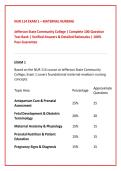
NUR 114 EXAM 1 – MATERNAL NURSING
Jefferson State Community College | Complete 100-Question
Test Bank | Verified Answers & Detailed Rationales | 100%
Pass Guarantee
EXAM 1
Based on the NUR 114 course at Jefferson State Community
College, Exam 1 covers foundational maternal-newborn nursing
concepts:
Approximate
Topic Area Percentage
Questions
Antepartum Care & Prenatal
25% 25
Assessment
Fetal Development & Obstetric
20% 20
Terminology
Maternal Anatomy & Physiology 15% 15
Prenatal Nutrition & Patient
15% 15
Education
Pregnancy Signs & Diagnosis 15% 15
, Approximate
Topic Area Percentage
Questions
Nursing Priorities & Health
10% 10
Promotion
SECTION 1: ANTEPARTUM CARE & PRENATAL ASSESSMENT
(Questions 1–25)
1. The nurse is preparing to teach a prenatal class about fetal
circulation. Which statements should be included in the
teaching plan? (Select all that apply)
A) "The ductus arteriosus allows blood to bypass the fetal
lungs."
B) "One vein carries oxygenated blood from the placenta to the
fetus."
C) "The normal fetal heartbeat range is 160 to 180 beats per
minute."
D) "Two arteries carry deoxygenated blood and waste products
away from the fetus to the placenta."
E) "Two veins carry blood that is high in carbon dioxide and
other waste products away from the fetus."
,Answer: A, B, D
Rationale: Theductus arteriosus is a unique fetalcirculation
structurethatallows blood to bypass the nonfunctioning fetal
lungs. Oxygenated blood is transported to thefetus by one
umbilical vein. Thenormalfetalheartraterange is 110 to 160
beats perminute (not 160–180). Two arteries carrydeoxygenated
blood and waste products fromthefetus, and one umbilical vein
carries oxygenated blood and nutrients.
2. The nurse is caringforapregnant patientat 12 weeks gestation.
Whichfinding wouldthe nurse expect during theprenatal
assessment?
A) Fetalheart tones audible with Doppler
B) Quickeningreported bythe mother
C) Fundal height atthe umbilicus
D) Braxton Hicks contractions
Answer: A) Fetalheart tones audible with Doppler
Rationale: Fetalheart tones can typicallybeheard with a Doppler
ultrasound deviceat 10–12 weeks gestation. Quickening (B) is
usually feltat 16–20 weeks. Fundal height atthe umbilicus (C)
occurs at approximately 20 weeks. Braxton Hicks contractions (D)
typicallybegin in thesecond trimester.
, 3. Apatientat 28 weeks gestation is scheduled foraglucose
tolerancetest to screenforgestationaldiabetes. Which
instruction should the nurse provide?
A) "Fast for 8–12 hours beforethetest."
B) "Eata high-carbohydrate meal 2 hours before the test."
C) "Drinktheglucosesolution and then eatalight meal."
D) "No special preparation is neededforthistest."
Answer: A) "Fast for 8–12 hours beforethetest."
Rationale: Forthe 3-houroralglucosetolerance test (OGTT), the
patient should fast for 8–12 hours beforethe test. The 1-hour
glucosechallenge test (GCT) doesnot require fasting.
4. Apatientat 16 weeks gestation asks the nurse, "Whenwill I feel
the baby move?" Which response is mostaccurate?
A) "You should feelmovement by 10–12 weeks."
B) "Most women feelmovement between 16–20 weeks."
C) "You willnotfeelmovementuntil 24–28 weeks."
D) "Movement is notfelt until thethirdtrimester."
Answer: B) "Most women feel movement between 16–20
weeks."
Rationale: Quickening(thefirstperception of fetalmovement)
typicallyoccurs between 16–20 weeks gestation. Primigravidas
often feelmovementlater(18–20 weeks), whilemultigravidas
mayfeel it earlier(16–18 weeks).
Jefferson State Community College | Complete 100-Question
Test Bank | Verified Answers & Detailed Rationales | 100%
Pass Guarantee
EXAM 1
Based on the NUR 114 course at Jefferson State Community
College, Exam 1 covers foundational maternal-newborn nursing
concepts:
Approximate
Topic Area Percentage
Questions
Antepartum Care & Prenatal
25% 25
Assessment
Fetal Development & Obstetric
20% 20
Terminology
Maternal Anatomy & Physiology 15% 15
Prenatal Nutrition & Patient
15% 15
Education
Pregnancy Signs & Diagnosis 15% 15
, Approximate
Topic Area Percentage
Questions
Nursing Priorities & Health
10% 10
Promotion
SECTION 1: ANTEPARTUM CARE & PRENATAL ASSESSMENT
(Questions 1–25)
1. The nurse is preparing to teach a prenatal class about fetal
circulation. Which statements should be included in the
teaching plan? (Select all that apply)
A) "The ductus arteriosus allows blood to bypass the fetal
lungs."
B) "One vein carries oxygenated blood from the placenta to the
fetus."
C) "The normal fetal heartbeat range is 160 to 180 beats per
minute."
D) "Two arteries carry deoxygenated blood and waste products
away from the fetus to the placenta."
E) "Two veins carry blood that is high in carbon dioxide and
other waste products away from the fetus."
,Answer: A, B, D
Rationale: Theductus arteriosus is a unique fetalcirculation
structurethatallows blood to bypass the nonfunctioning fetal
lungs. Oxygenated blood is transported to thefetus by one
umbilical vein. Thenormalfetalheartraterange is 110 to 160
beats perminute (not 160–180). Two arteries carrydeoxygenated
blood and waste products fromthefetus, and one umbilical vein
carries oxygenated blood and nutrients.
2. The nurse is caringforapregnant patientat 12 weeks gestation.
Whichfinding wouldthe nurse expect during theprenatal
assessment?
A) Fetalheart tones audible with Doppler
B) Quickeningreported bythe mother
C) Fundal height atthe umbilicus
D) Braxton Hicks contractions
Answer: A) Fetalheart tones audible with Doppler
Rationale: Fetalheart tones can typicallybeheard with a Doppler
ultrasound deviceat 10–12 weeks gestation. Quickening (B) is
usually feltat 16–20 weeks. Fundal height atthe umbilicus (C)
occurs at approximately 20 weeks. Braxton Hicks contractions (D)
typicallybegin in thesecond trimester.
, 3. Apatientat 28 weeks gestation is scheduled foraglucose
tolerancetest to screenforgestationaldiabetes. Which
instruction should the nurse provide?
A) "Fast for 8–12 hours beforethetest."
B) "Eata high-carbohydrate meal 2 hours before the test."
C) "Drinktheglucosesolution and then eatalight meal."
D) "No special preparation is neededforthistest."
Answer: A) "Fast for 8–12 hours beforethetest."
Rationale: Forthe 3-houroralglucosetolerance test (OGTT), the
patient should fast for 8–12 hours beforethe test. The 1-hour
glucosechallenge test (GCT) doesnot require fasting.
4. Apatientat 16 weeks gestation asks the nurse, "Whenwill I feel
the baby move?" Which response is mostaccurate?
A) "You should feelmovement by 10–12 weeks."
B) "Most women feelmovement between 16–20 weeks."
C) "You willnotfeelmovementuntil 24–28 weeks."
D) "Movement is notfelt until thethirdtrimester."
Answer: B) "Most women feel movement between 16–20
weeks."
Rationale: Quickening(thefirstperception of fetalmovement)
typicallyoccurs between 16–20 weeks gestation. Primigravidas
often feelmovementlater(18–20 weeks), whilemultigravidas
mayfeel it earlier(16–18 weeks).


