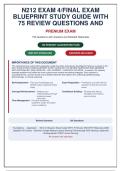
N212 EXAM 4/FINAL EXAM
BLUEPRINT STUDY GUIDE WITH
75 REVIEW QUESTIONS AND
PRENIUM EXAM
150 Questions with Answers and Detailed Rationales
100 PERCENT GUARANTEED PASS
INSTANT DOWNLOAD ANSWERS INCLUDED
IMPORTANCE OF THIS DOCUMENT
This comprehensive examination preparation guide has been meticulously developed to help you succeed in the
N212 EXAM 4/FINAL EXAM BLUEPRINT STUDY GUIDE WITH 75 REVIEW QUESTIONS AND ANSWERS
WITH RATIONALES | 2026 UPDATED | 100% CORRECT - EASTWICK COLLEGE.. It contains 150 carefully
selected questions that reflect the most current exam content and testing strategies. Each question is
accompanied by a correct answer and a detailed rationale that explains the underlying pathophysiology,
pharmacology, or clinical reasoning.
Self-Assessment – Test your knowledge and Exam Preparation – Familiarize yourself with the
identify areas requiring further question format and content
study areas
Concept Reinforcement – Deepen your Confidence Building – Develop test-taking
understanding through strategies and reduce
evidence-based exam anxiety
rationales
Time Management – Practice answering
questions under simulated
exam conditions
Review Summary 150 Questions
Foundations - Application - N212 4/ Blueprint Study Guide WITH 75 Review AND WITH Rationales 2026
Updated 100 Correct - Eastwick College Medical-surgical Nursing Pharmacology AND Nursing Leadership
Undergraduate YEAR 3 Junior Nursing
All answers with rationales
,Table of Contents
Content Area Questions Key Topics
Management OF CARE 1-25 Receiving, Finding, Pulmonary, Appropriate, Syndrome
Safety AND Infection Control 26-50 Acute, Appropriate, Heart Failure, Digoxin, Mechanism
Health Promotion AND 51-75 Acute, Requires, Serum, Caring, Finding
Maintenance
Psychosocial Integrity 76-100 Medication, Prescribed, Diabetes, Appropriate, Receiving
Basic CARE AND Comfort 101-125 Finding, Acute, Infusion, Prescribed, Laboratory
Pharmacological Therapies 126-150 Medication, Prescribed, Appropriate, Acute, Ventilation
TOTAL 150 All questions include answers and detailed rationales
,Section A - Management OF CARE
Q1.
A patient with septic shock has a pulmonary artery catheter in place. The cardiac output is
4.2 L/min, systemic vascular resistance is 700 dynes/sec/cm, and pulmonary artery wedge
pressure is 6 mm Hg. Which intervention is most appropriate?
A. Administer a fluid bolus of 500 mL B. Start norepinephrine infusion
crystalloid
C. Administer dobutamine infusion D. Prepare for intra-aortic balloon pump
placement
Correct: A - Administer a fluid bolus of 500 mL crystalloid
Rationale:The low wedge pressure (6 mm Hg) indicates hypovolemia; fluid resuscitation is
the priority. Norepinephrine would be used if SVR were low after volume repletion.
Dobutamine is for low cardiac output with adequate preload. IABP is not indicated in septic
shock.
Q2.
A patient on mechanical ventilation with ARDS has plateau pressure of 32 cm HO and
PaO/FiO ratio of 150. The provider orders a neuromuscular blocking agent. Which
parameter is most important to monitor during continuous infusion?
A. Train-of-four (TOF) response B. Serum potassium levels
C. Intracranial pressure D. Creatinine clearance
Correct: A - Train-of-four (TOF) response
Rationale:Continuous neuromuscular blockade requires monitoring TOF to prevent excessive
paralysis and ensure recovery. Potassium, ICP, and renal function are not directly affected by
NMBA infusion, though renal function may affect drug clearance.
Q3.
A patient receiving chemotherapy presents with tumor lysis syndrome. Which laboratory
finding is most indicative of this condition?
A. Hyperkalemia and hyperphosphatemia B. Hypocalcemia and hypokalemia
C. Hypernatremia and hypomagnesemia D. Hypophosphatemia and hypercalcemia
Correct: A - Hyperkalemia and hyperphosphatemia
Page 3
, Section A - Management OF CARE
Rationale: Tumor lysis syndrome releases intracellular potassium and phosphate, causing
hyperkalemia and hyperphosphatemia. Hypocalcemia occurs secondary to phosphate
binding, but hyperkalemia and hyperphosphatemia are hallmark. Other options do not match
the classic electrolyte derangements.
Q4.
A patient with liver cirrhosis and ascites is scheduled for a liver transplant. Which factor is
a contraindication to transplantation?
A. MELD score of 20 B. Active substance use disorder
C. Age over 65 D. Hepatocellular carcinoma within Milan
criteria
Correct: B - Active substance use disorder
Rationale:Active substance use is a contraindication due to risk of graft failure and
non-adherence. MELD score of 20 and age are not absolute contraindications. HCC within
Milan criteria is an indication for transplant.
Q5.
A nurse is caring for a patient with diabetic ketoacidosis. The arterial blood gas shows pH
7.30, PaCO 30 mm Hg, HCO 14 mEq/L. Which compensatory mechanism is most likely
occurring?
A. Renal retention of bicarbonate B. Increased respiratory rate with deep
breathing
C. Renal excretion of hydrogen ions D. Decreased metabolic acid production
Correct: B - Increased respiratory rate with deep breathing
Rationale:Metabolic acidosis (low pH and HCO ƒ {) triggers respiratory compensation via
Kussmaul respirations to blow off CO, as seen with PaCO 30. Renal compensation takes
hours to days, not immediate. Options A and C are renal compensations that occur later. D is
not a compensatory mechanism.
Q6.
A nurse manager is evaluating a nursing unit's performance on Patient Satisfaction
scores. Which quality improvement methodology focuses on reducing variation in
processes?
A. Root cause analysis B. Six Sigma
C. SWOT analysis D. Evidence-based practice
Correct: B - Six Sigma
Page 4
BLUEPRINT STUDY GUIDE WITH
75 REVIEW QUESTIONS AND
PRENIUM EXAM
150 Questions with Answers and Detailed Rationales
100 PERCENT GUARANTEED PASS
INSTANT DOWNLOAD ANSWERS INCLUDED
IMPORTANCE OF THIS DOCUMENT
This comprehensive examination preparation guide has been meticulously developed to help you succeed in the
N212 EXAM 4/FINAL EXAM BLUEPRINT STUDY GUIDE WITH 75 REVIEW QUESTIONS AND ANSWERS
WITH RATIONALES | 2026 UPDATED | 100% CORRECT - EASTWICK COLLEGE.. It contains 150 carefully
selected questions that reflect the most current exam content and testing strategies. Each question is
accompanied by a correct answer and a detailed rationale that explains the underlying pathophysiology,
pharmacology, or clinical reasoning.
Self-Assessment – Test your knowledge and Exam Preparation – Familiarize yourself with the
identify areas requiring further question format and content
study areas
Concept Reinforcement – Deepen your Confidence Building – Develop test-taking
understanding through strategies and reduce
evidence-based exam anxiety
rationales
Time Management – Practice answering
questions under simulated
exam conditions
Review Summary 150 Questions
Foundations - Application - N212 4/ Blueprint Study Guide WITH 75 Review AND WITH Rationales 2026
Updated 100 Correct - Eastwick College Medical-surgical Nursing Pharmacology AND Nursing Leadership
Undergraduate YEAR 3 Junior Nursing
All answers with rationales
,Table of Contents
Content Area Questions Key Topics
Management OF CARE 1-25 Receiving, Finding, Pulmonary, Appropriate, Syndrome
Safety AND Infection Control 26-50 Acute, Appropriate, Heart Failure, Digoxin, Mechanism
Health Promotion AND 51-75 Acute, Requires, Serum, Caring, Finding
Maintenance
Psychosocial Integrity 76-100 Medication, Prescribed, Diabetes, Appropriate, Receiving
Basic CARE AND Comfort 101-125 Finding, Acute, Infusion, Prescribed, Laboratory
Pharmacological Therapies 126-150 Medication, Prescribed, Appropriate, Acute, Ventilation
TOTAL 150 All questions include answers and detailed rationales
,Section A - Management OF CARE
Q1.
A patient with septic shock has a pulmonary artery catheter in place. The cardiac output is
4.2 L/min, systemic vascular resistance is 700 dynes/sec/cm, and pulmonary artery wedge
pressure is 6 mm Hg. Which intervention is most appropriate?
A. Administer a fluid bolus of 500 mL B. Start norepinephrine infusion
crystalloid
C. Administer dobutamine infusion D. Prepare for intra-aortic balloon pump
placement
Correct: A - Administer a fluid bolus of 500 mL crystalloid
Rationale:The low wedge pressure (6 mm Hg) indicates hypovolemia; fluid resuscitation is
the priority. Norepinephrine would be used if SVR were low after volume repletion.
Dobutamine is for low cardiac output with adequate preload. IABP is not indicated in septic
shock.
Q2.
A patient on mechanical ventilation with ARDS has plateau pressure of 32 cm HO and
PaO/FiO ratio of 150. The provider orders a neuromuscular blocking agent. Which
parameter is most important to monitor during continuous infusion?
A. Train-of-four (TOF) response B. Serum potassium levels
C. Intracranial pressure D. Creatinine clearance
Correct: A - Train-of-four (TOF) response
Rationale:Continuous neuromuscular blockade requires monitoring TOF to prevent excessive
paralysis and ensure recovery. Potassium, ICP, and renal function are not directly affected by
NMBA infusion, though renal function may affect drug clearance.
Q3.
A patient receiving chemotherapy presents with tumor lysis syndrome. Which laboratory
finding is most indicative of this condition?
A. Hyperkalemia and hyperphosphatemia B. Hypocalcemia and hypokalemia
C. Hypernatremia and hypomagnesemia D. Hypophosphatemia and hypercalcemia
Correct: A - Hyperkalemia and hyperphosphatemia
Page 3
, Section A - Management OF CARE
Rationale: Tumor lysis syndrome releases intracellular potassium and phosphate, causing
hyperkalemia and hyperphosphatemia. Hypocalcemia occurs secondary to phosphate
binding, but hyperkalemia and hyperphosphatemia are hallmark. Other options do not match
the classic electrolyte derangements.
Q4.
A patient with liver cirrhosis and ascites is scheduled for a liver transplant. Which factor is
a contraindication to transplantation?
A. MELD score of 20 B. Active substance use disorder
C. Age over 65 D. Hepatocellular carcinoma within Milan
criteria
Correct: B - Active substance use disorder
Rationale:Active substance use is a contraindication due to risk of graft failure and
non-adherence. MELD score of 20 and age are not absolute contraindications. HCC within
Milan criteria is an indication for transplant.
Q5.
A nurse is caring for a patient with diabetic ketoacidosis. The arterial blood gas shows pH
7.30, PaCO 30 mm Hg, HCO 14 mEq/L. Which compensatory mechanism is most likely
occurring?
A. Renal retention of bicarbonate B. Increased respiratory rate with deep
breathing
C. Renal excretion of hydrogen ions D. Decreased metabolic acid production
Correct: B - Increased respiratory rate with deep breathing
Rationale:Metabolic acidosis (low pH and HCO ƒ {) triggers respiratory compensation via
Kussmaul respirations to blow off CO, as seen with PaCO 30. Renal compensation takes
hours to days, not immediate. Options A and C are renal compensations that occur later. D is
not a compensatory mechanism.
Q6.
A nurse manager is evaluating a nursing unit's performance on Patient Satisfaction
scores. Which quality improvement methodology focuses on reducing variation in
processes?
A. Root cause analysis B. Six Sigma
C. SWOT analysis D. Evidence-based practice
Correct: B - Six Sigma
Page 4