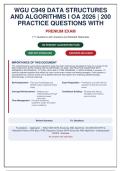
WGU C949 DATA STRUCTURES
AND ALGORITHMS I OA 2026 | 200
PRACTICE QUESTIONS WITH
PRENIUM EXAM
171 Questions with Answers and Detailed Rationales
100 PERCENT GUARANTEED PASS
INSTANT DOWNLOAD ANSWERS INCLUDED
IMPORTANCE OF THIS DOCUMENT
This comprehensive examination preparation guide has been meticulously developed to help you succeed in the
WGU C949 DATA STRUCTURES AND ALGORITHMS I OA 2026 | 200 PRACTICE QUESTIONS WITH
ANSWERS & RATIONALES | PYTHON, JAVA, BIG-O, TREE DIAGRAMS + 2 MOCK EXAMS. It contains 171
carefully selected questions that reflect the most current exam content and testing strategies. Each question is
accompanied by a correct answer and a detailed rationale that explains the underlying pathophysiology,
pharmacology, or clinical reasoning.
Self-Assessment – Test your knowledge and Exam Preparation – Familiarize yourself with the
identify areas requiring further question format and content
study areas
Concept Reinforcement – Deepen your Confidence Building – Develop test-taking
understanding through strategies and reduce
evidence-based exam anxiety
rationales
Time Management – Practice answering
questions under simulated
exam conditions
Review Summary 171 Questions
Foundations - Application - WGU C949 DATA Structures AND Algorithms I OA 2026 200 WITH &
Rationales Python JAVA Big-o TREE Diagrams 2 Exams DATA Structures AND Algorithms I Undergraduate
YEAR 3 / Graduate
All answers with rationales
,Table of Contents
Content Area Questions Key Topics
Algorithm Analysis AND 1-29 Complexity, Algorithm, Operation, Search, Array
Big-o Notation
Arrays AND Strings 30-58 Complexity, Search, Correctly, Algorithm, Table
Linked Lists 59-87 Complexity, Graph, Search, Worst-case, Algorithm
Stacks AND Queues 88-116 Algorithm, Binary, Complexity, Describes, Search
Trees AND TREE Traversals 117-145 Binary, Linked, Search, Algorithm, Complexity
Heaps AND Priority Queues 146-171 Complexity, Graph, Array, Correctly, Describes
TOTAL 171 All questions include answers and detailed rationales
,Section A - Algorithm Analysis AND Big-o Notation
Q1.
Given an array-based implementation of a queue that uses a circular buffer with a fixed
capacity N, the 'enqueue' operation checks for overflow by comparing the number of
elements to N. Which of the following modifications would allow the queue to grow
dynamically while preserving O(1) amortized time for both enqueue and dequeue, and
without wasting more than O(N) space at any point?
A. When full, allocate a new array of size B. When full, allocate a new array of size
2N, copy all elements in order, and reset 2N, copy the elements from head to tail, and
head to 0 and tail to N. set head to 0 and tail to the number of
elements.
C. Keep a linked list of fixed-size arrays and D. Use a dynamic array that resizes only
move elements between them as needed, when the queue is empty, so that no copying
maintaining a global head and tail. is ever needed during normal operations.
Correct: B - When full, allocate a new array of size 2N, copy the elements from head to tail,
and set head to 0 and tail to the number of elements.
Rationale:In a circular queue, when resizing, the elements must be copied from head to tail
into the new array, placing them contiguously starting at index 0. This preserves the logical
order and allows O(1) amortized operations. Option A incorrectly copies the entire underlying
array, including unused slots, and sets tail to N, which may misrepresent the number of
elements. Option C, while possible, is more complex and does not provide the same
simplicity or guarantee of O(1) amortized without careful implementation. Option D fails
because resizing only when empty would cause overflow during periods of high usage,
leading to O(N) enqueues.
Q2.
Which of the following statements about the Master Theorem is true when analyzing the
recurrence T(n) = 2T(n/2) + n log n?
A. The Master Theorem applies directly and B. The Master Theorem does not apply
yields T(n) = (n log n). because f(n) is not polynomial, but the
solution is (n log² n).
C. The Master Theorem applies directly and D. The Master Theorem does not apply, and
yields T(n) = (n log² n). the solution is (n²) due to the extra log
factor.
Correct: B - The Master Theorem does not apply because f(n) is not polynomial, but the
solution is (n log² n).
Page 3
, Section A - Algorithm Analysis AND Big-o Notation
Rationale: The Master Theorem requires f(n) to be polynomially comparable to n^(log_b a) =
n. Here, f(n) = n log n is not polynomially larger than n (it is larger by a factor of log n, which is
not n^ for any > 0), so the theorem does not apply. Using the recursion tree method (or the
extended Master Theorem), the solution is (n log² n). Option A is incorrect because the
Master Theorem cannot be applied directly. Option C incorrectly claims direct application.
Option D incorrectly estimates the growth as (n²).
Q3.
In a binary search tree (BST), a 'delete' operation is performed on a node with two
children. The standard algorithm replaces the node with its in-order successor. Which of
the following correctly describes the effect on the tree's structure and the complexity of
the operation?
A. The in-order successor is always the B. The in-order successor is always the
leftmost node in the right subtree, and rightmost node in the left subtree, and
deletion takes O(log n) time in the worst deletion takes O(log n) time on average but
case. O(n) in the worst case.
C. The in-order successor is the minimum D. The in-order successor is selected
node in the right subtree, and after deletion, randomly among the left and right subtrees,
the successor's right child must be and deletion takes O(1) time if the node is a
reattached, with overall time O(h) where h is leaf.
the tree height.
Correct: C - The in-order successor is the minimum node in the right subtree, and after
deletion, the successor's right child must be reattached, with overall time O(h) where h is
the tree height.
Rationale:In a BST, the in-order successor of a node with two children is the minimum node
in its right subtree. To delete, you replace the node's value with the successor's value, then
delete the successor (which has at most one child). The successor's right child must be
reattached to its parent. The time complexity is O(h), where h is the tree height, which is O(n)
in the worst case and O(log n) for balanced trees. Option A incorrectly states the successor is
always the leftmost node in the right subtree, which is true, but the complexity is O(h) not
O(log n) in the worst case. Option B incorrectly uses the rightmost node in the left subtree
(that's the predecessor). Option D is incorrect because the successor is deterministic, not
random, and the operation is not O(1) unless the node is a leaf.
Q4.
Consider a hash table with open addressing using linear probing. The table size is 10, and
the hash function is h(k) = k mod 10. The following keys are inserted in order: 15, 25, 35,
45, 55. What is the average number of probes required to search for a key that is present,
assuming all keys are equally likely?
A. 1.0 B. 3.0
Page 4
AND ALGORITHMS I OA 2026 | 200
PRACTICE QUESTIONS WITH
PRENIUM EXAM
171 Questions with Answers and Detailed Rationales
100 PERCENT GUARANTEED PASS
INSTANT DOWNLOAD ANSWERS INCLUDED
IMPORTANCE OF THIS DOCUMENT
This comprehensive examination preparation guide has been meticulously developed to help you succeed in the
WGU C949 DATA STRUCTURES AND ALGORITHMS I OA 2026 | 200 PRACTICE QUESTIONS WITH
ANSWERS & RATIONALES | PYTHON, JAVA, BIG-O, TREE DIAGRAMS + 2 MOCK EXAMS. It contains 171
carefully selected questions that reflect the most current exam content and testing strategies. Each question is
accompanied by a correct answer and a detailed rationale that explains the underlying pathophysiology,
pharmacology, or clinical reasoning.
Self-Assessment – Test your knowledge and Exam Preparation – Familiarize yourself with the
identify areas requiring further question format and content
study areas
Concept Reinforcement – Deepen your Confidence Building – Develop test-taking
understanding through strategies and reduce
evidence-based exam anxiety
rationales
Time Management – Practice answering
questions under simulated
exam conditions
Review Summary 171 Questions
Foundations - Application - WGU C949 DATA Structures AND Algorithms I OA 2026 200 WITH &
Rationales Python JAVA Big-o TREE Diagrams 2 Exams DATA Structures AND Algorithms I Undergraduate
YEAR 3 / Graduate
All answers with rationales
,Table of Contents
Content Area Questions Key Topics
Algorithm Analysis AND 1-29 Complexity, Algorithm, Operation, Search, Array
Big-o Notation
Arrays AND Strings 30-58 Complexity, Search, Correctly, Algorithm, Table
Linked Lists 59-87 Complexity, Graph, Search, Worst-case, Algorithm
Stacks AND Queues 88-116 Algorithm, Binary, Complexity, Describes, Search
Trees AND TREE Traversals 117-145 Binary, Linked, Search, Algorithm, Complexity
Heaps AND Priority Queues 146-171 Complexity, Graph, Array, Correctly, Describes
TOTAL 171 All questions include answers and detailed rationales
,Section A - Algorithm Analysis AND Big-o Notation
Q1.
Given an array-based implementation of a queue that uses a circular buffer with a fixed
capacity N, the 'enqueue' operation checks for overflow by comparing the number of
elements to N. Which of the following modifications would allow the queue to grow
dynamically while preserving O(1) amortized time for both enqueue and dequeue, and
without wasting more than O(N) space at any point?
A. When full, allocate a new array of size B. When full, allocate a new array of size
2N, copy all elements in order, and reset 2N, copy the elements from head to tail, and
head to 0 and tail to N. set head to 0 and tail to the number of
elements.
C. Keep a linked list of fixed-size arrays and D. Use a dynamic array that resizes only
move elements between them as needed, when the queue is empty, so that no copying
maintaining a global head and tail. is ever needed during normal operations.
Correct: B - When full, allocate a new array of size 2N, copy the elements from head to tail,
and set head to 0 and tail to the number of elements.
Rationale:In a circular queue, when resizing, the elements must be copied from head to tail
into the new array, placing them contiguously starting at index 0. This preserves the logical
order and allows O(1) amortized operations. Option A incorrectly copies the entire underlying
array, including unused slots, and sets tail to N, which may misrepresent the number of
elements. Option C, while possible, is more complex and does not provide the same
simplicity or guarantee of O(1) amortized without careful implementation. Option D fails
because resizing only when empty would cause overflow during periods of high usage,
leading to O(N) enqueues.
Q2.
Which of the following statements about the Master Theorem is true when analyzing the
recurrence T(n) = 2T(n/2) + n log n?
A. The Master Theorem applies directly and B. The Master Theorem does not apply
yields T(n) = (n log n). because f(n) is not polynomial, but the
solution is (n log² n).
C. The Master Theorem applies directly and D. The Master Theorem does not apply, and
yields T(n) = (n log² n). the solution is (n²) due to the extra log
factor.
Correct: B - The Master Theorem does not apply because f(n) is not polynomial, but the
solution is (n log² n).
Page 3
, Section A - Algorithm Analysis AND Big-o Notation
Rationale: The Master Theorem requires f(n) to be polynomially comparable to n^(log_b a) =
n. Here, f(n) = n log n is not polynomially larger than n (it is larger by a factor of log n, which is
not n^ for any > 0), so the theorem does not apply. Using the recursion tree method (or the
extended Master Theorem), the solution is (n log² n). Option A is incorrect because the
Master Theorem cannot be applied directly. Option C incorrectly claims direct application.
Option D incorrectly estimates the growth as (n²).
Q3.
In a binary search tree (BST), a 'delete' operation is performed on a node with two
children. The standard algorithm replaces the node with its in-order successor. Which of
the following correctly describes the effect on the tree's structure and the complexity of
the operation?
A. The in-order successor is always the B. The in-order successor is always the
leftmost node in the right subtree, and rightmost node in the left subtree, and
deletion takes O(log n) time in the worst deletion takes O(log n) time on average but
case. O(n) in the worst case.
C. The in-order successor is the minimum D. The in-order successor is selected
node in the right subtree, and after deletion, randomly among the left and right subtrees,
the successor's right child must be and deletion takes O(1) time if the node is a
reattached, with overall time O(h) where h is leaf.
the tree height.
Correct: C - The in-order successor is the minimum node in the right subtree, and after
deletion, the successor's right child must be reattached, with overall time O(h) where h is
the tree height.
Rationale:In a BST, the in-order successor of a node with two children is the minimum node
in its right subtree. To delete, you replace the node's value with the successor's value, then
delete the successor (which has at most one child). The successor's right child must be
reattached to its parent. The time complexity is O(h), where h is the tree height, which is O(n)
in the worst case and O(log n) for balanced trees. Option A incorrectly states the successor is
always the leftmost node in the right subtree, which is true, but the complexity is O(h) not
O(log n) in the worst case. Option B incorrectly uses the rightmost node in the left subtree
(that's the predecessor). Option D is incorrect because the successor is deterministic, not
random, and the operation is not O(1) unless the node is a leaf.
Q4.
Consider a hash table with open addressing using linear probing. The table size is 10, and
the hash function is h(k) = k mod 10. The following keys are inserted in order: 15, 25, 35,
45, 55. What is the average number of probes required to search for a key that is present,
assuming all keys are equally likely?
A. 1.0 B. 3.0
Page 4