

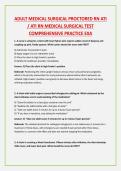
ADULT MEDICAL SURGICAL PROCTORED RN ATI
/ ATI RN MEDICAL SURGICAL TEST
COMPREHENSIVE PRACTICE EXA
1. A nurse is caring for a client with heart failure who reports sudden onset of dyspnea and
coughing up pink, frothy sputum. Which action should the nurse take FIRST?
A) Administer furosemide IV push
B) Apply oxygen via non-rebreather mask
C) Place the client in high-Fowler's position
D) Notify the healthcare provider immediately
Answer: C) Place the client in high-Fowler's position
Rationale: Positioning the client upright reduces venous return and pulmonary congestion,
which is the priority intervention for acute pulmonary edema before other treatments are
initiated. High-Fowler's position uses gravity to decrease blood return to the heart and lungs,
relieving respiratory distress .
2. A client with stable angina is prescribed nitroglycerin sublingual. Which statement by the
client indicates correct understanding of the medication?
A) "Store the tablets in a clear glass container near the sink"
B) "Swallow the tablet whole with a full glass of water"
C) "Take one tablet every 5 minutes for up to 3 doses if pain persists"
D) "If you have a headache, stop taking the medication"
Answer: C) "Take one tablet every 5 minutes for up to 3 doses if pain persists"
Rationale: The standard protocol for sublingual nitroglycerin is one tablet every 5 minutes for a
maximum of three doses, with emergency care needed if pain persists after three doses.
Headache is a common side effect and does not warrant stopping the medication .
3. A client is receiving a blood transfusion. Fifteen minutes after initiation, the client develops
chills, fever, and lower back pain. What should the nurse do FIRST?
,A) Administer acetaminophen
B) Notify the provider
C) Stop the transfusion
D) Slow the transfusion rate
Answer: C) Stop the transfusion
Rationale: These symptoms indicate a potential acute hemolytic transfusion reaction. The
priority action is to STOP the transfusion immediately, maintain IV access with normal saline,
and then notify the provider. The blood bag and tubing should be saved for investigation .
4. A client with atrial fibrillation is at highest risk for which complication?
A) Hemorrhagic stroke
B) Thromboembolic stroke
C) Myocardial infarction
D) Heart failure
Answer: B) Thromboembolic stroke
Rationale: Atrial fibrillation causes ineffective atrial contractions, leading to blood stasis in the
atria and potential clot formation. These clots can embolize to the brain, causing a stroke.
Anticoagulation therapy is typically prescribed to reduce this risk .
5. A nurse is assessing a client with left-sided heart failure. Which finding is most
characteristic?
A) Jugular venous distention
B) Peripheral edema
C) Crackles in the lungs
D) Hepatomegaly
Answer: C) Crackles in the lungs
Rationale: Left-sided heart failure results in pulmonary congestion due to backup of blood into
the pulmonary circulation, causing crackles (rales) on lung auscultation. JVD, peripheral edema,
and hepatomegaly are signs of right-sided heart failure .
,6. A nurse is caring for a client following a coronary artery bypass graft (CABG). Which
assessment finding requires immediate intervention?
A) Chest tube drainage of 50 mL/hr
B) Heart rate of 90 bpm
C) Sudden hypotension with jugular venous distention
D) Temperature of 37.5°C (99.5°F)
Answer: C) Sudden hypotension with jugular venous distention
Rationale: This presentation suggests cardiac tamponade, a life-threatening complication
following cardiac surgery. Blood or fluid accumulates in the pericardial space, compressing the
heart and reducing cardiac output. Immediate intervention is required .
7. Which symptom is a classic sign of digoxin toxicity?
A) Increased appetite
B) Hypertension
C) Tachycardia
D) Visual disturbances like yellow halos
Answer: D) Visual disturbances like yellow halos
Rationale: Digoxin toxicity manifests as nausea, vomiting, bradycardia, and visual changes
(yellow or green halos around lights) .
8. A client with peripheral arterial disease (PAD) reports pain while walking that stops with
rest. The nurse identifies this as:
A) Venous stasis
B) Neuropathy
C) Raynaud's phenomenon
D) Intermittent claudication
Answer: D) Intermittent claudication
Rationale: Intermittent claudication is ischemic muscle pain that occurs during exercise and is
relieved by rest, caused by inadequate arterial blood flow to the legs .
, 9. A client with peripheral arterial disease has a non-healing ulcer on the left great toe. Which
finding is expected?
A) Bilateral leg edema
B) Brownish discoloration around the ankles
C) Diminished or absent pedal pulses
D) Warm, erythematous lower extremities
Answer: C) Diminished or absent pedal pulses
Rationale: Peripheral arterial disease causes reduced arterial blood flow leading to diminished
or absent pulses, cool extremities, and pallor with elevation. Edema and brownish discoloration
are characteristic of venous insufficiency .
10. A nurse is providing teaching to a client with coronary artery disease. Which statement
indicates correct understanding?
A) "I can continue my current diet if I take my medications"
B) "I should exercise vigorously every day"
C) "Adopt a heart-healthy diet low in sodium and saturated fats"
D) "Smoking cessation is optional if you exercise regularly"
Answer: C) "Adopt a heart-healthy diet low in sodium and saturated fats"
Rationale: A heart-healthy diet, regular moderate exercise, smoking cessation, and medication
adherence are all essential for managing CAD. Diet modification is a foundational lifestyle
change that directly impacts cardiovascular health .
Respiratory Disorders
11. A nurse notes continuous bubbling in the water seal chamber of a chest tube. What does
this indicate?
A) The lung has fully re-expanded
B) The suction is set correctly
C) There is an air leak in the system
D) This is a normal finding
Answer: C) There is an air leak in the system
/ ATI RN MEDICAL SURGICAL TEST
COMPREHENSIVE PRACTICE EXA
1. A nurse is caring for a client with heart failure who reports sudden onset of dyspnea and
coughing up pink, frothy sputum. Which action should the nurse take FIRST?
A) Administer furosemide IV push
B) Apply oxygen via non-rebreather mask
C) Place the client in high-Fowler's position
D) Notify the healthcare provider immediately
Answer: C) Place the client in high-Fowler's position
Rationale: Positioning the client upright reduces venous return and pulmonary congestion,
which is the priority intervention for acute pulmonary edema before other treatments are
initiated. High-Fowler's position uses gravity to decrease blood return to the heart and lungs,
relieving respiratory distress .
2. A client with stable angina is prescribed nitroglycerin sublingual. Which statement by the
client indicates correct understanding of the medication?
A) "Store the tablets in a clear glass container near the sink"
B) "Swallow the tablet whole with a full glass of water"
C) "Take one tablet every 5 minutes for up to 3 doses if pain persists"
D) "If you have a headache, stop taking the medication"
Answer: C) "Take one tablet every 5 minutes for up to 3 doses if pain persists"
Rationale: The standard protocol for sublingual nitroglycerin is one tablet every 5 minutes for a
maximum of three doses, with emergency care needed if pain persists after three doses.
Headache is a common side effect and does not warrant stopping the medication .
3. A client is receiving a blood transfusion. Fifteen minutes after initiation, the client develops
chills, fever, and lower back pain. What should the nurse do FIRST?
,A) Administer acetaminophen
B) Notify the provider
C) Stop the transfusion
D) Slow the transfusion rate
Answer: C) Stop the transfusion
Rationale: These symptoms indicate a potential acute hemolytic transfusion reaction. The
priority action is to STOP the transfusion immediately, maintain IV access with normal saline,
and then notify the provider. The blood bag and tubing should be saved for investigation .
4. A client with atrial fibrillation is at highest risk for which complication?
A) Hemorrhagic stroke
B) Thromboembolic stroke
C) Myocardial infarction
D) Heart failure
Answer: B) Thromboembolic stroke
Rationale: Atrial fibrillation causes ineffective atrial contractions, leading to blood stasis in the
atria and potential clot formation. These clots can embolize to the brain, causing a stroke.
Anticoagulation therapy is typically prescribed to reduce this risk .
5. A nurse is assessing a client with left-sided heart failure. Which finding is most
characteristic?
A) Jugular venous distention
B) Peripheral edema
C) Crackles in the lungs
D) Hepatomegaly
Answer: C) Crackles in the lungs
Rationale: Left-sided heart failure results in pulmonary congestion due to backup of blood into
the pulmonary circulation, causing crackles (rales) on lung auscultation. JVD, peripheral edema,
and hepatomegaly are signs of right-sided heart failure .
,6. A nurse is caring for a client following a coronary artery bypass graft (CABG). Which
assessment finding requires immediate intervention?
A) Chest tube drainage of 50 mL/hr
B) Heart rate of 90 bpm
C) Sudden hypotension with jugular venous distention
D) Temperature of 37.5°C (99.5°F)
Answer: C) Sudden hypotension with jugular venous distention
Rationale: This presentation suggests cardiac tamponade, a life-threatening complication
following cardiac surgery. Blood or fluid accumulates in the pericardial space, compressing the
heart and reducing cardiac output. Immediate intervention is required .
7. Which symptom is a classic sign of digoxin toxicity?
A) Increased appetite
B) Hypertension
C) Tachycardia
D) Visual disturbances like yellow halos
Answer: D) Visual disturbances like yellow halos
Rationale: Digoxin toxicity manifests as nausea, vomiting, bradycardia, and visual changes
(yellow or green halos around lights) .
8. A client with peripheral arterial disease (PAD) reports pain while walking that stops with
rest. The nurse identifies this as:
A) Venous stasis
B) Neuropathy
C) Raynaud's phenomenon
D) Intermittent claudication
Answer: D) Intermittent claudication
Rationale: Intermittent claudication is ischemic muscle pain that occurs during exercise and is
relieved by rest, caused by inadequate arterial blood flow to the legs .
, 9. A client with peripheral arterial disease has a non-healing ulcer on the left great toe. Which
finding is expected?
A) Bilateral leg edema
B) Brownish discoloration around the ankles
C) Diminished or absent pedal pulses
D) Warm, erythematous lower extremities
Answer: C) Diminished or absent pedal pulses
Rationale: Peripheral arterial disease causes reduced arterial blood flow leading to diminished
or absent pulses, cool extremities, and pallor with elevation. Edema and brownish discoloration
are characteristic of venous insufficiency .
10. A nurse is providing teaching to a client with coronary artery disease. Which statement
indicates correct understanding?
A) "I can continue my current diet if I take my medications"
B) "I should exercise vigorously every day"
C) "Adopt a heart-healthy diet low in sodium and saturated fats"
D) "Smoking cessation is optional if you exercise regularly"
Answer: C) "Adopt a heart-healthy diet low in sodium and saturated fats"
Rationale: A heart-healthy diet, regular moderate exercise, smoking cessation, and medication
adherence are all essential for managing CAD. Diet modification is a foundational lifestyle
change that directly impacts cardiovascular health .
Respiratory Disorders
11. A nurse notes continuous bubbling in the water seal chamber of a chest tube. What does
this indicate?
A) The lung has fully re-expanded
B) The suction is set correctly
C) There is an air leak in the system
D) This is a normal finding
Answer: C) There is an air leak in the system


