
OB Drugs, RNC Test Questions with all Correct & 100% Verified
Answers |Actual Complete Update |Already Graded A+
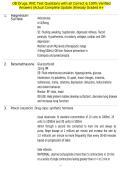
1. Magnesium
Sul-fate Anticonvulsa
nt 4/5mg
IM
SE: Flushing sweating, hypotension, depressed reflexes, flaccid
paralysis, hy-pothermia, circulatory collapse, cardiac and CNS
depression
Monitor serum Mg levels (therapeutic range
3-6mg/100mL) OB Use: Seizure prevention in
Eclampsia and preeclampsia
2. Betamethasone Glucocorticoid
12mg IM
SE: Fluid retention/accumulation, hyperglycemia, glucose
intolerance, hy-pokalemia, GI upset, mood changes, insomnia,
restlessness, mania, catatonia, depression, delusions, hallucinations
and violent behavior.
Monitor: BP vitals, mood
OB USE: Help preterm babies develop surfactant...decrease lung disease
and increase lung function
3. Pitocin (oxytocin) Drug class: synthetic hormone
Usual dose/route: IV standard concentration of 10 units to 1000ml, 20
units to 1000ml and 30 units in 500ml
Admin through a second line connected to main line and always by
pump. Begin dosage at 1 milliunit per minute and increase the rate by
1-2 milliunits per minute no more frequently than every 30-60 minutes
based on progression of labor.
Side ettects:
MATERNAL: uterine tachysystole (more than 5 contractions in 10 min
or a series of single contractions lasting greater than or = to 2 min or
,OB Drugs, RNC Test Questions with all Correct & 100% Verified
Answers |Actual Complete Update |Already Graded A+
contractions of normal duration occurring within 1 minute of each other),
placental abruptions, uterine rupture, unnecessary c section due to
abnormal FHR and patterns, postpartum hemorrhaging, and infection.
FETAL: hypoxemia and acidosis eventually resulting in abnormal FHR
and pat-terns.
, OB Drugs, RNC Test Questions with all Correct & 100% Verified
Answers |Actual Complete Update |Already Graded A+
Use in obstetrics: primarily used for labor induction and augmentation,
stimulate lactation, prevent hemorrhage post partum.
Patient teaching: explain reasons for usage, ettects of the drug (expect
contrac-tions, intensity and more frequent) monitoring to anticipate.
4. Cytotec (Miso- Drug class: Prostaglandin E1 (PGE1)
prostol)
Usual dose/route: 100 or 200 mcg tablet which is prepared in
pharmacy to ensure proper dosage. Initial dose is 25mcg inserted
transvaginally into the posterior of the vaginal fornix using the tips of
the index and middle fingers WITHOUT lubricant. Repeat every 3-6
hours up to 6 doses in a 24 hour period or until and ettective
contraction pattern is established, the cervix ripens (Bishop score of 8 or
more) or adverse reactions occur.
Side ettects: higer doses more likely to cause nausea vomiting,
diarrhea, fever, uterine tachysystole, with or withought an abnormal
FHR and patterns or fetal passage of meconium. The risk for adverse
reactions is reduced with lower doses at longer intervals between
doses.
5. Methergin Use in obstetrics: Used to ripen the cervix making it softer and causing it
e to begin to dilate and ettace, stimulating contractions.
(Methyler-
gonovine
maleate)
Patient teaching: : explain procedure to patient and family. Void before
insertion, must maintain a supine with lateral tilt or side lying position
for 30-40 minafter insertion.
Drug class: ADRENERGIC ANTAGONIST; ERGOT; OXYTOCIC
Usual dose/route: 0.2 mg IM every 2-4hours up to 5 doses may also be
given intrauterine or orally.
, OB Drugs, RNC Test Questions with all Correct & 100% Verified
Answers |Actual Complete Update |Already Graded A+
Side ettects:
hypertension, nausea,
vomiting, headache.
Answers |Actual Complete Update |Already Graded A+
1. Magnesium
Sul-fate Anticonvulsa
nt 4/5mg
IM
SE: Flushing sweating, hypotension, depressed reflexes, flaccid
paralysis, hy-pothermia, circulatory collapse, cardiac and CNS
depression
Monitor serum Mg levels (therapeutic range
3-6mg/100mL) OB Use: Seizure prevention in
Eclampsia and preeclampsia
2. Betamethasone Glucocorticoid
12mg IM
SE: Fluid retention/accumulation, hyperglycemia, glucose
intolerance, hy-pokalemia, GI upset, mood changes, insomnia,
restlessness, mania, catatonia, depression, delusions, hallucinations
and violent behavior.
Monitor: BP vitals, mood
OB USE: Help preterm babies develop surfactant...decrease lung disease
and increase lung function
3. Pitocin (oxytocin) Drug class: synthetic hormone
Usual dose/route: IV standard concentration of 10 units to 1000ml, 20
units to 1000ml and 30 units in 500ml
Admin through a second line connected to main line and always by
pump. Begin dosage at 1 milliunit per minute and increase the rate by
1-2 milliunits per minute no more frequently than every 30-60 minutes
based on progression of labor.
Side ettects:
MATERNAL: uterine tachysystole (more than 5 contractions in 10 min
or a series of single contractions lasting greater than or = to 2 min or
,OB Drugs, RNC Test Questions with all Correct & 100% Verified
Answers |Actual Complete Update |Already Graded A+
contractions of normal duration occurring within 1 minute of each other),
placental abruptions, uterine rupture, unnecessary c section due to
abnormal FHR and patterns, postpartum hemorrhaging, and infection.
FETAL: hypoxemia and acidosis eventually resulting in abnormal FHR
and pat-terns.
, OB Drugs, RNC Test Questions with all Correct & 100% Verified
Answers |Actual Complete Update |Already Graded A+
Use in obstetrics: primarily used for labor induction and augmentation,
stimulate lactation, prevent hemorrhage post partum.
Patient teaching: explain reasons for usage, ettects of the drug (expect
contrac-tions, intensity and more frequent) monitoring to anticipate.
4. Cytotec (Miso- Drug class: Prostaglandin E1 (PGE1)
prostol)
Usual dose/route: 100 or 200 mcg tablet which is prepared in
pharmacy to ensure proper dosage. Initial dose is 25mcg inserted
transvaginally into the posterior of the vaginal fornix using the tips of
the index and middle fingers WITHOUT lubricant. Repeat every 3-6
hours up to 6 doses in a 24 hour period or until and ettective
contraction pattern is established, the cervix ripens (Bishop score of 8 or
more) or adverse reactions occur.
Side ettects: higer doses more likely to cause nausea vomiting,
diarrhea, fever, uterine tachysystole, with or withought an abnormal
FHR and patterns or fetal passage of meconium. The risk for adverse
reactions is reduced with lower doses at longer intervals between
doses.
5. Methergin Use in obstetrics: Used to ripen the cervix making it softer and causing it
e to begin to dilate and ettace, stimulating contractions.
(Methyler-
gonovine
maleate)
Patient teaching: : explain procedure to patient and family. Void before
insertion, must maintain a supine with lateral tilt or side lying position
for 30-40 minafter insertion.
Drug class: ADRENERGIC ANTAGONIST; ERGOT; OXYTOCIC
Usual dose/route: 0.2 mg IM every 2-4hours up to 5 doses may also be
given intrauterine or orally.
, OB Drugs, RNC Test Questions with all Correct & 100% Verified
Answers |Actual Complete Update |Already Graded A+
Side ettects:
hypertension, nausea,
vomiting, headache.


