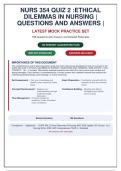
NURS 354 QUIZ 2 :ETHICAL
DILEMMAS IN NURSING |
QUESTIONS AND ANSWERS |
LATEST MOCK PRACTICE SET
188 Questions with Answers and Detailed Rationales
100 PERCENT GUARANTEED PASS
INSTANT DOWNLOAD ANSWERS INCLUDED
IMPORTANCE OF THIS DOCUMENT
This comprehensive examination preparation guide has been meticulously developed to help you succeed in the
NURS 354 QUIZ 2 :ETHICAL DILEMMAS IN NURSING | QUESTIONS AND ANSWERS | 2026 UPDATE | 100%
CORRECT - ULL.. It contains 188 carefully selected questions that reflect the most current exam content and
testing strategies. Each question is accompanied by a correct answer and a detailed rationale that explains the
underlying pathophysiology, pharmacology, or clinical reasoning.
Self-Assessment – Test your knowledge and Exam Preparation – Familiarize yourself with the
identify areas requiring further question format and content
study areas
Concept Reinforcement – Deepen your Confidence Building – Develop test-taking
understanding through strategies and reduce
evidence-based exam anxiety
rationales
Time Management – Practice answering
questions under simulated
exam conditions
Review Summary 188 Questions
Foundations - Application - NURS 354 2 Ethical Dilemmas IN Nursing AND 2026 Update 100 Correct - ULL
Nursing Ethics AND LAW Undergraduate YEAR 4 / Graduate
All answers with rationales
,Table of Contents
Content Area Questions Key Topics
Ethical Principles IN Nursing 1-32 Ethical, Patient S, Principle, Family, Caring
Moral Distress AND Ethical 33-64 Ethical, Principle, Nurse S, Consent, Treatment
Dilemmas
Advocacy AND Patient 65-96 Ethical, Nurse S, Principle, Patient S, Colleague
Rights
Informed Consent AND 97-128 Ethical, Patient S, Family, Nurse S, Caring
Decision-making
End-of-life CARE AND 129-160 Ethical, Patient S, Nurse S, Caring, Principle
Euthanasia
Confidentiality AND Privacy 161-188 Ethical, Nurse S, Patient S, Principle, Colleague
TOTAL 188 All questions include answers and detailed rationales
,Section A - Ethical Principles IN Nursing
Q1.
In a case where a patient's family demands aggressive life-sustaining treatment that the
interprofessional team deems futile, which ethical framework best supports the nurse's
responsibility to initiate a structured institutional ethics consultation?
A. Deontological principle of absolute B. Utilitarian calculation of greatest good for
respect for patient autonomy the greatest number
C. The moral distress mitigation framework D. The negotiated consensus model of
emphasizing nurse self-care shared decision-making
Correct: D - The negotiated consensus model of shared decision-making
Rationale:The negotiated consensus model emphasizes collaborative dialogue among all
stakeholders to resolve conflicts over futility, aligning with the nurse's role to facilitate ethics
consultation. Autonomy (A) is not absolute when treatment is futile. Utilitarianism (B) may
disregard individual rights. Moral distress mitigation (C) addresses nurse well-being but not
the immediate conflict resolution.
Q2.
A nurse is asked by a physician to withhold a terminal diagnosis from a competent adult
patient because the family believes it will cause harm. Which ethical principle most
directly obligates the nurse to disclose the diagnosis despite the physician's request?
A. Nonmaleficence, because disclosure may B. Veracity, because the patient has a right
cause psychological distress to truthful information
C. Fidelity, because the nurse must remain D. Justice, because all patients deserve
loyal to the physician's directive equal access to information
Correct: B - Veracity, because the patient has a right to truthful information
Rationale:Veracity is the ethical principle requiring truthfulness; it supports the patient's right
to know their diagnosis. Nonmaleficence (A) might argue against disclosure, but the duty to
tell the truth is fundamental. Fidelity (C) is to the patient, not the physician. Justice (D) is
about fairness, not truth-telling.
Q3.
A nurse working in an ICU experiences recurrent moral distress when providing
aggressive interventions to patients with poor prognoses. According to the American
Association of Critical-Care Nurses (AACN) The 4 A's to Rise Above Moral Distress, which
initial step should the nurse take to address this distress?
Page 3
, Section A - Ethical Principles IN Nursing
A. Ask: Reflect on the situation and B. Act: Implement an action plan to change
acknowledge personal distress the situation
C. Affirm: Commit to addressing the distress D. Assess: Evaluate the outcomes of the
and seek support action taken
Correct: A - Ask: Reflect on the situation and acknowledge personal distress
Rationale:The 4 A's (Ask, Affirm, Assess, Act) begin with 'Ask'—the nurse must recognize
and name the moral distress. Affirming (C) is the second step. Assessing (D) and Acting (B)
are later steps. Without first acknowledging the distress, subsequent actions are premature.
Q4.
A patient with decision-making capacity requests a treatment that the nurse believes is
not in the patient's best interest, but the physician agrees to provide it. Under the ethical
principle of respect for autonomy, what should the nurse do?
A. Refuse to participate in the treatment due B. Advocate for the patient's right to
to conscientious objection self-determination while documenting
concerns
C. Delegate the treatment to another nurse D. Attempt to persuade the patient to
to avoid personal conflict change their mind based on beneficence
Correct: B - Advocate for the patient's right to self-determination while documenting
concerns
Rationale:Respect for autonomy obligates the nurse to support the patient's right to make
their own health care decisions, even if the nurse disagrees. Conscientious objection (A) is
allowed only in specific circumstances and does not override autonomy. Delegation (C)
avoids the issue. Beneficence (D) should not override autonomy in a competent patient.
Q5.
Which of the following best distinguishes a 'values conflict' from an 'ethical dilemma' in
nursing practice?
A. Values conflicts involve personal beliefs, B. Ethical dilemmas are always resolved by
while ethical dilemmas involve conflicting law, while values conflicts are not
professional obligations
C. Values conflicts are subjective, while D. Ethical dilemmas involve two or more
ethical dilemmas are objective morally correct actions, while values
conflicts involve a conflict between personal
values and professional duties
Correct: D - Ethical dilemmas involve two or more morally correct actions, while values
conflicts involve a conflict between personal values and professional duties
Page 4
DILEMMAS IN NURSING |
QUESTIONS AND ANSWERS |
LATEST MOCK PRACTICE SET
188 Questions with Answers and Detailed Rationales
100 PERCENT GUARANTEED PASS
INSTANT DOWNLOAD ANSWERS INCLUDED
IMPORTANCE OF THIS DOCUMENT
This comprehensive examination preparation guide has been meticulously developed to help you succeed in the
NURS 354 QUIZ 2 :ETHICAL DILEMMAS IN NURSING | QUESTIONS AND ANSWERS | 2026 UPDATE | 100%
CORRECT - ULL.. It contains 188 carefully selected questions that reflect the most current exam content and
testing strategies. Each question is accompanied by a correct answer and a detailed rationale that explains the
underlying pathophysiology, pharmacology, or clinical reasoning.
Self-Assessment – Test your knowledge and Exam Preparation – Familiarize yourself with the
identify areas requiring further question format and content
study areas
Concept Reinforcement – Deepen your Confidence Building – Develop test-taking
understanding through strategies and reduce
evidence-based exam anxiety
rationales
Time Management – Practice answering
questions under simulated
exam conditions
Review Summary 188 Questions
Foundations - Application - NURS 354 2 Ethical Dilemmas IN Nursing AND 2026 Update 100 Correct - ULL
Nursing Ethics AND LAW Undergraduate YEAR 4 / Graduate
All answers with rationales
,Table of Contents
Content Area Questions Key Topics
Ethical Principles IN Nursing 1-32 Ethical, Patient S, Principle, Family, Caring
Moral Distress AND Ethical 33-64 Ethical, Principle, Nurse S, Consent, Treatment
Dilemmas
Advocacy AND Patient 65-96 Ethical, Nurse S, Principle, Patient S, Colleague
Rights
Informed Consent AND 97-128 Ethical, Patient S, Family, Nurse S, Caring
Decision-making
End-of-life CARE AND 129-160 Ethical, Patient S, Nurse S, Caring, Principle
Euthanasia
Confidentiality AND Privacy 161-188 Ethical, Nurse S, Patient S, Principle, Colleague
TOTAL 188 All questions include answers and detailed rationales
,Section A - Ethical Principles IN Nursing
Q1.
In a case where a patient's family demands aggressive life-sustaining treatment that the
interprofessional team deems futile, which ethical framework best supports the nurse's
responsibility to initiate a structured institutional ethics consultation?
A. Deontological principle of absolute B. Utilitarian calculation of greatest good for
respect for patient autonomy the greatest number
C. The moral distress mitigation framework D. The negotiated consensus model of
emphasizing nurse self-care shared decision-making
Correct: D - The negotiated consensus model of shared decision-making
Rationale:The negotiated consensus model emphasizes collaborative dialogue among all
stakeholders to resolve conflicts over futility, aligning with the nurse's role to facilitate ethics
consultation. Autonomy (A) is not absolute when treatment is futile. Utilitarianism (B) may
disregard individual rights. Moral distress mitigation (C) addresses nurse well-being but not
the immediate conflict resolution.
Q2.
A nurse is asked by a physician to withhold a terminal diagnosis from a competent adult
patient because the family believes it will cause harm. Which ethical principle most
directly obligates the nurse to disclose the diagnosis despite the physician's request?
A. Nonmaleficence, because disclosure may B. Veracity, because the patient has a right
cause psychological distress to truthful information
C. Fidelity, because the nurse must remain D. Justice, because all patients deserve
loyal to the physician's directive equal access to information
Correct: B - Veracity, because the patient has a right to truthful information
Rationale:Veracity is the ethical principle requiring truthfulness; it supports the patient's right
to know their diagnosis. Nonmaleficence (A) might argue against disclosure, but the duty to
tell the truth is fundamental. Fidelity (C) is to the patient, not the physician. Justice (D) is
about fairness, not truth-telling.
Q3.
A nurse working in an ICU experiences recurrent moral distress when providing
aggressive interventions to patients with poor prognoses. According to the American
Association of Critical-Care Nurses (AACN) The 4 A's to Rise Above Moral Distress, which
initial step should the nurse take to address this distress?
Page 3
, Section A - Ethical Principles IN Nursing
A. Ask: Reflect on the situation and B. Act: Implement an action plan to change
acknowledge personal distress the situation
C. Affirm: Commit to addressing the distress D. Assess: Evaluate the outcomes of the
and seek support action taken
Correct: A - Ask: Reflect on the situation and acknowledge personal distress
Rationale:The 4 A's (Ask, Affirm, Assess, Act) begin with 'Ask'—the nurse must recognize
and name the moral distress. Affirming (C) is the second step. Assessing (D) and Acting (B)
are later steps. Without first acknowledging the distress, subsequent actions are premature.
Q4.
A patient with decision-making capacity requests a treatment that the nurse believes is
not in the patient's best interest, but the physician agrees to provide it. Under the ethical
principle of respect for autonomy, what should the nurse do?
A. Refuse to participate in the treatment due B. Advocate for the patient's right to
to conscientious objection self-determination while documenting
concerns
C. Delegate the treatment to another nurse D. Attempt to persuade the patient to
to avoid personal conflict change their mind based on beneficence
Correct: B - Advocate for the patient's right to self-determination while documenting
concerns
Rationale:Respect for autonomy obligates the nurse to support the patient's right to make
their own health care decisions, even if the nurse disagrees. Conscientious objection (A) is
allowed only in specific circumstances and does not override autonomy. Delegation (C)
avoids the issue. Beneficence (D) should not override autonomy in a competent patient.
Q5.
Which of the following best distinguishes a 'values conflict' from an 'ethical dilemma' in
nursing practice?
A. Values conflicts involve personal beliefs, B. Ethical dilemmas are always resolved by
while ethical dilemmas involve conflicting law, while values conflicts are not
professional obligations
C. Values conflicts are subjective, while D. Ethical dilemmas involve two or more
ethical dilemmas are objective morally correct actions, while values
conflicts involve a conflict between personal
values and professional duties
Correct: D - Ethical dilemmas involve two or more morally correct actions, while values
conflicts involve a conflict between personal values and professional duties
Page 4