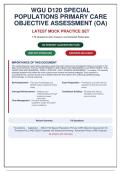
WGU D120 SPECIAL
POPULATIONS PRIMARY CARE
OBJECTIVE ASSESSMENT (OA)
LATEST MOCK PRACTICE SET
179 Questions with Answers and Detailed Rationales
100 PERCENT GUARANTEED PASS
INSTANT DOWNLOAD ANSWERS INCLUDED
IMPORTANCE OF THIS DOCUMENT
This comprehensive examination preparation guide has been meticulously developed to help you succeed in the
WGU D120 SPECIAL POPULATIONS PRIMARY CARE OBJECTIVE ASSESSMENT (OA) PROCTORED | FULL
QUESTIONS AND ANSWERS | 2026/27 UPDATED | 100% VERIFIED ASSESSMENT.. It contains 179 carefully
selected questions that reflect the most current exam content and testing strategies. Each question is
accompanied by a correct answer and a detailed rationale that explains the underlying pathophysiology,
pharmacology, or clinical reasoning.
Self-Assessment – Test your knowledge and Exam Preparation – Familiarize yourself with the
identify areas requiring further question format and content
study areas
Concept Reinforcement – Deepen your Confidence Building – Develop test-taking
understanding through strategies and reduce
evidence-based exam anxiety
rationales
Time Management – Practice answering
questions under simulated
exam conditions
Review Summary 179 Questions
Foundations - Application - WGU D120 Special Populations Primary CARE Objective Assessment OA
Proctored FULL AND 2026/27 Updated 100 Assessment Nursing / Advanced Primary CARE Graduate
All answers with rationales
,Table of Contents
Content Area Questions Key Topics
Health Promotion AND 1-30 Primary, History, Presents, Current, Health
Disease Prevention
Management OF Common 31-60 Appropriate, Disease, Chronic, Kidney, Screening
Acute AND Chronic
Conditions IN Special
Populations
Pediatric Primary CARE 61-90 Appropriate, Adult, Disease, Limited, Current
Adolescent Health 91-120 Disease, Appropriate, Reduce, Primary, Intervention
Women S Health AND 121-150 Appropriate, Disease, Presents, Primary CARE, Chronic
Pregnancy
Geriatric Primary CARE 151-179 Appropriate, Chronic, Disease, Kidney, Anemia
TOTAL 179 All questions include answers and detailed rationales
,Section A - Health Promotion AND Disease Prevention
Q1.
In a primary care setting, which physiological change in pregnancy most significantly
alters the pharmacokinetics of renally cleared medications, requiring dose adjustment?
A. Increased glomerular filtration rate and B. Decreased plasma albumin concentration
renal plasma flow
C. Increased hepatic blood flow and enzyme D. Expanded extracellular fluid volume
induction
Correct: A - Increased glomerular filtration rate and renal plasma flow
Rationale:During pregnancy, GFR increases by up to 50%, enhancing renal clearance of
drugs excreted unchanged. While albumin dilution and hepatic changes also occur, renal
clearance is the dominant factor for renally cleared drugs. Extracellular fluid volume affects
distribution, not clearance.
Q2.
A patient with a history of recurrent Clostridioides difficile infection (CDI) requires
antibiotic therapy for a urinary tract infection. Which agent is least likely to precipitate CDI
recurrence?
A. Ciprofloxacin B. Nitrofurantoin
C. Amoxicillin-clavulanate D. Cefpodoxime
Correct: B - Nitrofurantoin
Rationale:Nitrofurantoin has minimal impact on the colonic microbiome and is associated
with low CDI risk. Fluoroquinolones, beta-lactams, and cephalosporins are high-risk agents
that disrupt gut flora and promote C. difficile overgrowth.
Q3.
For a frail older adult with type 2 diabetes and chronic kidney disease (eGFR 35 mL/min),
which glycemic target is most appropriate to minimize hypoglycemia risk while achieving
reasonable control?
A. HbA1c < 6.5% B. HbA1c 7.0-7.5%
C. HbA1c 8.0-8.5% D. HbA1c < 7.0%
Correct: C - HbA1c 8.0-8.5%
Page 3
, Section A - Health Promotion AND Disease Prevention
Rationale: For older adults with frailty and CKD, higher HbA1c targets (8.0-8.5%) are
recommended to reduce hypoglycemia risk. Lower targets are reserved for healthier, younger
patients with long life expectancy. The 7.0-7.5% range is for those with moderate comorbidity.
Q4.
Which finding on a routine prenatal ultrasound at 20 weeks gestation most strongly
suggests a need for fetal echocardiography due to increased risk of congenital heart
disease?
A. Single umbilical artery B. Choroid plexus cyst
C. Echogenic intracardiac focus D. Mild pyelectasis
Correct: A - Single umbilical artery
Rationale:A single umbilical artery is associated with a higher incidence of congenital heart
defects, warranting fetal echocardiography. Choroid plexus cysts and echogenic intracardiac
foci are soft markers with weaker associations. Mild pyelectasis is a renal finding.
Q5.
A child presents with acute otitis media. Which factor most reliably predicts a poor
response to watchful waiting and supports immediate antibiotic prescription?
A. Age 18 months with unilateral otalgia B. Temperature 38.5°C and severe otalgia
for 48 hours
C. Bilateral otitis media in a 2-year-old D. Presence of middle ear effusion without
bulging
Correct: B - Temperature 38.5°C and severe otalgia for 48 hours
Rationale:Severe symptoms (high fever, severe otalgia) indicate a more severe infection
where antibiotics are recommended. Age under 6 months, severe illness, and certain
high-risk factors are indications. Bilateral otitis media in older children may be observed;
effusion without bulging is not acute otitis media.
Q6.
Which pharmacokinetic change in the elderly most contributes to an increased risk of
nephrotoxicity from aminoglycosides?
A. Reduced renal blood flow and GFR B. Decreased lean body mass
C. Increased body fat composition D. Reduced hepatic metabolism
Correct: A - Reduced renal blood flow and GFR
Page 4
POPULATIONS PRIMARY CARE
OBJECTIVE ASSESSMENT (OA)
LATEST MOCK PRACTICE SET
179 Questions with Answers and Detailed Rationales
100 PERCENT GUARANTEED PASS
INSTANT DOWNLOAD ANSWERS INCLUDED
IMPORTANCE OF THIS DOCUMENT
This comprehensive examination preparation guide has been meticulously developed to help you succeed in the
WGU D120 SPECIAL POPULATIONS PRIMARY CARE OBJECTIVE ASSESSMENT (OA) PROCTORED | FULL
QUESTIONS AND ANSWERS | 2026/27 UPDATED | 100% VERIFIED ASSESSMENT.. It contains 179 carefully
selected questions that reflect the most current exam content and testing strategies. Each question is
accompanied by a correct answer and a detailed rationale that explains the underlying pathophysiology,
pharmacology, or clinical reasoning.
Self-Assessment – Test your knowledge and Exam Preparation – Familiarize yourself with the
identify areas requiring further question format and content
study areas
Concept Reinforcement – Deepen your Confidence Building – Develop test-taking
understanding through strategies and reduce
evidence-based exam anxiety
rationales
Time Management – Practice answering
questions under simulated
exam conditions
Review Summary 179 Questions
Foundations - Application - WGU D120 Special Populations Primary CARE Objective Assessment OA
Proctored FULL AND 2026/27 Updated 100 Assessment Nursing / Advanced Primary CARE Graduate
All answers with rationales
,Table of Contents
Content Area Questions Key Topics
Health Promotion AND 1-30 Primary, History, Presents, Current, Health
Disease Prevention
Management OF Common 31-60 Appropriate, Disease, Chronic, Kidney, Screening
Acute AND Chronic
Conditions IN Special
Populations
Pediatric Primary CARE 61-90 Appropriate, Adult, Disease, Limited, Current
Adolescent Health 91-120 Disease, Appropriate, Reduce, Primary, Intervention
Women S Health AND 121-150 Appropriate, Disease, Presents, Primary CARE, Chronic
Pregnancy
Geriatric Primary CARE 151-179 Appropriate, Chronic, Disease, Kidney, Anemia
TOTAL 179 All questions include answers and detailed rationales
,Section A - Health Promotion AND Disease Prevention
Q1.
In a primary care setting, which physiological change in pregnancy most significantly
alters the pharmacokinetics of renally cleared medications, requiring dose adjustment?
A. Increased glomerular filtration rate and B. Decreased plasma albumin concentration
renal plasma flow
C. Increased hepatic blood flow and enzyme D. Expanded extracellular fluid volume
induction
Correct: A - Increased glomerular filtration rate and renal plasma flow
Rationale:During pregnancy, GFR increases by up to 50%, enhancing renal clearance of
drugs excreted unchanged. While albumin dilution and hepatic changes also occur, renal
clearance is the dominant factor for renally cleared drugs. Extracellular fluid volume affects
distribution, not clearance.
Q2.
A patient with a history of recurrent Clostridioides difficile infection (CDI) requires
antibiotic therapy for a urinary tract infection. Which agent is least likely to precipitate CDI
recurrence?
A. Ciprofloxacin B. Nitrofurantoin
C. Amoxicillin-clavulanate D. Cefpodoxime
Correct: B - Nitrofurantoin
Rationale:Nitrofurantoin has minimal impact on the colonic microbiome and is associated
with low CDI risk. Fluoroquinolones, beta-lactams, and cephalosporins are high-risk agents
that disrupt gut flora and promote C. difficile overgrowth.
Q3.
For a frail older adult with type 2 diabetes and chronic kidney disease (eGFR 35 mL/min),
which glycemic target is most appropriate to minimize hypoglycemia risk while achieving
reasonable control?
A. HbA1c < 6.5% B. HbA1c 7.0-7.5%
C. HbA1c 8.0-8.5% D. HbA1c < 7.0%
Correct: C - HbA1c 8.0-8.5%
Page 3
, Section A - Health Promotion AND Disease Prevention
Rationale: For older adults with frailty and CKD, higher HbA1c targets (8.0-8.5%) are
recommended to reduce hypoglycemia risk. Lower targets are reserved for healthier, younger
patients with long life expectancy. The 7.0-7.5% range is for those with moderate comorbidity.
Q4.
Which finding on a routine prenatal ultrasound at 20 weeks gestation most strongly
suggests a need for fetal echocardiography due to increased risk of congenital heart
disease?
A. Single umbilical artery B. Choroid plexus cyst
C. Echogenic intracardiac focus D. Mild pyelectasis
Correct: A - Single umbilical artery
Rationale:A single umbilical artery is associated with a higher incidence of congenital heart
defects, warranting fetal echocardiography. Choroid plexus cysts and echogenic intracardiac
foci are soft markers with weaker associations. Mild pyelectasis is a renal finding.
Q5.
A child presents with acute otitis media. Which factor most reliably predicts a poor
response to watchful waiting and supports immediate antibiotic prescription?
A. Age 18 months with unilateral otalgia B. Temperature 38.5°C and severe otalgia
for 48 hours
C. Bilateral otitis media in a 2-year-old D. Presence of middle ear effusion without
bulging
Correct: B - Temperature 38.5°C and severe otalgia for 48 hours
Rationale:Severe symptoms (high fever, severe otalgia) indicate a more severe infection
where antibiotics are recommended. Age under 6 months, severe illness, and certain
high-risk factors are indications. Bilateral otitis media in older children may be observed;
effusion without bulging is not acute otitis media.
Q6.
Which pharmacokinetic change in the elderly most contributes to an increased risk of
nephrotoxicity from aminoglycosides?
A. Reduced renal blood flow and GFR B. Decreased lean body mass
C. Increased body fat composition D. Reduced hepatic metabolism
Correct: A - Reduced renal blood flow and GFR
Page 4