
COMPLEX CR NR 341-Critical care exam 1
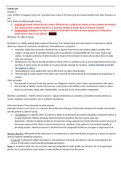
COMPLEX CR NR 341-Critical care exam 1 Critical care Chapter 3 Laws: EMTALA: Emergency room law - everyone who comes in ER room must be treated whether they have insurance or not. Torts: Doing something legally wrong Intentional: Assault (Verbal threats), battery (Physical harm, putting your hands on them without permission), false imprisonment (medical restraint is a necessity) (Haldol to sedate them is chemical restraint) Unintentional: Negligence (no harm to patient we just didn’t do what we were supposed to), Malpractice (when harm is done to the patient). ON TEST Dilemmas: No right or wrong Principlism is a widely applied ethical approach based on four fundamental moral principles to contemporary ethical dilemmas: respect for autonomy, beneficence, nonmaleficence, and justice. Autonomy states that all persons should be free to govern their lives to the greatest degree possible. This implies a strong sense of self-determination and an acceptance of responsibility for one's own choices and actions. To respect autonomy of others means to respect their freedom of choice and to allow them to make their own decisions. Beneficence is the duty to provide benefits to others when in a position to do so and to help balance harms and benefits. In other words, the benefits of an action should outweigh the burdens. Actions intended to benefit the patients or others. Nonmaleficence is the explicit duty not to inflict harm on others intentionally. The principle of justice requires that health care resources be distributed fairly and equitably among groups of people. Other principals The principle of veracity states that persons are obligated to tell the truth in their communication with others. The principle of fidelity requires that one has a moral duty to be faithful to the commitments made to others. These two principles, along with confidentiality, are the key to the nurse-patient relationship. Bioethics committees – Address ethical concerns. Typical membership of a bioethics committee includes physicians, nurses, chaplains, social workers, and, if available, bioethicists. Informed consent: Three elements must be present. Informed consent is not a form. It is a process that entails the exchange of information between the health care provider and the patient or patient's proxy. 1. Competence (or capacity) refers to a person's ability to understand information regarding a proposed medical or nursing treatment. Patients providing informed consent should be free from severe pain and depression. Critically ill patients usually do not have the mental capacity to provide informed consent because of the severe nature of their illness or their treatment (e.g., sedation). If the patient is not mentally capable of providing consent, informed consent is obtained from the designated healthcare surrogate or legal next of kin. Advance directive: Witnessed written document or oral statement in which instructions are given by a person to express desires related to healthcare decisions. Living will: A witnessed written document or oral statement voluntarily executed by a person that expresses the person's instructions concerning life-prolonging procedures. Proxy: A competent adult who has not been expressly designated to make health care decisions for an incapacitated person, but is authorized by state statute to make healthcare decisions for the person. Surrogate: A competent adult designated by a person to make health care decisions should that person become incapacitated. Life-prolonging procedure: Any medical procedure or treatment, including sustenance and hydration, that sustains, restores, or supplants a spontaneous vital function. Does not include the administration of medication or treatments deemed necessary to provide comfort care or to alleviate pain. In hospice AND (allow natural death) - don’t treat just about comfort y DNR in hospice (you do treat like antibiotics but if they code you do nothing) Extraordinary care includes complex, invasive, and experimental treatments such as resuscitation efforts by CPR or emergency cardiac care, maintenance of life support through invasive means, or renal dialysis. Experimental treatments such as gene therapy also are extraordinary therapies. Ordinary care usually involves common, noninvasive, to tested treatments such as providing nutrition, hydration, or antibiotic therapy. In the critical care setting the noninvasive criterion does not apply; ordinary care is defined as usual and customary for the patient's condition. Maintenance of hydration and nutrition through a tube feeding is an example of a treatment that falls somewhere between ordinary and extraordinary care and is a highly debatable issue. Therefore it is important fo
Document information
- Uploaded on
- July 5, 2021
- Number of pages
- 47
- Written in
- 2020/2021
- Type
- Exam (elaborations)
- Contains
- Questions & answers


