
COMPLEX CR NR 34-Critical care exam 2. Questions and Answers
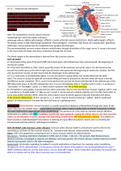
COMPLEX CR NR 34-Critical care exam 2. Questions and Answers h 12 – Cardiovascular alterations – TIP – THIS EXAM HAD A LOT OF DRUGS ON IT. LEARN DRUGS IN THIS CHAPTER AND THE SHOCK CHAPTER. VERY IMPORTANT TO UNDERSTAND WHICH DRUG DOES WHAT AND WHICH ONE YOU WOULD GIVE OPPOSED TO ANOTHER. ANA: The sympathetic nervous system releases norepinephrine, which has alpha- and betaadrenergic effects. Alpha-adrenergic effects cause arterial vasoconstriction. Beta-adrenergic effects increase sinus node discharge (positive chronotropic), increase the force of contraction (positive inotropic), and accelerate the AV conduction time (positive dromotropic). The parasympathetic nervous system releases acetylcholine through stimulation of the vagus nerve. It causes a decrease in the sinus node discharge and slows conduction through the AV node. The blood supply to the myocardium is derived from the coronary arteries NOT ON EXAM S1: best heard at the apex of the heart (fifth intercostal space, left midclavicular line) and represents the beginning of ventricular systole. S2: It has been described as “dub” and is caused by closure of the pulmonic and aortic valves. It is best heard at the second intercostal space at the left or right sternal border and represents the beginning of ventricular diastole. The first and second heart sounds are best heard with the diaphragm of the stethoscope. S3: S3 or ventricular or protodiastolic gallop, is a normal variant in young adults, but usually abnormal the older adult. The sound is caused by rapid left ventricular filling and may be produced at the time when the heart is already overfilled or poorly compliant. The S3 sound is low pitched and can best be heard with the bell of the stethoscope at the fifth intercostal space, at the left midclavicular line. It occurs immediately after S 2. Together with S1 and S2, S3 produces a “lub-dubba” or “ken-tuk'e” sound. S3 is often heard in patients with HF or fluid overload. S4: Presystolic or atrial gallop, is produced from atrial contraction that is more forceful than normal. Together with S 1 and S2, S4produces a “te-lubb-dubb” or “ten'-ne-see” sound. S4 can be normal in elderly patients, but it is often heard after an acute myocardial infarction (AMI), when the atria contract more forcefully against ventricles distended with blood. In the severely failing heart, all four sounds (S4, S1, S2, and S3) may be heard, producing a “gallop” rhythm (quadruple gallop), so named because it sounds like the hoof beats of a galloping horse. ON EXAM!!!! Heart Murmur: A heart murmur is a sound caused by turbulence of blood flow through the valves of the heart. Murmurs are audible when a septal defect is present; when a valve (usually aortic or mitral) is stenosed, or when the valve leaflets fail to approximate (valve insufficiency). The presence of a new murmur warrants special attention, particularly in a patient with AMI. A papillary muscle may have ruptured, causing the mitral valve to not close correctly, which can be indicative of severe damage and impending complications (HF and pulmonary edema). Auscultation of heart sounds is a skill developed from practice in listening to many different patients' hearts and in correlating the sounds heard with the patients' pathological conditions. NOT ON EXAM: CAD (Coronary artery disease): Coronary artery disease (CAD) is a broad term used to refer to the narrowing or occlusion of the coronary arteries (ie.. coronary heart disease, atherosclerotic heart disease) Patho: CAD is the progressive narrowing of one or more coronary arteries by atherosclerosis. Risk factors: Smoking, high blood cholesterol (200), LDL of (100), (40 men, 50 women), high blood pressure, physical inactivity, overweight or obesity, and diabetes, men have greater risk of heart disease, women have them earlier. Women have greater risk for CAD after menopause Assessment: Information regarding the patient's current medications is important. For example, when considering nitroglycerin (NTG) administration, it is necessary to know the history of the patient's use of phosphodiesterase type 5 (PDE5) inhibitors taken for erectile dysfunction, such as sildenafil (Viagra). These medications potentiate the hypotensive effects of nitrates such as NTG; thus concurrent use is contraindi
Document information
- Uploaded on
- July 5, 2021
- Number of pages
- 12
- Written in
- 2020/2021
- Type
- Exam (elaborations)
- Contains
- Questions & answers


