CHAPTER 8
Intelligence and Academic
Achievement
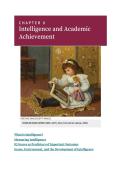
CHARLES HAIGH-WOOD (1856–1927), Story Time (oil on canvas, 1893)
What Is Intelligence?
Measuring Intelligence
IQ Scores as Predictors of Important Outcomes
Genes, Environment, and the Development of Intelligence
,Alternative Perspectives on Intelligence
Acquisition of Academic Skills: Reading, Writing, and Mathematics
THEMES
NATURE AND NURTURE
THE ACTIVE CHILD
CONTINUITY/DISCONTINUITY
MECHANISMS OF CHANGE
THE SOCIOCULTURAL CONTEXT
INDIVIDUAL DIFFERENCES
RESEARCH AND CHILDREN’S WELFARE
In 1904, the minister of education of France faced a problem. France,
like other western European and North American countries, had
recently introduced universal public education, and it was apparent
that some children were not learning well. Therefore, the minister
wanted a means of identifying children who would have difficulty
succeeding in standard classrooms, so that they could be given
special education. His problem was how to identify such children.
One obvious solution was to ask teachers to indicate which of their
students were encountering difficulty. However, the minister worried
that teachers’ assessments might be biased. In particular, he was
concerned that some teachers would be prejudiced against poor
children and would claim that those children were unable to learn,
even if they actually could. He therefore asked Alfred Binet, a French
psychologist who studied intelligence, to develop an easy-to-
,administer objective test of intelligence.
The prevailing view at the time was that intelligence is based on
simple skills, such as associating objects with the sounds they make
(e.g., ducks with quacking, bells with ringing), responding quickly to
stimuli, and recognizing whether two objects are identical or subtly
different. According to this view, children who are more adept than
their peers at such simple skills learn more quickly and thus become
more intelligent. The theory was plausible — but wrong. Differences
in simple skills among children proved only modestly related to
differences among them in broader, everyday indicators of
intelligence, such as school performance.
Binet’s theory differed from the prevailing wisdom of his time. He
believed that the key components of intelligence were high-level
abilities, such as problem solving, reasoning, and judgment, and he
maintained that intelligence tests should assess such abilities directly.
Therefore, on the test that he and his colleague Théophile Simon
devised — the Binet–Simon Intelligence Test — children were asked
(among other things) to interpret proverbs, solve puzzles, define
words, and sequence cartoon panels so that the jokes made sense.
Binet’s approach was successful in identifying children who would
have difficulty learning from classroom instruction; they were the
children who rarely could interpret the proverbs, solve the puzzles,
define the words, and so on. More generally, children’s performance
on the Binet–Simon Intelligence Test correlated highly not only with
, their school grades at the time of testing but also with their grades
years later. The test was also reasonably successful in meeting a goal
of intelligence testing that has been pursued ever since — to provide
an objective measure of scholastic aptitude that would allow fairer
decisions about children’s schooling, including which children
should be in honors classes and which need special education.
In addition to the practical impact of his test, Binet’s theoretical
approach to intelligence has continued to influence research on the
topic to this day. In most areas of cognitive development —
perception, language, conceptual understanding, and so forth — the
emphasis is on age-related changes: the ways in which younger
children differ from older ones. Following Binet’s lead, however,
research on intelligence has focused on individual differences — that is,
on how and why children of the same age differ from one another
and on the amount of continuity of such individual differences over
time.
Questions regarding the development of intelligence excite strong
passions, and for good reason. Research in this area raises many of
the most basic issues about human nature: the roles of heredity and
environment, the influence of ethnic and racial differences, the
effects of wealth and poverty, and the possibility of improvement.
Almost everyone has opinions, often heartfelt ones, about why some
people are more intelligent than others.
Intelligence research has added greatly to understanding all the
Intelligence and Academic
Achievement
CHARLES HAIGH-WOOD (1856–1927), Story Time (oil on canvas, 1893)
What Is Intelligence?
Measuring Intelligence
IQ Scores as Predictors of Important Outcomes
Genes, Environment, and the Development of Intelligence
,Alternative Perspectives on Intelligence
Acquisition of Academic Skills: Reading, Writing, and Mathematics
THEMES
NATURE AND NURTURE
THE ACTIVE CHILD
CONTINUITY/DISCONTINUITY
MECHANISMS OF CHANGE
THE SOCIOCULTURAL CONTEXT
INDIVIDUAL DIFFERENCES
RESEARCH AND CHILDREN’S WELFARE
In 1904, the minister of education of France faced a problem. France,
like other western European and North American countries, had
recently introduced universal public education, and it was apparent
that some children were not learning well. Therefore, the minister
wanted a means of identifying children who would have difficulty
succeeding in standard classrooms, so that they could be given
special education. His problem was how to identify such children.
One obvious solution was to ask teachers to indicate which of their
students were encountering difficulty. However, the minister worried
that teachers’ assessments might be biased. In particular, he was
concerned that some teachers would be prejudiced against poor
children and would claim that those children were unable to learn,
even if they actually could. He therefore asked Alfred Binet, a French
psychologist who studied intelligence, to develop an easy-to-
,administer objective test of intelligence.
The prevailing view at the time was that intelligence is based on
simple skills, such as associating objects with the sounds they make
(e.g., ducks with quacking, bells with ringing), responding quickly to
stimuli, and recognizing whether two objects are identical or subtly
different. According to this view, children who are more adept than
their peers at such simple skills learn more quickly and thus become
more intelligent. The theory was plausible — but wrong. Differences
in simple skills among children proved only modestly related to
differences among them in broader, everyday indicators of
intelligence, such as school performance.
Binet’s theory differed from the prevailing wisdom of his time. He
believed that the key components of intelligence were high-level
abilities, such as problem solving, reasoning, and judgment, and he
maintained that intelligence tests should assess such abilities directly.
Therefore, on the test that he and his colleague Théophile Simon
devised — the Binet–Simon Intelligence Test — children were asked
(among other things) to interpret proverbs, solve puzzles, define
words, and sequence cartoon panels so that the jokes made sense.
Binet’s approach was successful in identifying children who would
have difficulty learning from classroom instruction; they were the
children who rarely could interpret the proverbs, solve the puzzles,
define the words, and so on. More generally, children’s performance
on the Binet–Simon Intelligence Test correlated highly not only with
, their school grades at the time of testing but also with their grades
years later. The test was also reasonably successful in meeting a goal
of intelligence testing that has been pursued ever since — to provide
an objective measure of scholastic aptitude that would allow fairer
decisions about children’s schooling, including which children
should be in honors classes and which need special education.
In addition to the practical impact of his test, Binet’s theoretical
approach to intelligence has continued to influence research on the
topic to this day. In most areas of cognitive development —
perception, language, conceptual understanding, and so forth — the
emphasis is on age-related changes: the ways in which younger
children differ from older ones. Following Binet’s lead, however,
research on intelligence has focused on individual differences — that is,
on how and why children of the same age differ from one another
and on the amount of continuity of such individual differences over
time.
Questions regarding the development of intelligence excite strong
passions, and for good reason. Research in this area raises many of
the most basic issues about human nature: the roles of heredity and
environment, the influence of ethnic and racial differences, the
effects of wealth and poverty, and the possibility of improvement.
Almost everyone has opinions, often heartfelt ones, about why some
people are more intelligent than others.
Intelligence research has added greatly to understanding all the