CHAPTER 3
Biology and Behaviour
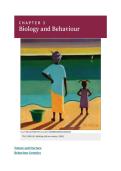
TILLY WILLIS, Waiting (oil on canvas, 2005)
Nature and Nurture
Behaviour Genetics
,Brain Development
The Body: Physical Growth and Development
THEMES
NATURE AND NURTURE
THE ACTIVE CHILD
CONTINUITY/DISCONTINUITY
MECHANISMS OF CHANGE
INDIVIDUAL DIFFERENCES
RESEARCH AND CHILDREN’S WELFARE
Dramatizations of twins separated at birth have fascinated us for
centuries, starting with Shakespeare’s masterpiece The Comedy of
Errors and continuing with modern films, such as Twins (1988), the
Parent Trap (in 1961 and again in 1998), and Three Identical Strangers
(2018). While in reality such situations are rare, they provide a
potentially invaluable opportunity to tease apart nature and nurture
by illustrating how the same genomes function in different
environments.
, When reunited at the age of 31, identical twins Gerald Levey and Mark Newman
discovered, among many other similarities, that they were both volunteer firemen
with droopy moustaches; long sideburns; and a penchant for hunting, fishing, and
John Wayne movies. They even drank the same brand of beer, from a can, which they
held with their pinkie tucked under the bottom and crushed when they had emptied
it.
The Minnesota Study of Twins Reared Apart was designed to do
exactly that (Bouchard et al., 1990). More than 100 pairs of twins
reared apart were brought to Minneapolis to undergo a battery of
tests. Among the identical twin pairs in this study, Gerald Levey and
Mark Newman (shown in the photo at right) were separated at birth
and reared separately in middle-class Jewish homes in the New York
area. The twins showed many striking similarities, both physical and
, behavioural, including a similar work history and their roles as
volunteer firemen. The Minnesota study’s team of investigators was
struck by the extent of the similarities they found in the separated
twins; they identified genetic contributions to “almost every
behavioral trait so far investigated from reaction time to religiosity”
(Bouchard et al., 1990).
Identical twins Mark and Scott Kelly have added a unique chapter to the twin studies
annals. Both are astronauts and Scott’s recent stay of nearly a year aboard the
International Space Station while his brother stayed on Earth has provided NASA
with the opportunity for a groundbreaking study of the effects of extended space
travel, including exposure to radiation, carbon monoxide, and the micro-gravity
environment.
Biology and Behaviour
TILLY WILLIS, Waiting (oil on canvas, 2005)
Nature and Nurture
Behaviour Genetics
,Brain Development
The Body: Physical Growth and Development
THEMES
NATURE AND NURTURE
THE ACTIVE CHILD
CONTINUITY/DISCONTINUITY
MECHANISMS OF CHANGE
INDIVIDUAL DIFFERENCES
RESEARCH AND CHILDREN’S WELFARE
Dramatizations of twins separated at birth have fascinated us for
centuries, starting with Shakespeare’s masterpiece The Comedy of
Errors and continuing with modern films, such as Twins (1988), the
Parent Trap (in 1961 and again in 1998), and Three Identical Strangers
(2018). While in reality such situations are rare, they provide a
potentially invaluable opportunity to tease apart nature and nurture
by illustrating how the same genomes function in different
environments.
, When reunited at the age of 31, identical twins Gerald Levey and Mark Newman
discovered, among many other similarities, that they were both volunteer firemen
with droopy moustaches; long sideburns; and a penchant for hunting, fishing, and
John Wayne movies. They even drank the same brand of beer, from a can, which they
held with their pinkie tucked under the bottom and crushed when they had emptied
it.
The Minnesota Study of Twins Reared Apart was designed to do
exactly that (Bouchard et al., 1990). More than 100 pairs of twins
reared apart were brought to Minneapolis to undergo a battery of
tests. Among the identical twin pairs in this study, Gerald Levey and
Mark Newman (shown in the photo at right) were separated at birth
and reared separately in middle-class Jewish homes in the New York
area. The twins showed many striking similarities, both physical and
, behavioural, including a similar work history and their roles as
volunteer firemen. The Minnesota study’s team of investigators was
struck by the extent of the similarities they found in the separated
twins; they identified genetic contributions to “almost every
behavioral trait so far investigated from reaction time to religiosity”
(Bouchard et al., 1990).
Identical twins Mark and Scott Kelly have added a unique chapter to the twin studies
annals. Both are astronauts and Scott’s recent stay of nearly a year aboard the
International Space Station while his brother stayed on Earth has provided NASA
with the opportunity for a groundbreaking study of the effects of extended space
travel, including exposure to radiation, carbon monoxide, and the micro-gravity
environment.