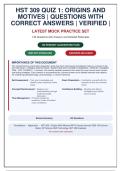
HST 309 QUIZ 1: ORIGINS AND
MOTIVES | QUESTIONS WITH
CORRECT ANSWERS | VERIFIED |
LATEST MOCK PRACTICE SET
140 Questions with Answers and Detailed Rationales
100 PERCENT GUARANTEED PASS
INSTANT DOWNLOAD ANSWERS INCLUDED
IMPORTANCE OF THIS DOCUMENT
This comprehensive examination preparation guide has been meticulously developed to help you succeed in the
HST 309 QUIZ 1: ORIGINS AND MOTIVES | QUESTIONS WITH CORRECT ANSWERS | VERIFIED | SUMMER
2026 | 100% CORRECT.. It contains 140 carefully selected questions that reflect the most current exam content
and testing strategies. Each question is accompanied by a correct answer and a detailed rationale that explains
the underlying pathophysiology, pharmacology, or clinical reasoning.
Self-Assessment – Test your knowledge and Exam Preparation – Familiarize yourself with the
identify areas requiring further question format and content
study areas
Concept Reinforcement – Deepen your Confidence Building – Develop test-taking
understanding through strategies and reduce
evidence-based exam anxiety
rationales
Time Management – Practice answering
questions under simulated
exam conditions
Review Summary 140 Questions
Foundations - Application - HST 309 1 Origins AND Motives WITH Correct Summer 2026 100 Correct
History OF Science AND Technology HST 309 Graduate
All answers with rationales
,Table of Contents
Content Area Questions Key Topics
Origins OF THE United 1-24 Historian, Context, Argues, Primarily, Driven
States Colonial Foundations
Motives FOR Exploration 25-48 Context, Motive, Economic, Factor, Explains
AND Settlement
Economic Motives 49-72 Historian, Revolution, Motives, European, Context
Mercantilism AND Trade
Religious Motives Puritanism 73-96 European, Historian, Concept, Explains, Factor
AND Religious Freedom
Political Motives Imperial 97-120 Science, Modern, Crusade, Historiography, Argues
Rivalries AND Governance
Social Motives 121-140 Context, Responsibility, Protect, Argues, Humanitarian
Demographics AND Class
Structures
TOTAL 140 All questions include answers and detailed rationales
,Section A - Origins OF THE United States Colonial
Foundations
Q1.
In the context of the 'origins' debate in the history of science, which of the following best
characterizes the shift from 'presentist' to 'contextualist' approaches?
A. A move from internalist accounts to B. A move from teleological narratives to
externalist accounts that emphasize social those that reconstruct past meanings and
and cultural factors. contingencies.
C. A move from biographical studies to D. A move from quantitative methods to
institutional analyses. qualitative ethnographic methods.
Correct: B - A move from teleological narratives to those that reconstruct past meanings
and contingencies.
Rationale:The key shift is from presentist (teleological) histories that see the past as leading
inevitably to the present, to contextualist histories that seek to understand the past on its own
terms, emphasizing contingency and the actors' categories. Internalist/externalist (A) is a
related but different distinction. Biographical vs. institutional (C) and quantitative vs.
qualitative (D) are methodological contrasts, not the central historiographical shift.
Q2.
A historian argues that the Scientific Revolution was primarily driven by the rise of a
'mechanical philosophy' that had its roots in artisan-engineer culture. This argument most
closely aligns with the work of which scholar?
A. Thomas Kuhn, for his paradigm-shift B. Frances Yates, for her emphasis on
theory. Hermeticism.
C. Edgar Zilsel, for his thesis on the 'origins D. Steven Shapin, for his 'gentlemanly'
of modern science'. interpretation.
Correct: C - Edgar Zilsel, for his thesis on the 'origins of modern science'.
Rationale:Edgar Zilsel's thesis specifically links the rise of modern science to the merging of
learned humanist scholars with artisan-engineers who had practical knowledge. Kuhn (A)
focuses on paradigm shifts, Yates (B) on esoteric traditions, and Shapin (D) on the social
status of gentlemen, none of which center on artisan culture as the primary driver.
Q3.
In the context of the 'motives' for early modern exploration, the Spanish 'Requerimiento'
(1513) is best understood as a document that:
Page 3
, Section A - Origins OF THE United States Colonial Foundations
A. Legally justified conquest by offering B. Established the encomienda system for
indigenous peoples the choice to convert the exploitation of native labor.
peacefully or face war.
C. Prohibited the enslavement of indigenous D. Granted the Spanish Crown exclusive
peoples under any circumstances. rights to navigation in the New World.
Correct: A - Legally justified conquest by offering indigenous peoples the choice to
convert peacefully or face war.
Rationale:The Requerimiento was a legal and religious justification for conquest, read to
indigenous peoples, offering them the option to accept Christianity and Spanish rule or be
subjected to war and enslavement. It did not establish the encomienda (B), which came later;
it did not prohibit enslavement (C), indeed it allowed it for resistance; and it was not a
navigation charter (D).
Q4.
Which of the following best describes the primary motive behind the establishment of the
Royal Society of London in 1660?
A. To provide a haven for royalist B. To promote a Baconian program of
intellectuals during the Interregnum. experimental philosophy for the
improvement of natural knowledge.
C. To serve as an official government body D. To preserve ancient Greek and Roman
for regulating scientific research and texts through systematic translation and
patents. commentary.
Correct: B - To promote a Baconian program of experimental philosophy for the
improvement of natural knowledge.
Rationale:The Royal Society was founded to promote the 'new science' based on
experimentation and empirical observation, following Francis Bacon's vision. It was not a
haven for royalists (A), as it included many parliamentarians; it was not a government
regulatory body (C); and it did not focus on classical texts (D), which was more characteristic
of humanist academies.
Q5.
A common thread in the motivations of both the 'Republic of Letters' and the early modern
'scientific academies' is:
A. A commitment to public funding of B. A focus on practical inventions and
research and universal education. technological patents.
C. An emphasis on collaborative, open D. A strict separation of scientific inquiry
communication and the pursuit of from religious and political authority.
knowledge as a collective enterprise.
Page 4
MOTIVES | QUESTIONS WITH
CORRECT ANSWERS | VERIFIED |
LATEST MOCK PRACTICE SET
140 Questions with Answers and Detailed Rationales
100 PERCENT GUARANTEED PASS
INSTANT DOWNLOAD ANSWERS INCLUDED
IMPORTANCE OF THIS DOCUMENT
This comprehensive examination preparation guide has been meticulously developed to help you succeed in the
HST 309 QUIZ 1: ORIGINS AND MOTIVES | QUESTIONS WITH CORRECT ANSWERS | VERIFIED | SUMMER
2026 | 100% CORRECT.. It contains 140 carefully selected questions that reflect the most current exam content
and testing strategies. Each question is accompanied by a correct answer and a detailed rationale that explains
the underlying pathophysiology, pharmacology, or clinical reasoning.
Self-Assessment – Test your knowledge and Exam Preparation – Familiarize yourself with the
identify areas requiring further question format and content
study areas
Concept Reinforcement – Deepen your Confidence Building – Develop test-taking
understanding through strategies and reduce
evidence-based exam anxiety
rationales
Time Management – Practice answering
questions under simulated
exam conditions
Review Summary 140 Questions
Foundations - Application - HST 309 1 Origins AND Motives WITH Correct Summer 2026 100 Correct
History OF Science AND Technology HST 309 Graduate
All answers with rationales
,Table of Contents
Content Area Questions Key Topics
Origins OF THE United 1-24 Historian, Context, Argues, Primarily, Driven
States Colonial Foundations
Motives FOR Exploration 25-48 Context, Motive, Economic, Factor, Explains
AND Settlement
Economic Motives 49-72 Historian, Revolution, Motives, European, Context
Mercantilism AND Trade
Religious Motives Puritanism 73-96 European, Historian, Concept, Explains, Factor
AND Religious Freedom
Political Motives Imperial 97-120 Science, Modern, Crusade, Historiography, Argues
Rivalries AND Governance
Social Motives 121-140 Context, Responsibility, Protect, Argues, Humanitarian
Demographics AND Class
Structures
TOTAL 140 All questions include answers and detailed rationales
,Section A - Origins OF THE United States Colonial
Foundations
Q1.
In the context of the 'origins' debate in the history of science, which of the following best
characterizes the shift from 'presentist' to 'contextualist' approaches?
A. A move from internalist accounts to B. A move from teleological narratives to
externalist accounts that emphasize social those that reconstruct past meanings and
and cultural factors. contingencies.
C. A move from biographical studies to D. A move from quantitative methods to
institutional analyses. qualitative ethnographic methods.
Correct: B - A move from teleological narratives to those that reconstruct past meanings
and contingencies.
Rationale:The key shift is from presentist (teleological) histories that see the past as leading
inevitably to the present, to contextualist histories that seek to understand the past on its own
terms, emphasizing contingency and the actors' categories. Internalist/externalist (A) is a
related but different distinction. Biographical vs. institutional (C) and quantitative vs.
qualitative (D) are methodological contrasts, not the central historiographical shift.
Q2.
A historian argues that the Scientific Revolution was primarily driven by the rise of a
'mechanical philosophy' that had its roots in artisan-engineer culture. This argument most
closely aligns with the work of which scholar?
A. Thomas Kuhn, for his paradigm-shift B. Frances Yates, for her emphasis on
theory. Hermeticism.
C. Edgar Zilsel, for his thesis on the 'origins D. Steven Shapin, for his 'gentlemanly'
of modern science'. interpretation.
Correct: C - Edgar Zilsel, for his thesis on the 'origins of modern science'.
Rationale:Edgar Zilsel's thesis specifically links the rise of modern science to the merging of
learned humanist scholars with artisan-engineers who had practical knowledge. Kuhn (A)
focuses on paradigm shifts, Yates (B) on esoteric traditions, and Shapin (D) on the social
status of gentlemen, none of which center on artisan culture as the primary driver.
Q3.
In the context of the 'motives' for early modern exploration, the Spanish 'Requerimiento'
(1513) is best understood as a document that:
Page 3
, Section A - Origins OF THE United States Colonial Foundations
A. Legally justified conquest by offering B. Established the encomienda system for
indigenous peoples the choice to convert the exploitation of native labor.
peacefully or face war.
C. Prohibited the enslavement of indigenous D. Granted the Spanish Crown exclusive
peoples under any circumstances. rights to navigation in the New World.
Correct: A - Legally justified conquest by offering indigenous peoples the choice to
convert peacefully or face war.
Rationale:The Requerimiento was a legal and religious justification for conquest, read to
indigenous peoples, offering them the option to accept Christianity and Spanish rule or be
subjected to war and enslavement. It did not establish the encomienda (B), which came later;
it did not prohibit enslavement (C), indeed it allowed it for resistance; and it was not a
navigation charter (D).
Q4.
Which of the following best describes the primary motive behind the establishment of the
Royal Society of London in 1660?
A. To provide a haven for royalist B. To promote a Baconian program of
intellectuals during the Interregnum. experimental philosophy for the
improvement of natural knowledge.
C. To serve as an official government body D. To preserve ancient Greek and Roman
for regulating scientific research and texts through systematic translation and
patents. commentary.
Correct: B - To promote a Baconian program of experimental philosophy for the
improvement of natural knowledge.
Rationale:The Royal Society was founded to promote the 'new science' based on
experimentation and empirical observation, following Francis Bacon's vision. It was not a
haven for royalists (A), as it included many parliamentarians; it was not a government
regulatory body (C); and it did not focus on classical texts (D), which was more characteristic
of humanist academies.
Q5.
A common thread in the motivations of both the 'Republic of Letters' and the early modern
'scientific academies' is:
A. A commitment to public funding of B. A focus on practical inventions and
research and universal education. technological patents.
C. An emphasis on collaborative, open D. A strict separation of scientific inquiry
communication and the pursuit of from religious and political authority.
knowledge as a collective enterprise.
Page 4