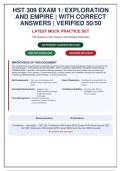
HST 309 EXAM 1: EXPLORATION
AND EMPIRE | WITH CORRECT
ANSWERS | VERIFIED 50/50
LATEST MOCK PRACTICE SET
130 Questions with Answers and Detailed Rationales
100 PERCENT GUARANTEED PASS
INSTANT DOWNLOAD ANSWERS INCLUDED
IMPORTANCE OF THIS DOCUMENT
This comprehensive examination preparation guide has been meticulously developed to help you succeed in the
HST 309 EXAM 1: EXPLORATION AND EMPIRE | WITH CORRECT ANSWERS | VERIFIED 50/50 SCORE |
SUMMER 2026. It contains 130 carefully selected questions that reflect the most current exam content and
testing strategies. Each question is accompanied by a correct answer and a detailed rationale that explains the
underlying pathophysiology, pharmacology, or clinical reasoning.
Self-Assessment – Test your knowledge and Exam Preparation – Familiarize yourself with the
identify areas requiring further question format and content
study areas
Concept Reinforcement – Deepen your Confidence Building – Develop test-taking
understanding through strategies and reduce
evidence-based exam anxiety
rationales
Time Management – Practice answering
questions under simulated
exam conditions
Review Summary 130 Questions
Foundations - Application - HST 309 1 Exploration AND Empire WITH Correct 50/50 Score Summer 2026
HST 309 1 Exploration AND Empire WITH Correct 50/50 Score Summer 2026 University
All answers with rationales
,Table of Contents
Content Area Questions Key Topics
European Exploration 1-22 Context, Atlantic, Spanish, Americas, Modern
Motives AND Technologies
Portuguese AND Spanish 23-44 British, Colonial, Explains, Directly, Century
Maritime Expansion
Conquest OF THE Aztec AND 45-66 British, Expansion, Century, Empire, Colonial
INCA Empires
Columbian Exchange AND 67-88 Spanish, Empire, Colonial, Century, European
ITS Global Impact
Spanish Colonial 89-110 British, Colonial, Spanish, India, Imperial
Administration AND Labor
Systems
French AND Dutch Colonial 111-130 Century, British, Spanish, Explains, India
Ventures IN North America
TOTAL 130 All questions include answers and detailed rationales
,Section A - European Exploration Motives AND
Technologies
Q1.
In the Iberian Atlantic, the transition from the encomienda to the repartimiento and later to
free wage labor is often interpreted as a linear progression toward modernity. Which
revisionist argument best challenges this narrative?
A. The repartimiento was a purely B. The shift reflected a deliberate strategy to
administrative reform that abolished maintain indigenous labor pools while
indigenous tribute. accommodating crown legalism and colonial
fiscal needs.
C. Free wage labor emerged organically D. The encomienda persisted unchanged in
from indigenous resistance, not from practice until the Bourbon reforms.
colonial policy.
Correct: B - The shift reflected a deliberate strategy to maintain indigenous labor pools
while accommodating crown legalism and colonial fiscal needs.
Rationale:Recent historiography argues that labor transitions were not linear but represented
pragmatic adaptations: the crown used repartimiento to control labor and extract surplus while
maintaining legal fictions of indigenous freedom, and free wage labor coexisted with coercive
forms. Option A misreads the repartimiento as purely administrative; C overstates indigenous
agency; D ignores documented shifts.
Q2.
A historian argues that the British and French Atlantic empires in the 18th century were
'complementary rivals' rather than competing systems. Which piece of evidence most
directly supports this interpretation?
A. British and French colonies had nearly B. Inter-imperial trade in slaves and
identical legal codes for slavery. provisions linked the economies of British
and French colonies despite warfare.
C. Both empires relied exclusively on the D. French and British navies cooperated to
same African slave-trading companies. suppress piracy.
Correct: B - Inter-imperial trade in slaves and provisions linked the economies of British
and French colonies despite warfare.
Rationale:Scholars like David Hancock and others have shown that British North American
colonies supplied food, lumber, and slaves to French Caribbean plantations, creating
economic interdependence that persisted even during wars. The other options are inaccurate:
legal codes differed significantly, trading companies were separate, and naval cooperation
was rare.
Page 3
, Section A - European Exploration Motives AND Technologies
Q3.
In the context of the Spanish conquest of the Americas, the 'Columbian Exchange' has
been reconceptualized by recent scholars as a site of 'ecological imperialism.' Which
statement best captures this modern reinterpretation?
A. The exchange was a symmetrical transfer B. European biota acted as invasive agents
of crops, animals, and diseases between that disrupted indigenous ecologies and
Old and New Worlds. facilitated colonial settlement.
C. The exchange primarily benefited D. The exchange was limited to biological
indigenous populations through the items and had no impact on social
introduction of new domesticates. structures.
Correct: B - European biota acted as invasive agents that disrupted indigenous ecologies
and facilitated colonial settlement.
Rationale:Alfred Crosby's concept of ecological imperialism emphasizes that European
plants, animals, and pathogens overwhelmed native ecosystems, creating environments
favorable to European settlers and undermining indigenous livelihoods. This is not a
symmetrical exchange (A), did not primarily benefit natives (C), and had profound social
effects (D).
Q4.
A researcher examines 17th-century English colonial charters and finds that they often
granted 'all lands from sea to sea.' How does this geographic language complicate the
legal fiction of terra nullius in English colonial ideology?
A. It shows that charters were based on B. It reveals that English claims were rooted
prior indigenous land sales. in the doctrine of discovery, which ignored
indigenous sovereignty by asserting a divine
mandate to spread Christianity.
C. It demonstrates that charters were purely D. It indicates that English claims were
symbolic and never used in legal disputes. limited to coastal areas and did not extend
inland.
Correct: B - It reveals that English claims were rooted in the doctrine of discovery, which
ignored indigenous sovereignty by asserting a divine mandate to spread Christianity.
Rationale:The 'sea to sea' clauses reflected the doctrine of discovery, which granted
European nations title to lands they had 'discovered,' regardless of indigenous presence. This
language was used to claim vast interior territories and to justify dispossession. The other
options are anachronistic or factually incorrect.
Q5.
In the historiography of the Portuguese Estado da Índia, the concept of 'carreira da Índia'
refers to the annual fleet voyage. Which analytical shift has recently transformed
Page 4
AND EMPIRE | WITH CORRECT
ANSWERS | VERIFIED 50/50
LATEST MOCK PRACTICE SET
130 Questions with Answers and Detailed Rationales
100 PERCENT GUARANTEED PASS
INSTANT DOWNLOAD ANSWERS INCLUDED
IMPORTANCE OF THIS DOCUMENT
This comprehensive examination preparation guide has been meticulously developed to help you succeed in the
HST 309 EXAM 1: EXPLORATION AND EMPIRE | WITH CORRECT ANSWERS | VERIFIED 50/50 SCORE |
SUMMER 2026. It contains 130 carefully selected questions that reflect the most current exam content and
testing strategies. Each question is accompanied by a correct answer and a detailed rationale that explains the
underlying pathophysiology, pharmacology, or clinical reasoning.
Self-Assessment – Test your knowledge and Exam Preparation – Familiarize yourself with the
identify areas requiring further question format and content
study areas
Concept Reinforcement – Deepen your Confidence Building – Develop test-taking
understanding through strategies and reduce
evidence-based exam anxiety
rationales
Time Management – Practice answering
questions under simulated
exam conditions
Review Summary 130 Questions
Foundations - Application - HST 309 1 Exploration AND Empire WITH Correct 50/50 Score Summer 2026
HST 309 1 Exploration AND Empire WITH Correct 50/50 Score Summer 2026 University
All answers with rationales
,Table of Contents
Content Area Questions Key Topics
European Exploration 1-22 Context, Atlantic, Spanish, Americas, Modern
Motives AND Technologies
Portuguese AND Spanish 23-44 British, Colonial, Explains, Directly, Century
Maritime Expansion
Conquest OF THE Aztec AND 45-66 British, Expansion, Century, Empire, Colonial
INCA Empires
Columbian Exchange AND 67-88 Spanish, Empire, Colonial, Century, European
ITS Global Impact
Spanish Colonial 89-110 British, Colonial, Spanish, India, Imperial
Administration AND Labor
Systems
French AND Dutch Colonial 111-130 Century, British, Spanish, Explains, India
Ventures IN North America
TOTAL 130 All questions include answers and detailed rationales
,Section A - European Exploration Motives AND
Technologies
Q1.
In the Iberian Atlantic, the transition from the encomienda to the repartimiento and later to
free wage labor is often interpreted as a linear progression toward modernity. Which
revisionist argument best challenges this narrative?
A. The repartimiento was a purely B. The shift reflected a deliberate strategy to
administrative reform that abolished maintain indigenous labor pools while
indigenous tribute. accommodating crown legalism and colonial
fiscal needs.
C. Free wage labor emerged organically D. The encomienda persisted unchanged in
from indigenous resistance, not from practice until the Bourbon reforms.
colonial policy.
Correct: B - The shift reflected a deliberate strategy to maintain indigenous labor pools
while accommodating crown legalism and colonial fiscal needs.
Rationale:Recent historiography argues that labor transitions were not linear but represented
pragmatic adaptations: the crown used repartimiento to control labor and extract surplus while
maintaining legal fictions of indigenous freedom, and free wage labor coexisted with coercive
forms. Option A misreads the repartimiento as purely administrative; C overstates indigenous
agency; D ignores documented shifts.
Q2.
A historian argues that the British and French Atlantic empires in the 18th century were
'complementary rivals' rather than competing systems. Which piece of evidence most
directly supports this interpretation?
A. British and French colonies had nearly B. Inter-imperial trade in slaves and
identical legal codes for slavery. provisions linked the economies of British
and French colonies despite warfare.
C. Both empires relied exclusively on the D. French and British navies cooperated to
same African slave-trading companies. suppress piracy.
Correct: B - Inter-imperial trade in slaves and provisions linked the economies of British
and French colonies despite warfare.
Rationale:Scholars like David Hancock and others have shown that British North American
colonies supplied food, lumber, and slaves to French Caribbean plantations, creating
economic interdependence that persisted even during wars. The other options are inaccurate:
legal codes differed significantly, trading companies were separate, and naval cooperation
was rare.
Page 3
, Section A - European Exploration Motives AND Technologies
Q3.
In the context of the Spanish conquest of the Americas, the 'Columbian Exchange' has
been reconceptualized by recent scholars as a site of 'ecological imperialism.' Which
statement best captures this modern reinterpretation?
A. The exchange was a symmetrical transfer B. European biota acted as invasive agents
of crops, animals, and diseases between that disrupted indigenous ecologies and
Old and New Worlds. facilitated colonial settlement.
C. The exchange primarily benefited D. The exchange was limited to biological
indigenous populations through the items and had no impact on social
introduction of new domesticates. structures.
Correct: B - European biota acted as invasive agents that disrupted indigenous ecologies
and facilitated colonial settlement.
Rationale:Alfred Crosby's concept of ecological imperialism emphasizes that European
plants, animals, and pathogens overwhelmed native ecosystems, creating environments
favorable to European settlers and undermining indigenous livelihoods. This is not a
symmetrical exchange (A), did not primarily benefit natives (C), and had profound social
effects (D).
Q4.
A researcher examines 17th-century English colonial charters and finds that they often
granted 'all lands from sea to sea.' How does this geographic language complicate the
legal fiction of terra nullius in English colonial ideology?
A. It shows that charters were based on B. It reveals that English claims were rooted
prior indigenous land sales. in the doctrine of discovery, which ignored
indigenous sovereignty by asserting a divine
mandate to spread Christianity.
C. It demonstrates that charters were purely D. It indicates that English claims were
symbolic and never used in legal disputes. limited to coastal areas and did not extend
inland.
Correct: B - It reveals that English claims were rooted in the doctrine of discovery, which
ignored indigenous sovereignty by asserting a divine mandate to spread Christianity.
Rationale:The 'sea to sea' clauses reflected the doctrine of discovery, which granted
European nations title to lands they had 'discovered,' regardless of indigenous presence. This
language was used to claim vast interior territories and to justify dispossession. The other
options are anachronistic or factually incorrect.
Q5.
In the historiography of the Portuguese Estado da Índia, the concept of 'carreira da Índia'
refers to the annual fleet voyage. Which analytical shift has recently transformed
Page 4