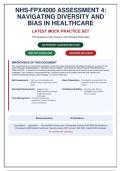
NHS-FPX4000 ASSESSMENT 4:
NAVIGATING DIVERSITY AND
BIAS IN HEALTHCARE
LATEST MOCK PRACTICE SET
150 Questions with Answers and Detailed Rationales
100 PERCENT GUARANTEED PASS
INSTANT DOWNLOAD ANSWERS INCLUDED
IMPORTANCE OF THIS DOCUMENT
This comprehensive examination preparation guide has been meticulously developed to help you succeed in the
NHS-FPX4000 ASSESSMENT 4: NAVIGATING DIVERSITY AND BIAS IN HEALTHCARE PROFESSIONS |
2026 UPDATE.. It contains 150 carefully selected questions that reflect the most current exam content and testing
strategies. Each question is accompanied by a correct answer and a detailed rationale that explains the
underlying pathophysiology, pharmacology, or clinical reasoning.
Self-Assessment – Test your knowledge and Exam Preparation – Familiarize yourself with the
identify areas requiring further question format and content
study areas
Concept Reinforcement – Deepen your Confidence Building – Develop test-taking
understanding through strategies and reduce
evidence-based exam anxiety
rationales
Time Management – Practice answering
questions under simulated
exam conditions
Review Summary 150 Questions
Foundations - Application - Nhs-fpx4000 Assessment 4 Navigating Diversity AND BIAS IN Healthcare
Professions 2026 Update Healthcare Diversity Equity AND Inclusion DEI AND Implicit BIAS Graduate
All answers with rationales
,Table of Contents
Content Area Questions Key Topics
Understanding Diversity AND 1-25 Health, Hospital, Disparities, Training, Implicit BIAS
Cultural Competence IN
Healthcare
Implicit BIAS AND ITS Impact 26-50 Health, Patients, Approach, Implicit BIAS, Address
ON Patient CARE
Strategies FOR Mitigating 51-75 Healthcare, Patients, Implicit, Training, Approach
BIAS IN Clinical
Decision-making
Health Disparities AND 76-100 Healthcare, Clinical, Likely, Reduce, Approach
Social Determinants OF
Health
Legal AND Ethical 101-125 Health, Clinical, Organization, Equity, Disparities
Considerations IN Diversity
AND BIAS
Communication AND 126-150 Healthcare, Approach, Patients, Disparities, Reduce
Interpersonal Skills Across
Cultures
TOTAL 150 All questions include answers and detailed rationales
,Section A - Understanding Diversity AND Cultural
Competence IN Healthcare
Q1.
A hospital system is designing a new implicit bias training program. Which approach is
most likely to produce sustained reduction in racial disparities in pain management?
A. One-time online module on unconscious B. Repeated, spaced training with
bias with pre- and post-test knowledge individualized feedback on prescribing
checks patterns and peer benchmarking
C. Annual diversity lecture featuring patient D. Mandatory training that emphasizes
testimonials and cultural sensitivity tips personal responsibility and moral reasoning
Correct: B - Repeated, spaced training with individualized feedback on prescribing
patterns and peer benchmarking
Rationale:Evidence shows that one-time training has minimal long-term impact. Sustained
change requires repeated, spaced practice, feedback on actual behavior, and benchmarking
against peers. This approach targets behavior change directly, addressing the gap between
awareness and practice.
Q2.
Which of the following best illustrates the difference between explicit and implicit bias in a
clinical encounter?
A. Explicit bias is conscious and deliberate, B. Explicit bias is more harmful than implicit
while implicit bias operates automatically bias because it is intentional.
and outside awareness.
C. Implicit bias is easier to measure through D. Explicit bias is biologically determined,
self-report than explicit bias. while implicit bias is socially constructed.
Correct: A - Explicit bias is conscious and deliberate, while implicit bias operates
automatically and outside awareness.
Rationale:Explicit bias is conscious and controllable, whereas implicit bias is automatic and
unconscious. This distinction is foundational to understanding how bias manifests in
healthcare. The other options mischaracterize the constructs or their measurement.
Q3.
A clinic is implementing the National Culturally and Linguistically Appropriate Services
(CLAS) Standards. Which action reflects the governance, leadership, and workforce
standard?
Page 3
, Section A - Understanding Diversity AND Cultural Competence IN Healthcare
A. Providing free language assistance B. Recruiting and retaining a diverse
services to patients with limited English workforce that mirrors the community served
proficiency
C. Conducting regular community health D. Offering cultural competence training to
needs assessments all staff annually
Correct: B - Recruiting and retaining a diverse workforce that mirrors the community
served
Rationale:The CLAS standards are organized into themes: governance, communication, and
engagement. The governance, leadership, and workforce standard specifically calls for a
diverse workforce and leadership that reflect the community. Language assistance falls under
communication, and community needs assessments fall under engagement.
Q4.
A quality improvement team observes that Black patients with chronic pain are less likely
to receive specialty referrals than White patients. To address this inequity using the
Institute for Healthcare Improvement (IHI) Triple Aim framework, which intervention is
most appropriate?
A. Standardize referral criteria across all B. Increase the number of specialty clinics in
patients to reduce clinician discretion low-income neighborhoods
C. Provide implicit bias training to all D. Implement a patient navigation program
providers and staff for Black patients with chronic pain
Correct: A - Standardize referral criteria across all patients to reduce clinician discretion
Rationale:Standardizing referral criteria reduces the influence of implicit bias on clinical
decision-making by limiting discretion. This directly targets the observed disparity. The other
options address access or awareness but do not directly reduce bias-driven variation in
referrals.
Q5.
Which of the following scenarios exemplifies the concept of 'structural racism' in
healthcare as opposed to individual-level discrimination?
A. A provider uses a different pain B. A hospital has a policy that requires
management protocol for a patient based on patients to have a fixed address to schedule
race appointments
C. A nurse makes a derogatory comment D. A white patient receives a faster triage
about a patient's accent than a Black patient with the same
presentation
Correct: B - A hospital has a policy that requires patients to have a fixed address to
schedule appointments
Page 4
NAVIGATING DIVERSITY AND
BIAS IN HEALTHCARE
LATEST MOCK PRACTICE SET
150 Questions with Answers and Detailed Rationales
100 PERCENT GUARANTEED PASS
INSTANT DOWNLOAD ANSWERS INCLUDED
IMPORTANCE OF THIS DOCUMENT
This comprehensive examination preparation guide has been meticulously developed to help you succeed in the
NHS-FPX4000 ASSESSMENT 4: NAVIGATING DIVERSITY AND BIAS IN HEALTHCARE PROFESSIONS |
2026 UPDATE.. It contains 150 carefully selected questions that reflect the most current exam content and testing
strategies. Each question is accompanied by a correct answer and a detailed rationale that explains the
underlying pathophysiology, pharmacology, or clinical reasoning.
Self-Assessment – Test your knowledge and Exam Preparation – Familiarize yourself with the
identify areas requiring further question format and content
study areas
Concept Reinforcement – Deepen your Confidence Building – Develop test-taking
understanding through strategies and reduce
evidence-based exam anxiety
rationales
Time Management – Practice answering
questions under simulated
exam conditions
Review Summary 150 Questions
Foundations - Application - Nhs-fpx4000 Assessment 4 Navigating Diversity AND BIAS IN Healthcare
Professions 2026 Update Healthcare Diversity Equity AND Inclusion DEI AND Implicit BIAS Graduate
All answers with rationales
,Table of Contents
Content Area Questions Key Topics
Understanding Diversity AND 1-25 Health, Hospital, Disparities, Training, Implicit BIAS
Cultural Competence IN
Healthcare
Implicit BIAS AND ITS Impact 26-50 Health, Patients, Approach, Implicit BIAS, Address
ON Patient CARE
Strategies FOR Mitigating 51-75 Healthcare, Patients, Implicit, Training, Approach
BIAS IN Clinical
Decision-making
Health Disparities AND 76-100 Healthcare, Clinical, Likely, Reduce, Approach
Social Determinants OF
Health
Legal AND Ethical 101-125 Health, Clinical, Organization, Equity, Disparities
Considerations IN Diversity
AND BIAS
Communication AND 126-150 Healthcare, Approach, Patients, Disparities, Reduce
Interpersonal Skills Across
Cultures
TOTAL 150 All questions include answers and detailed rationales
,Section A - Understanding Diversity AND Cultural
Competence IN Healthcare
Q1.
A hospital system is designing a new implicit bias training program. Which approach is
most likely to produce sustained reduction in racial disparities in pain management?
A. One-time online module on unconscious B. Repeated, spaced training with
bias with pre- and post-test knowledge individualized feedback on prescribing
checks patterns and peer benchmarking
C. Annual diversity lecture featuring patient D. Mandatory training that emphasizes
testimonials and cultural sensitivity tips personal responsibility and moral reasoning
Correct: B - Repeated, spaced training with individualized feedback on prescribing
patterns and peer benchmarking
Rationale:Evidence shows that one-time training has minimal long-term impact. Sustained
change requires repeated, spaced practice, feedback on actual behavior, and benchmarking
against peers. This approach targets behavior change directly, addressing the gap between
awareness and practice.
Q2.
Which of the following best illustrates the difference between explicit and implicit bias in a
clinical encounter?
A. Explicit bias is conscious and deliberate, B. Explicit bias is more harmful than implicit
while implicit bias operates automatically bias because it is intentional.
and outside awareness.
C. Implicit bias is easier to measure through D. Explicit bias is biologically determined,
self-report than explicit bias. while implicit bias is socially constructed.
Correct: A - Explicit bias is conscious and deliberate, while implicit bias operates
automatically and outside awareness.
Rationale:Explicit bias is conscious and controllable, whereas implicit bias is automatic and
unconscious. This distinction is foundational to understanding how bias manifests in
healthcare. The other options mischaracterize the constructs or their measurement.
Q3.
A clinic is implementing the National Culturally and Linguistically Appropriate Services
(CLAS) Standards. Which action reflects the governance, leadership, and workforce
standard?
Page 3
, Section A - Understanding Diversity AND Cultural Competence IN Healthcare
A. Providing free language assistance B. Recruiting and retaining a diverse
services to patients with limited English workforce that mirrors the community served
proficiency
C. Conducting regular community health D. Offering cultural competence training to
needs assessments all staff annually
Correct: B - Recruiting and retaining a diverse workforce that mirrors the community
served
Rationale:The CLAS standards are organized into themes: governance, communication, and
engagement. The governance, leadership, and workforce standard specifically calls for a
diverse workforce and leadership that reflect the community. Language assistance falls under
communication, and community needs assessments fall under engagement.
Q4.
A quality improvement team observes that Black patients with chronic pain are less likely
to receive specialty referrals than White patients. To address this inequity using the
Institute for Healthcare Improvement (IHI) Triple Aim framework, which intervention is
most appropriate?
A. Standardize referral criteria across all B. Increase the number of specialty clinics in
patients to reduce clinician discretion low-income neighborhoods
C. Provide implicit bias training to all D. Implement a patient navigation program
providers and staff for Black patients with chronic pain
Correct: A - Standardize referral criteria across all patients to reduce clinician discretion
Rationale:Standardizing referral criteria reduces the influence of implicit bias on clinical
decision-making by limiting discretion. This directly targets the observed disparity. The other
options address access or awareness but do not directly reduce bias-driven variation in
referrals.
Q5.
Which of the following scenarios exemplifies the concept of 'structural racism' in
healthcare as opposed to individual-level discrimination?
A. A provider uses a different pain B. A hospital has a policy that requires
management protocol for a patient based on patients to have a fixed address to schedule
race appointments
C. A nurse makes a derogatory comment D. A white patient receives a faster triage
about a patient's accent than a Black patient with the same
presentation
Correct: B - A hospital has a policy that requires patients to have a fixed address to
schedule appointments
Page 4