

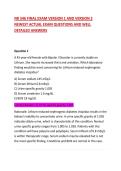
NR 546 FINAL EXAM VERSION 1 AND VERSION 2
NEWEST ACTUAL EXAM QUESTIONS AND WELL
DETAILED ANSWERS
Question 1
A 45-year-old female with Bipolar I Disorder is currently stable on
Lithium. She reports increased thirst and urination. Which laboratory
finding would be most concerning for Lithium-induced nephrogenic
diabetes insipidus?
A) Serum sodium 145 mEq/L
B) Serum lithium 0.8 mEq/L
C) Urine specific gravity 1.005
D) Serum creatinine 1.0 mg/dL
E) BUN 18 mg/dL
Correct Answer: C) Urine specific gravity 1.005
Rationale: Lithium-induced nephrogenic diabetes insipidus results in the
kidney's inability to concentrate urine. A urine specific gravity of 1.005
indicates dilute urine, which is characteristic of this condition. Normal
urine specific gravity ranges from 1.005 to 1.030. Patients with this
condition will have polyuria and polydipsia. Serum lithium of 0.8 mEq/L
is within therapeutic range. Serum sodium may be elevated but is not
the most specific finding. Creatinine and BUN are normal in this case.
,Question 2
Which of the following is the most appropriate initial treatment for a
patient experiencing acute mania with psychotic features?
A) Lithium monotherapy
B) Valproic acid monotherapy
C) Atypical antipsychotic monotherapy
D) SSRI combined with benzodiazepine
E) Lamotrigine monotherapy
Correct Answer: C) Atypical antipsychotic monotherapy
Rationale: For acute mania with psychotic features, atypical
antipsychotics such as olanzapine, risperidone, or quetiapine are
recommended as first-line treatment due to their rapid onset of action
and efficacy in treating both manic and psychotic symptoms. Lithium
and valproic acid are effective for mania but have slower onset. SSRIs
can worsen mania. Lamotrigine is more effective for bipolar depression
than acute mania.
Question 3
A 28-year-old patient with Bipolar II Disorder reports recurrent episodes
of hypomania and depression. Which medication is considered first-line
for maintenance treatment in this population?
A) Lithium
B) Lamotrigine
C) Carbamazepine
,D) Olanzapine
E) Fluoxetine
Correct Answer: B) Lamotrigine
Rationale: Lamotrigine is FDA-approved for maintenance treatment of
Bipolar I Disorder but is also commonly used in Bipolar II Disorder. It is
particularly effective at preventing depressive episodes. Lithium is first-
line for Bipolar I maintenance. Carbamazepine is a second-line agent.
Olanzapine is more appropriate for acute mania. Fluoxetine as
monotherapy would be inappropriate in bipolar disorder.
Question 4
What is the primary mechanism of action of Aripiprazole?
A) D2 receptor antagonist
B) D2 receptor partial agonist
C) 5-HT2A receptor antagonist
D) D2 receptor full agonist
E) 5-HT3 receptor antagonist
Correct Answer: B) D2 receptor partial agonist
Rationale: Aripiprazole is unique among atypical antipsychotics as a
partial agonist at D2 dopamine receptors. This mechanism allows it to
stabilize dopamine activity by acting as an agonist when dopamine
levels are low and as an antagonist when dopamine levels are high. This
property is associated with a lower risk of extrapyramidal symptoms
and hyperprolactinemia compared to full D2 antagonists.
, Question 5
Which of the following laboratory parameters should be monitored
regularly in a patient taking Quetiapine?
A) Serum lithium levels
B) Fasting blood glucose and lipid panel
C) Complete blood count only
D) Liver function tests only
E) Thyroid function tests
Correct Answer: B) Fasting blood glucose and lipid panel
Rationale: Quetiapine is associated with metabolic side effects including
weight gain, hyperglycemia, and dyslipidemia. Regular monitoring of
fasting blood glucose and lipid panels is essential. The American
Diabetes Association recommends baseline and periodic monitoring of
weight, BMI, fasting glucose, and lipid profile in patients on atypical
antipsychotics.
Question 6
A patient on Clozapine develops fever, tachycardia, and severe
constipation. Which potentially fatal adverse effect should be
suspected?
A) Neuroleptic malignant syndrome
B) Agranulocytosis
C) Paralytic ileus
D) Seizures
E) Myocarditis
NEWEST ACTUAL EXAM QUESTIONS AND WELL
DETAILED ANSWERS
Question 1
A 45-year-old female with Bipolar I Disorder is currently stable on
Lithium. She reports increased thirst and urination. Which laboratory
finding would be most concerning for Lithium-induced nephrogenic
diabetes insipidus?
A) Serum sodium 145 mEq/L
B) Serum lithium 0.8 mEq/L
C) Urine specific gravity 1.005
D) Serum creatinine 1.0 mg/dL
E) BUN 18 mg/dL
Correct Answer: C) Urine specific gravity 1.005
Rationale: Lithium-induced nephrogenic diabetes insipidus results in the
kidney's inability to concentrate urine. A urine specific gravity of 1.005
indicates dilute urine, which is characteristic of this condition. Normal
urine specific gravity ranges from 1.005 to 1.030. Patients with this
condition will have polyuria and polydipsia. Serum lithium of 0.8 mEq/L
is within therapeutic range. Serum sodium may be elevated but is not
the most specific finding. Creatinine and BUN are normal in this case.
,Question 2
Which of the following is the most appropriate initial treatment for a
patient experiencing acute mania with psychotic features?
A) Lithium monotherapy
B) Valproic acid monotherapy
C) Atypical antipsychotic monotherapy
D) SSRI combined with benzodiazepine
E) Lamotrigine monotherapy
Correct Answer: C) Atypical antipsychotic monotherapy
Rationale: For acute mania with psychotic features, atypical
antipsychotics such as olanzapine, risperidone, or quetiapine are
recommended as first-line treatment due to their rapid onset of action
and efficacy in treating both manic and psychotic symptoms. Lithium
and valproic acid are effective for mania but have slower onset. SSRIs
can worsen mania. Lamotrigine is more effective for bipolar depression
than acute mania.
Question 3
A 28-year-old patient with Bipolar II Disorder reports recurrent episodes
of hypomania and depression. Which medication is considered first-line
for maintenance treatment in this population?
A) Lithium
B) Lamotrigine
C) Carbamazepine
,D) Olanzapine
E) Fluoxetine
Correct Answer: B) Lamotrigine
Rationale: Lamotrigine is FDA-approved for maintenance treatment of
Bipolar I Disorder but is also commonly used in Bipolar II Disorder. It is
particularly effective at preventing depressive episodes. Lithium is first-
line for Bipolar I maintenance. Carbamazepine is a second-line agent.
Olanzapine is more appropriate for acute mania. Fluoxetine as
monotherapy would be inappropriate in bipolar disorder.
Question 4
What is the primary mechanism of action of Aripiprazole?
A) D2 receptor antagonist
B) D2 receptor partial agonist
C) 5-HT2A receptor antagonist
D) D2 receptor full agonist
E) 5-HT3 receptor antagonist
Correct Answer: B) D2 receptor partial agonist
Rationale: Aripiprazole is unique among atypical antipsychotics as a
partial agonist at D2 dopamine receptors. This mechanism allows it to
stabilize dopamine activity by acting as an agonist when dopamine
levels are low and as an antagonist when dopamine levels are high. This
property is associated with a lower risk of extrapyramidal symptoms
and hyperprolactinemia compared to full D2 antagonists.
, Question 5
Which of the following laboratory parameters should be monitored
regularly in a patient taking Quetiapine?
A) Serum lithium levels
B) Fasting blood glucose and lipid panel
C) Complete blood count only
D) Liver function tests only
E) Thyroid function tests
Correct Answer: B) Fasting blood glucose and lipid panel
Rationale: Quetiapine is associated with metabolic side effects including
weight gain, hyperglycemia, and dyslipidemia. Regular monitoring of
fasting blood glucose and lipid panels is essential. The American
Diabetes Association recommends baseline and periodic monitoring of
weight, BMI, fasting glucose, and lipid profile in patients on atypical
antipsychotics.
Question 6
A patient on Clozapine develops fever, tachycardia, and severe
constipation. Which potentially fatal adverse effect should be
suspected?
A) Neuroleptic malignant syndrome
B) Agranulocytosis
C) Paralytic ileus
D) Seizures
E) Myocarditis


