

Nurs 5463 Module 7 test
Study online at https://quizlet.com/_8ik8k5
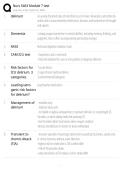
1. delirium an acutely disturbed state of mind that occurs in fever, intoxication, and other dis-
orders and is characterized by restlessness, illusions, and incoherence of thought
and speech.
2. Dementia a slowly progressive decline in mental abilities, including memory, thinking, and
judgment, that is often accompanied by personality changes
3. RASS Richmond Agitation Sedation Scale
4. CAM ICU test -4 questions and a command
-Only tool validated for use on vent patients to diagnose delirium
5. Risk factors for 1) acute illness
ICU delirium. 3 2) age/chronic health problems
categories 3) environmental/iatrogenic
6. Leading iatro- psychoactive medications
genic risk factors
for delirium?
7. Management of - mobilize early
delirium - improve sleep cycle
- no haldol or atypical antipsychotics to prevent dilirium, or is prolonged QT,
Torsades, or when taking meds that prolongs QT
-Use Precedex rather than benzos when require sedation
-Benzos and delirium in alcohol or benzo withdrawal
8. Transient Is- - transient episode of neurologic dysfunction caused by focal brain, spinal cord,
chemic Attack or retinal ischemia, without acute infarction
(TIA) -highest risk for stroke after a TIA is within 48hr
-15% of TIA precede stroke
-early intervention of TIA reduce risk for stroke-80%
, Nurs 5463 Module 7 test
Study online at https://quizlet.com/_8ik8k5
9. TIA common and common: atherosclerosis of large vessels, cardioembolism and a-fib
uncommon caus- uncommon: hypercoaguable states, aortic dissection, hyperlipidemia, smoking,
es. obesity and DM
10. ABCD2 Risk Strat- -used by clinicians to determine risk of stroke in the first 7 days following a TIA
ification Score -5 parameters: age, BP, clinical features, duration of TIA, DM
-Score range 0-7
11. Management of Use ABCD score to determine risk of CVA. If 3 or greater, should be admitted
TIA -Age (>60)
-Blood pressure (>140/90)
-Clinical symptoms
-Duration (>60 minutes)
-Diabetes
12. Treatment of TIA -tPA initiated if symptoms do not resolve and r/o bleed
-prophylactic antiplatelet therapy (if TIA is NOT caridogenic); ASA, ticlopidine
(ticlid), clopidogrel (Plavix), dipyridamole
-cardiogenic TIA requires anticoagulation
-IV heparin and then warfarin longterm
-carotid endarterectomy indicated in pts with ant circulation TIA and moder-
ate-to-high grade carotid stenosis (70-90%)
-control BP, (treat 220/120 or map >110) with CCB Nicardipine; mixed a1/b1,2
blocker Labetalol (it decreases PVR w/o significant decrease in HR or CO
-serum cholesterol, glucose, afib, stop smoking, avoid excessive alcohol, lose
weight
13. Modifiable risk *Hypertension-most significant
factors for stroke Hypercholesterolemia
Atherosclerosis
Atrial fibrillation
Obesity
Drugs and alcohol
, Nurs 5463 Module 7 test
Study online at https://quizlet.com/_8ik8k5
Diabetes, sickle cell anemia
TIA's
14. Non-modifiable a-fib
risk factors for heart failure
stroke cardiomyopathy
valve disorders
age,
gender,
race,
heredity
15. What is vision loss (1/2 of visual field) in one or both eyes
hemi-
anopia/hemi-
anopsia?
16. What is transient loss of vision in one eye 2nd to decreased bf in retinal circulation
monocular blind-
ness?
17. Aphasia impairment of language, usually caused by left hemisphere damage either to Bro-
ca's area (impairing speaking) or to Wernicke's area (impairing understanding).
18. What does the The internal carotid, middle anterior cerebral arteries supply blood to the frontal,
anterior cerebral parietal, temporal lobes, basal ganglia, thalamus, hypothalamus
circulation sup-
ply blood too?
19. What does the 2 vertebrobasilar artery supply mid and lower temporal and occipital lobes,
posterior cere- cerebellum, brainstem and part of diencephalon (thalamic)
bral circulation
Study online at https://quizlet.com/_8ik8k5
1. delirium an acutely disturbed state of mind that occurs in fever, intoxication, and other dis-
orders and is characterized by restlessness, illusions, and incoherence of thought
and speech.
2. Dementia a slowly progressive decline in mental abilities, including memory, thinking, and
judgment, that is often accompanied by personality changes
3. RASS Richmond Agitation Sedation Scale
4. CAM ICU test -4 questions and a command
-Only tool validated for use on vent patients to diagnose delirium
5. Risk factors for 1) acute illness
ICU delirium. 3 2) age/chronic health problems
categories 3) environmental/iatrogenic
6. Leading iatro- psychoactive medications
genic risk factors
for delirium?
7. Management of - mobilize early
delirium - improve sleep cycle
- no haldol or atypical antipsychotics to prevent dilirium, or is prolonged QT,
Torsades, or when taking meds that prolongs QT
-Use Precedex rather than benzos when require sedation
-Benzos and delirium in alcohol or benzo withdrawal
8. Transient Is- - transient episode of neurologic dysfunction caused by focal brain, spinal cord,
chemic Attack or retinal ischemia, without acute infarction
(TIA) -highest risk for stroke after a TIA is within 48hr
-15% of TIA precede stroke
-early intervention of TIA reduce risk for stroke-80%
, Nurs 5463 Module 7 test
Study online at https://quizlet.com/_8ik8k5
9. TIA common and common: atherosclerosis of large vessels, cardioembolism and a-fib
uncommon caus- uncommon: hypercoaguable states, aortic dissection, hyperlipidemia, smoking,
es. obesity and DM
10. ABCD2 Risk Strat- -used by clinicians to determine risk of stroke in the first 7 days following a TIA
ification Score -5 parameters: age, BP, clinical features, duration of TIA, DM
-Score range 0-7
11. Management of Use ABCD score to determine risk of CVA. If 3 or greater, should be admitted
TIA -Age (>60)
-Blood pressure (>140/90)
-Clinical symptoms
-Duration (>60 minutes)
-Diabetes
12. Treatment of TIA -tPA initiated if symptoms do not resolve and r/o bleed
-prophylactic antiplatelet therapy (if TIA is NOT caridogenic); ASA, ticlopidine
(ticlid), clopidogrel (Plavix), dipyridamole
-cardiogenic TIA requires anticoagulation
-IV heparin and then warfarin longterm
-carotid endarterectomy indicated in pts with ant circulation TIA and moder-
ate-to-high grade carotid stenosis (70-90%)
-control BP, (treat 220/120 or map >110) with CCB Nicardipine; mixed a1/b1,2
blocker Labetalol (it decreases PVR w/o significant decrease in HR or CO
-serum cholesterol, glucose, afib, stop smoking, avoid excessive alcohol, lose
weight
13. Modifiable risk *Hypertension-most significant
factors for stroke Hypercholesterolemia
Atherosclerosis
Atrial fibrillation
Obesity
Drugs and alcohol
, Nurs 5463 Module 7 test
Study online at https://quizlet.com/_8ik8k5
Diabetes, sickle cell anemia
TIA's
14. Non-modifiable a-fib
risk factors for heart failure
stroke cardiomyopathy
valve disorders
age,
gender,
race,
heredity
15. What is vision loss (1/2 of visual field) in one or both eyes
hemi-
anopia/hemi-
anopsia?
16. What is transient loss of vision in one eye 2nd to decreased bf in retinal circulation
monocular blind-
ness?
17. Aphasia impairment of language, usually caused by left hemisphere damage either to Bro-
ca's area (impairing speaking) or to Wernicke's area (impairing understanding).
18. What does the The internal carotid, middle anterior cerebral arteries supply blood to the frontal,
anterior cerebral parietal, temporal lobes, basal ganglia, thalamus, hypothalamus
circulation sup-
ply blood too?
19. What does the 2 vertebrobasilar artery supply mid and lower temporal and occipital lobes,
posterior cere- cerebellum, brainstem and part of diencephalon (thalamic)
bral circulation


