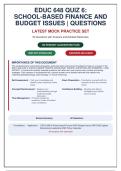
EDUC 648 QUIZ 6:
SCHOOL-BASED FINANCE AND
BUDGET ISSUES | QUESTIONS
LATEST MOCK PRACTICE SET
60 Questions with Answers and Detailed Rationales
100 PERCENT GUARANTEED PASS
INSTANT DOWNLOAD ANSWERS INCLUDED
IMPORTANCE OF THIS DOCUMENT
This comprehensive examination preparation guide has been meticulously developed to help you succeed in the
EDUC 648 QUIZ 6: SCHOOL-BASED FINANCE AND BUDGET ISSUES | QUESTIONS AND ANSWERS | | 2026
UPDATE.. It contains 60 carefully selected questions that reflect the most current exam content and testing
strategies. Each question is accompanied by a correct answer and a detailed rationale that explains the
underlying pathophysiology, pharmacology, or clinical reasoning.
Self-Assessment – Test your knowledge and Exam Preparation – Familiarize yourself with the
identify areas requiring further question format and content
study areas
Concept Reinforcement – Deepen your Confidence Building – Develop test-taking
understanding through strategies and reduce
evidence-based exam anxiety
rationales
Time Management – Practice answering
questions under simulated
exam conditions
Review Summary 60 Questions
Foundations - Application - EDUC 648 6 School-based Finance AND Budget Issues AND 2026 Update
Educational Leadership AND Policy Graduate
All answers with rationales
,Table of Contents
Content Area Questions Key Topics
Introduction TO School 1-10 School, District, Budget, Likely, Considering
Finance
Legal AND Regulatory 11-20 District, School, Funding, Budget, Considering
Frameworks
Budget Development AND 21-30 District, Likely, Budget, Considering, State
Planning
Revenue Sources AND 31-40 School, District, Funding, State, Fiscal
Allocation
Expenditure Management 41-50 District, School, Budget, Program, Funds
AND Control
Financial Reporting AND 51-60 District S, Balance, School, Unreserved FUND, Student
Accountability
TOTAL 60 All questions include answers and detailed rationales
, Section A - Introduction TO School Finance
Q1.
A school district is considering adopting a weighted student funding model. Which of the
following best describes a key advantage of this approach over traditional staffing-based
allocations?
A. It simplifies budgeting by allocating equal B. It directs resources to follow students
per-pupil amounts to all schools. based on their specific needs and
characteristics.
C. It ensures that all schools have identical D. It reduces the need for site-based budget
class sizes and staffing ratios. decision-making.
Correct: B - It directs resources to follow students based on their specific needs and
characteristics.
Rationale:Weighted student funding allocates dollars based on student characteristics (e.g.,
poverty, ELL status, special education), allowing resources to follow students to schools,
thereby addressing varied needs. It does not equalize per-pupil amounts (A) nor guarantee
identical class sizes (C). It actually promotes site-based flexibility (contrary to D).
Q2.
A school district is facing a budget shortfall. Which of the following strategies is most
likely to be considered a 'one-time' budget solution rather than a structural fix?
A. Reducing the number of school days in B. Using fund balance reserves to cover
the academic calendar. recurring expenses.
C. Negotiating lower health insurance D. Implementing a hiring freeze for
premiums for staff. non-essential positions.
Correct: B - Using fund balance reserves to cover recurring expenses.
Rationale:Using one-time fund balance reserves to cover ongoing costs is a classic one-time
fix; it does not address the underlying structural deficit. Reducing days, negotiating premiums,
and hiring freezes are structural changes that alter ongoing expenditure patterns. (A, C, D)
are recurring adjustments.
Q3.
In the context of school finance, what does 'adequacy' refer to?
A. The equal distribution of funds across all B. The provision of sufficient resources to
school districts. enable all students to meet state academic
standards.
Page 3
SCHOOL-BASED FINANCE AND
BUDGET ISSUES | QUESTIONS
LATEST MOCK PRACTICE SET
60 Questions with Answers and Detailed Rationales
100 PERCENT GUARANTEED PASS
INSTANT DOWNLOAD ANSWERS INCLUDED
IMPORTANCE OF THIS DOCUMENT
This comprehensive examination preparation guide has been meticulously developed to help you succeed in the
EDUC 648 QUIZ 6: SCHOOL-BASED FINANCE AND BUDGET ISSUES | QUESTIONS AND ANSWERS | | 2026
UPDATE.. It contains 60 carefully selected questions that reflect the most current exam content and testing
strategies. Each question is accompanied by a correct answer and a detailed rationale that explains the
underlying pathophysiology, pharmacology, or clinical reasoning.
Self-Assessment – Test your knowledge and Exam Preparation – Familiarize yourself with the
identify areas requiring further question format and content
study areas
Concept Reinforcement – Deepen your Confidence Building – Develop test-taking
understanding through strategies and reduce
evidence-based exam anxiety
rationales
Time Management – Practice answering
questions under simulated
exam conditions
Review Summary 60 Questions
Foundations - Application - EDUC 648 6 School-based Finance AND Budget Issues AND 2026 Update
Educational Leadership AND Policy Graduate
All answers with rationales
,Table of Contents
Content Area Questions Key Topics
Introduction TO School 1-10 School, District, Budget, Likely, Considering
Finance
Legal AND Regulatory 11-20 District, School, Funding, Budget, Considering
Frameworks
Budget Development AND 21-30 District, Likely, Budget, Considering, State
Planning
Revenue Sources AND 31-40 School, District, Funding, State, Fiscal
Allocation
Expenditure Management 41-50 District, School, Budget, Program, Funds
AND Control
Financial Reporting AND 51-60 District S, Balance, School, Unreserved FUND, Student
Accountability
TOTAL 60 All questions include answers and detailed rationales
, Section A - Introduction TO School Finance
Q1.
A school district is considering adopting a weighted student funding model. Which of the
following best describes a key advantage of this approach over traditional staffing-based
allocations?
A. It simplifies budgeting by allocating equal B. It directs resources to follow students
per-pupil amounts to all schools. based on their specific needs and
characteristics.
C. It ensures that all schools have identical D. It reduces the need for site-based budget
class sizes and staffing ratios. decision-making.
Correct: B - It directs resources to follow students based on their specific needs and
characteristics.
Rationale:Weighted student funding allocates dollars based on student characteristics (e.g.,
poverty, ELL status, special education), allowing resources to follow students to schools,
thereby addressing varied needs. It does not equalize per-pupil amounts (A) nor guarantee
identical class sizes (C). It actually promotes site-based flexibility (contrary to D).
Q2.
A school district is facing a budget shortfall. Which of the following strategies is most
likely to be considered a 'one-time' budget solution rather than a structural fix?
A. Reducing the number of school days in B. Using fund balance reserves to cover
the academic calendar. recurring expenses.
C. Negotiating lower health insurance D. Implementing a hiring freeze for
premiums for staff. non-essential positions.
Correct: B - Using fund balance reserves to cover recurring expenses.
Rationale:Using one-time fund balance reserves to cover ongoing costs is a classic one-time
fix; it does not address the underlying structural deficit. Reducing days, negotiating premiums,
and hiring freezes are structural changes that alter ongoing expenditure patterns. (A, C, D)
are recurring adjustments.
Q3.
In the context of school finance, what does 'adequacy' refer to?
A. The equal distribution of funds across all B. The provision of sufficient resources to
school districts. enable all students to meet state academic
standards.
Page 3