

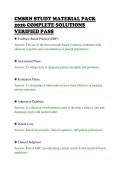
CMSRN STUDY MATERIAL PACK
2026 COMPLETE SOLUTIONS
VERIFIED PASS
◉ Evidence-Based Practice (EBP).
Answer: The use of the best research-based evidence combined with
clinician expertise and consideration of patient preferences.
◉ Assessment Phase.
Answer: To obtain data to diagnose patient strengths and problems.
◉ Evaluation Phase.
Answer: To determine if interventions have been effective in meeting
patient outcomes.
◉ Admission Database.
Answer: A collection of information used to develop a plan of care and
discharge goals with patient input.
◉ Patient Care.
Answer: Based on research, clinical expertise, and patient preferences.
◉ Clinical Judgment.
Answer: Part of EBP, incorporating current research and research-based
guidelines.
,◉ Patient Outcomes.
Answer: Results that are evaluated to determine the effectiveness of
nursing interventions.
◉ Hypovolemia.
Answer: A condition characterized by a deficiency in the amount of
blood volume in the body.
◉ Balanced Intake and Output.
Answer: Measurable data showing resolution of the problem of deficient
fluid volume.
◉ Patient Goals.
Answer: The desired outcomes that are established in the clinical
problem statement.
◉ Clinical Expertise.
Answer: The knowledge and skills acquired through experience in
patient care.
◉ Nursing Theory.
Answer: A framework that guides nursing practice and incorporates the
biopsychosocial nature of humans.
, ◉ Patient Concerns.
Answer: Issues that need to be assessed to choose appropriate
interventions.
◉ Interventions.
Answer: Actions taken by nurses to address patient health problems.
◉ Data Analysis.
Answer: The process of evaluating patient outcomes, though not
required to use EBP.
◉ Clinical Problem Statement.
Answer: Includes the problem, its causes, and the signs and symptoms of
the problem.
◉ Patient Preferences.
Answer: Considerations that should be included in the planning of
patient care.
◉ Research Evidence.
Answer: Credible studies that inform nursing practices, preferably
randomized controlled studies.
◉ Nursing Interventions.
2026 COMPLETE SOLUTIONS
VERIFIED PASS
◉ Evidence-Based Practice (EBP).
Answer: The use of the best research-based evidence combined with
clinician expertise and consideration of patient preferences.
◉ Assessment Phase.
Answer: To obtain data to diagnose patient strengths and problems.
◉ Evaluation Phase.
Answer: To determine if interventions have been effective in meeting
patient outcomes.
◉ Admission Database.
Answer: A collection of information used to develop a plan of care and
discharge goals with patient input.
◉ Patient Care.
Answer: Based on research, clinical expertise, and patient preferences.
◉ Clinical Judgment.
Answer: Part of EBP, incorporating current research and research-based
guidelines.
,◉ Patient Outcomes.
Answer: Results that are evaluated to determine the effectiveness of
nursing interventions.
◉ Hypovolemia.
Answer: A condition characterized by a deficiency in the amount of
blood volume in the body.
◉ Balanced Intake and Output.
Answer: Measurable data showing resolution of the problem of deficient
fluid volume.
◉ Patient Goals.
Answer: The desired outcomes that are established in the clinical
problem statement.
◉ Clinical Expertise.
Answer: The knowledge and skills acquired through experience in
patient care.
◉ Nursing Theory.
Answer: A framework that guides nursing practice and incorporates the
biopsychosocial nature of humans.
, ◉ Patient Concerns.
Answer: Issues that need to be assessed to choose appropriate
interventions.
◉ Interventions.
Answer: Actions taken by nurses to address patient health problems.
◉ Data Analysis.
Answer: The process of evaluating patient outcomes, though not
required to use EBP.
◉ Clinical Problem Statement.
Answer: Includes the problem, its causes, and the signs and symptoms of
the problem.
◉ Patient Preferences.
Answer: Considerations that should be included in the planning of
patient care.
◉ Research Evidence.
Answer: Credible studies that inform nursing practices, preferably
randomized controlled studies.
◉ Nursing Interventions.


