

Page 1 of 147
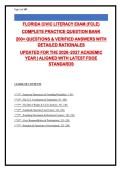
FLORIDA CIVIC LITERACY EXAM (FCLE)
COMPLETE PRACTICE QUESTION BANK
200+ QUESTIONS & VERIFIED ANSWERS WITH
DETAILED RATIONALES
UPDATED FOR THE 2026–2027 ACADEMIC
YEAR | ALIGNED WITH LATEST FDOE
STANDARDS
# TABLE OF CONTENTS
| **1** | American Democracy & Founding Principles | 1–50 |
| **2** | The U.S. Constitution & Federalism | 51–100 |
| **3** | The Bill of Rights & Civil Liberties | 101–140 |
| **4** | Landmark Supreme Court Cases | 141–180 |
| **5** | Founding Documents & Historical Context | 181–210 |
| **6** | Civic Responsibilities & Participation | 211–230 |
| **7** | Structure & Functions of Government | 231–250 |
,Page 2 of 147
# SECTION 1: AMERICAN DEMOCRACY & FOUNDING PRINCIPLES
## Questions 1–50
### Question 1
**What is the primary purpose of government in a democratic society according to the
Declaration of Independence?**
A) To establish a powerful central authority that controls all aspects of citizens' lives
B) To secure the unalienable rights of life, liberty, and the pursuit of happiness
C) To create a monarchy with inherited leadership
D) To eliminate all individual freedoms for the sake of national security
**Correct Answer: B**
**Rationale:** The Declaration of Independence explicitly states that governments are instituted
to secure the unalienable rights of life, liberty, and the pursuit of happiness. This foundational
principle establishes that government exists to protect individual rights rather than to control
citizens. Option A describes an authoritarian system, C describes a monarchy, and D contradicts
the fundamental purpose of protecting freedoms.
---
### Question 2
**Which concept is central to the idea of "republican form of government" as described in the
U.S. Constitution?**
A) Direct democracy where all citizens vote on every law
B) A system where representatives are elected to govern on behalf of the people
C) A government led by a hereditary monarch
,Page 3 of 147
D) A system with no elected officials
**Correct Answer: B**
**Rationale:** A republican form of government is one in which citizens elect representatives to
make decisions and govern on their behalf. This is distinct from direct democracy (A), monarchy
(C), or a system without elections (D). The Constitution guarantees every state a republican form
of government (Article IV, Section 4).
---
### Question 3
**The concept of "popular sovereignty" means that:**
A) The government has unlimited power over the people
B) The authority of the government is created and sustained by the consent of its people
C) Only wealthy citizens have the right to vote
D) The military should rule the nation
**Correct Answer: B**
**Rationale:** Popular sovereignty is the principle that the authority of a state and its
government is created and sustained by the consent of its people, through their elected
representatives. This is a cornerstone of American democracy. Options A, C, and D contradict
democratic principles.
---
### Question 4
, Page 4 of 147
**Which of the following best describes the social contract theory as articulated by John Locke
and reflected in the Declaration of Independence?**
A) Citizens must obey the government without question
B) Government exists to protect natural rights, and citizens consent to be governed in exchange
for protection of those rights
C) The government should own all property
D) Citizens have no rights unless granted by the government
**Correct Answer: B**
**Rationale:** Social contract theory holds that individuals consent to be governed in exchange
for the protection of their natural rights. If the government fails to protect these rights, the people
have the right to alter or abolish it. This philosophy heavily influenced the Declaration of
Independence. Options A, C, and D are inconsistent with social contract theory.
---
### Question 5
**What is the significance of the phrase "unalienable Rights" in the Declaration of
Independence?**
A) These rights can be taken away by the government at any time
B) These rights are inherent to all human beings and cannot be surrendered or transferred
C) These rights apply only to property owners
D) These rights must be earned through military service
**Correct Answer: B**
FLORIDA CIVIC LITERACY EXAM (FCLE)
COMPLETE PRACTICE QUESTION BANK
200+ QUESTIONS & VERIFIED ANSWERS WITH
DETAILED RATIONALES
UPDATED FOR THE 2026–2027 ACADEMIC
YEAR | ALIGNED WITH LATEST FDOE
STANDARDS
# TABLE OF CONTENTS
| **1** | American Democracy & Founding Principles | 1–50 |
| **2** | The U.S. Constitution & Federalism | 51–100 |
| **3** | The Bill of Rights & Civil Liberties | 101–140 |
| **4** | Landmark Supreme Court Cases | 141–180 |
| **5** | Founding Documents & Historical Context | 181–210 |
| **6** | Civic Responsibilities & Participation | 211–230 |
| **7** | Structure & Functions of Government | 231–250 |
,Page 2 of 147
# SECTION 1: AMERICAN DEMOCRACY & FOUNDING PRINCIPLES
## Questions 1–50
### Question 1
**What is the primary purpose of government in a democratic society according to the
Declaration of Independence?**
A) To establish a powerful central authority that controls all aspects of citizens' lives
B) To secure the unalienable rights of life, liberty, and the pursuit of happiness
C) To create a monarchy with inherited leadership
D) To eliminate all individual freedoms for the sake of national security
**Correct Answer: B**
**Rationale:** The Declaration of Independence explicitly states that governments are instituted
to secure the unalienable rights of life, liberty, and the pursuit of happiness. This foundational
principle establishes that government exists to protect individual rights rather than to control
citizens. Option A describes an authoritarian system, C describes a monarchy, and D contradicts
the fundamental purpose of protecting freedoms.
---
### Question 2
**Which concept is central to the idea of "republican form of government" as described in the
U.S. Constitution?**
A) Direct democracy where all citizens vote on every law
B) A system where representatives are elected to govern on behalf of the people
C) A government led by a hereditary monarch
,Page 3 of 147
D) A system with no elected officials
**Correct Answer: B**
**Rationale:** A republican form of government is one in which citizens elect representatives to
make decisions and govern on their behalf. This is distinct from direct democracy (A), monarchy
(C), or a system without elections (D). The Constitution guarantees every state a republican form
of government (Article IV, Section 4).
---
### Question 3
**The concept of "popular sovereignty" means that:**
A) The government has unlimited power over the people
B) The authority of the government is created and sustained by the consent of its people
C) Only wealthy citizens have the right to vote
D) The military should rule the nation
**Correct Answer: B**
**Rationale:** Popular sovereignty is the principle that the authority of a state and its
government is created and sustained by the consent of its people, through their elected
representatives. This is a cornerstone of American democracy. Options A, C, and D contradict
democratic principles.
---
### Question 4
, Page 4 of 147
**Which of the following best describes the social contract theory as articulated by John Locke
and reflected in the Declaration of Independence?**
A) Citizens must obey the government without question
B) Government exists to protect natural rights, and citizens consent to be governed in exchange
for protection of those rights
C) The government should own all property
D) Citizens have no rights unless granted by the government
**Correct Answer: B**
**Rationale:** Social contract theory holds that individuals consent to be governed in exchange
for the protection of their natural rights. If the government fails to protect these rights, the people
have the right to alter or abolish it. This philosophy heavily influenced the Declaration of
Independence. Options A, C, and D are inconsistent with social contract theory.
---
### Question 5
**What is the significance of the phrase "unalienable Rights" in the Declaration of
Independence?**
A) These rights can be taken away by the government at any time
B) These rights are inherent to all human beings and cannot be surrendered or transferred
C) These rights apply only to property owners
D) These rights must be earned through military service
**Correct Answer: B**


