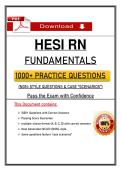
HESI RN
FUNDAMENTALS
1000+ PRACTICE QUESTIONS
(NGN-STYLE QUESTIONS & CASE “SCENARIOS”)
Pass the Exam with Confidence
This Document contains:
➢ 1000+ Questions with Correct Answers
➢ Passing Score Guarantee
➢ multiple-choice format (A, B, C, D) with correct answers
➢ Next Generation NCLEX (NGN)-style.
➢ Some questions feature “case scenarios”
, DIGITAL DOCUMENT PREVIEW
PREVIEW QUESTIONS BELOW
Get the Complete PDF After Purchase
If you require further clarification or in need of any study
resources, feel free to Message me.
,1. The physician orders hourly urine output measurement for a postoperative
client. The nurse records the following amounts of output for 2 consecutive
hours: 8 a.m.: 50 ml; 9 a.m.: 60 ml. Based on these amounts, which action
should the nurse take?
Correct Answer: Beyond continued evaluation, no nursing action is warranted.
Normal urine output for an adult is approximately 1 ml/minute (60 ml/hour).
Therefore, this client's output is normal. Beyond continued evaluation, no nursing
action is warranted.
2. A hospitalized client who has a living will is being fed through a nasogastric
(NG) tube. During a bolus feeding, the client vomits and begins choking. Which
of the following actions is most appropriate for the nurse to take?
Correct Answer: The nurse should clear the client's airway.
A living will states that no life-saving measures are to be used in terminal
conditions. There is no indication that the client is terminally ill. Furthermore, a
living will doesn't apply to nonterminal events such as choking on an enteral
feeding device. The nurse should clear the client's airway. Making the client
comfortable ignores the life-threatening event. Cardiopulmonary resuscitation
isn't indicated, and removing the NG tube would exacerbate the situation.
3. The physician orders an intestinal tube to decompress a client's GI tract.
When gathering equipment for this procedure, the nurse identifies which of the
following as an intestinal tube?
Correct Answer: A Miller-Abbott tube is an intestinal tube.
A Miller-Abbott tube is an intestinal tube. A Sengstaken-Blakemore tube is an
esophageal tube. A Levin tube and a Salem sump tube are nasogastric tubes.
, 4. A pediatric nurse is asked to work temporarily (float) in the intensive care unit
(ICU) because there are few clients in the pediatric unit. The nurse has never
worked in ICU and has no critical care experience. Which action is most
appropriate for this nurse?
Correct Answer: The pediatric nurse should notify the nursing supervisor about
feeling unqualified and untrained.
The pediatric nurse should notify the nursing supervisor about feeling unqualified
and untrained. The nursing supervisor can guide the pediatric nurse as to the tasks
the pediatric nurse is qualified to perform in the ICU without jeopardizing the
nurse's nursing license. When the census on a unit is low, many facilities use staff
to float to another unit as a cost-effective and reasonable manner for managing
resources. Option 4 puts the decision and responsibility for performance on ICU
nurses. However, the nursing supervisor should make those decisions because the
supervisor knows the overall needs of the facility and can, therefore, best allocate
nursing resources. A nurse should never take responsibility for a total client care
assignment if the nurse doesn't have the skills to plan and deliver that care.
5. A nurse manages a unit that has four full-time vacant positions, and nurses
volunteer to work extra shifts to cover the staffing shortages. One of the staff
nurses hasn't volunteered and states, "Forty hours a week of nursing is all I can
manage to do. I won't volunteer for overtime." The nurse-manager says to an
attending physician on the unit, "I'll adjust her schedule to make her wish she'd
volunteered." The physician to whom she commented should:
Correct Answer: The remark is inappropriate and unprofessional, and the nurse-
manager should receive counseling.
It's discriminatory and punitive for the nurse-manager to alter the staff nurse's
schedule. The remark is inappropriate and unprofessional, and the nurse-manager
should receive counseling. The physician could choose to ignore the comment, but
any provider who hears of discrimination should deal with it. If the matter can be
FUNDAMENTALS
1000+ PRACTICE QUESTIONS
(NGN-STYLE QUESTIONS & CASE “SCENARIOS”)
Pass the Exam with Confidence
This Document contains:
➢ 1000+ Questions with Correct Answers
➢ Passing Score Guarantee
➢ multiple-choice format (A, B, C, D) with correct answers
➢ Next Generation NCLEX (NGN)-style.
➢ Some questions feature “case scenarios”
, DIGITAL DOCUMENT PREVIEW
PREVIEW QUESTIONS BELOW
Get the Complete PDF After Purchase
If you require further clarification or in need of any study
resources, feel free to Message me.
,1. The physician orders hourly urine output measurement for a postoperative
client. The nurse records the following amounts of output for 2 consecutive
hours: 8 a.m.: 50 ml; 9 a.m.: 60 ml. Based on these amounts, which action
should the nurse take?
Correct Answer: Beyond continued evaluation, no nursing action is warranted.
Normal urine output for an adult is approximately 1 ml/minute (60 ml/hour).
Therefore, this client's output is normal. Beyond continued evaluation, no nursing
action is warranted.
2. A hospitalized client who has a living will is being fed through a nasogastric
(NG) tube. During a bolus feeding, the client vomits and begins choking. Which
of the following actions is most appropriate for the nurse to take?
Correct Answer: The nurse should clear the client's airway.
A living will states that no life-saving measures are to be used in terminal
conditions. There is no indication that the client is terminally ill. Furthermore, a
living will doesn't apply to nonterminal events such as choking on an enteral
feeding device. The nurse should clear the client's airway. Making the client
comfortable ignores the life-threatening event. Cardiopulmonary resuscitation
isn't indicated, and removing the NG tube would exacerbate the situation.
3. The physician orders an intestinal tube to decompress a client's GI tract.
When gathering equipment for this procedure, the nurse identifies which of the
following as an intestinal tube?
Correct Answer: A Miller-Abbott tube is an intestinal tube.
A Miller-Abbott tube is an intestinal tube. A Sengstaken-Blakemore tube is an
esophageal tube. A Levin tube and a Salem sump tube are nasogastric tubes.
, 4. A pediatric nurse is asked to work temporarily (float) in the intensive care unit
(ICU) because there are few clients in the pediatric unit. The nurse has never
worked in ICU and has no critical care experience. Which action is most
appropriate for this nurse?
Correct Answer: The pediatric nurse should notify the nursing supervisor about
feeling unqualified and untrained.
The pediatric nurse should notify the nursing supervisor about feeling unqualified
and untrained. The nursing supervisor can guide the pediatric nurse as to the tasks
the pediatric nurse is qualified to perform in the ICU without jeopardizing the
nurse's nursing license. When the census on a unit is low, many facilities use staff
to float to another unit as a cost-effective and reasonable manner for managing
resources. Option 4 puts the decision and responsibility for performance on ICU
nurses. However, the nursing supervisor should make those decisions because the
supervisor knows the overall needs of the facility and can, therefore, best allocate
nursing resources. A nurse should never take responsibility for a total client care
assignment if the nurse doesn't have the skills to plan and deliver that care.
5. A nurse manages a unit that has four full-time vacant positions, and nurses
volunteer to work extra shifts to cover the staffing shortages. One of the staff
nurses hasn't volunteered and states, "Forty hours a week of nursing is all I can
manage to do. I won't volunteer for overtime." The nurse-manager says to an
attending physician on the unit, "I'll adjust her schedule to make her wish she'd
volunteered." The physician to whom she commented should:
Correct Answer: The remark is inappropriate and unprofessional, and the nurse-
manager should receive counseling.
It's discriminatory and punitive for the nurse-manager to alter the staff nurse's
schedule. The remark is inappropriate and unprofessional, and the nurse-manager
should receive counseling. The physician could choose to ignore the comment, but
any provider who hears of discrimination should deal with it. If the matter can be