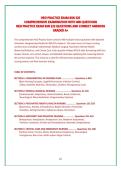
This comprehensive HESI Practice Exam contains 400 multiple-choice questions with detailed
rationales, designed specifically for BSN 225 students. The exam covers all major nursing
content areas including Fundamentals, Medical-Surgical, Psychiatric-Mental Health,
Maternity/Pediatrics, and Critical Care. Each question follows NCLEX-style formatting with four
answer choices, one correct answer, and detailed rationales explaining the reasoning behind
the correct response. This resource is ideal for HESI exit exam preparation, comprehensive
nursing review, and final semester testing.
TABLE OF CONTENTS:
SECTION 1: FUNDAMENTALS OF NURSING CARE ..................... Questions 1-050
(Basic Nursing Concepts, Legal/Ethical Issues, Infection Control,
Safety, Mobility, Nutrition, Elimination, Comfort, Perioperative Care)
SECTION 2: MEDICAL-SURGICAL NURSING ........................ Questions 51-130
(Cardiovascular, Respiratory, Gastrointestinal, Renal, Endocrine,
Neurological, Musculoskeletal, Integumentary Systems)
SECTION 3: PSYCHIATRIC-MENTAL HEALTH NURSING ............... Questions 131-220
(Depression, Anxiety, Schizophrenia, Bipolar Disorder, Personality
Disorders, Eating Disorders, Substance Abuse, Dementia)
SECTION 4: MATERNITY AND PEDIATRIC NURSING ................. Questions 221-310
(Antepartum, Intrapartum, Postpartum Care, Newborn Assessment,
Pediatric Conditions, Growth and Development, Neonatal Complications)
SECTION 5: CRITICAL CARE AND EMERGENCY NURSING ............. Questions 311-400
(Cardiac Arrest, Trauma, Shock, Respiratory Emergencies, Neurological
Emergencies, Burn Care, Multi-system Organ Failure)
[1]
,SECTION 1: FUNDAMENTALS OF NURSING CARE (Questions 1-50)
1. Which statement made by a client with chronic obstructive pulmonary disease indicates a
need for further teaching about energy conservation techniques?
1) "I will sit on a chair in the shower to conserve energy"
2) "I will use a bedside commode to avoid walking to the bathroom"
3) "I will organize my activities to balance rest and activity"
4) "I will perform all my morning care activities at one time to get them done"
Correct Answer: 4
Rationale: Performing all morning care activities at one time does not allow for adequate rest
periods and can lead to excessive fatigue. Energy conservation techniques should include
pacing activities, alternating rest periods with activity, and prioritizing tasks. Clients with COPD
should spread activities throughout the day and take frequent rest breaks to conserve energy
and prevent oxygen desaturation. The other options demonstrate appropriate energy
conservation strategies that help the client maintain independence while managing respiratory
limitations.
2. A client with a urinary tract infection is prescribed ciprofloxacin. Which instruction should the
nurse include in the teaching plan?
1) "Take the medication with an antacid to prevent gastrointestinal upset"
2) "Drink at least 2000 mL of fluid daily while taking this medication"
3) "Avoid dairy products while taking this medication"
4) "Take this medication with meals to enhance absorption"
Correct Answer: 3
Rationale: Ciprofloxacin should not be taken with dairy products or calcium-fortified foods
because calcium binds with the medication, reducing its absorption and effectiveness. Clients
should be instructed to take ciprofloxacin at least two hours before or six hours after
consuming dairy products, antacids, or supplements containing calcium, magnesium, or
aluminum. Adequate hydration is also important to prevent crystalluria, a potential side effect
[2]
,of ciprofloxacin therapy. The medication should be taken with a full glass of water and may be
taken with meals if gastrointestinal upset occurs, but dairy products should be avoided.
3. The nurse is caring for a client with a nasogastric tube attached to low intermittent suction.
Which assessment finding indicates that the tube may be displaced?
1) The client reports nausea and abdominal distention
2) The tube drainage is greenish-yellow in color
3) The tube is taped securely to the client's nose
4) The suction machine is set at the prescribed pressure
Correct Answer: 1
Rationale: Nausea and abdominal distention suggest that the nasogastric tube is not effectively
draining gastric contents, which may indicate tube displacement or malfunction. A properly
placed nasogastric tube should provide gastric decompression, reducing distention and
preventing nausea. Greenish-yellow drainage is consistent with gastric contents and would be
expected. While tube security and suction settings should be verified, the presence of nausea
and distention are the most sensitive indicators of potential tube displacement requiring
immediate assessment and intervention.
4. Which action should the nurse implement when adding sterile liquids to a sterile field?
1) Pour the liquid from a height of 12 inches above the receptacle
2) Place the receptacle near the back edge of the sterile field
3) Consider the sterile field contaminated if it becomes wet during the procedure
4) Replace the cap on the liquid container immediately after pouring
Correct Answer: 3
Rationale: Wet or damp areas on a sterile field allow organisms to wick from the table surface
and permeate into the sterile area, so the field is considered contaminated if it becomes wet.
Outdated liquids may be contaminated and should be discarded. The container's cap should be
removed, placed facing up, and off the sterile field. To prevent contamination of the sterile
field, liquids should be held close (6 inches) to the receptacle when pouring to prevent
splashing, and the receptacle should be placed near the front edge to avoid reaching over or
[3]
, across the sterile field. Maintaining the integrity of the sterile field is essential for preventing
surgical site infections and ensuring client safety during invasive procedures.
5. A client is admitted with a stage four pressure injury that has a black, hardened surface
(eschar) that is stable. Which dressing is best for the nurse to use first?
1) Hydrocolloid dressing
2) Transparent film dressing
3) No dressing
4) Wet-to-dry saline dressing
Correct Answer: 3
Rationale: If eschar is dry and intact and debridement is not part of the plan of care, no dressing
is used, allowing eschar to act as physiological cover. The eschar provides a natural protective
barrier against infection. Applying a dressing to stable, dry eschar can macerate the tissue and
promote bacterial growth. The wound should be monitored regularly for signs of infection or
changes in the eschar, such as softening, drainage, or odor, which would indicate the need for
debridement and dressing application. This approach follows the principle of moist wound
healing while respecting the body's natural protective mechanisms.
6. A male client with an infected wound tells the nurse that he follows a macrobiotic diet.
Which type of foods should the nurse recommend that the client select from the hospital
menu?
1) High-protein animal foods such as lean meats and fish
2) Combination of plant proteins to provide essential amino acids
3) Low-carbohydrate foods to prevent inflammation
4) High-fat dairy products for calorie density
Correct Answer: 2
Rationale: A macrobiotic diet is high in whole-grain cereals, vegetables, sea vegetables, beans,
and vegetarian soups, and the client needs essential amino acids to provide complete proteins
to heal the infected wound. Although a macrobiotic diet contains no source of animal protein,
essential amino acids should be obtained by combining plant (incomplete) proteins to provide
[4]
rationales, designed specifically for BSN 225 students. The exam covers all major nursing
content areas including Fundamentals, Medical-Surgical, Psychiatric-Mental Health,
Maternity/Pediatrics, and Critical Care. Each question follows NCLEX-style formatting with four
answer choices, one correct answer, and detailed rationales explaining the reasoning behind
the correct response. This resource is ideal for HESI exit exam preparation, comprehensive
nursing review, and final semester testing.
TABLE OF CONTENTS:
SECTION 1: FUNDAMENTALS OF NURSING CARE ..................... Questions 1-050
(Basic Nursing Concepts, Legal/Ethical Issues, Infection Control,
Safety, Mobility, Nutrition, Elimination, Comfort, Perioperative Care)
SECTION 2: MEDICAL-SURGICAL NURSING ........................ Questions 51-130
(Cardiovascular, Respiratory, Gastrointestinal, Renal, Endocrine,
Neurological, Musculoskeletal, Integumentary Systems)
SECTION 3: PSYCHIATRIC-MENTAL HEALTH NURSING ............... Questions 131-220
(Depression, Anxiety, Schizophrenia, Bipolar Disorder, Personality
Disorders, Eating Disorders, Substance Abuse, Dementia)
SECTION 4: MATERNITY AND PEDIATRIC NURSING ................. Questions 221-310
(Antepartum, Intrapartum, Postpartum Care, Newborn Assessment,
Pediatric Conditions, Growth and Development, Neonatal Complications)
SECTION 5: CRITICAL CARE AND EMERGENCY NURSING ............. Questions 311-400
(Cardiac Arrest, Trauma, Shock, Respiratory Emergencies, Neurological
Emergencies, Burn Care, Multi-system Organ Failure)
[1]
,SECTION 1: FUNDAMENTALS OF NURSING CARE (Questions 1-50)
1. Which statement made by a client with chronic obstructive pulmonary disease indicates a
need for further teaching about energy conservation techniques?
1) "I will sit on a chair in the shower to conserve energy"
2) "I will use a bedside commode to avoid walking to the bathroom"
3) "I will organize my activities to balance rest and activity"
4) "I will perform all my morning care activities at one time to get them done"
Correct Answer: 4
Rationale: Performing all morning care activities at one time does not allow for adequate rest
periods and can lead to excessive fatigue. Energy conservation techniques should include
pacing activities, alternating rest periods with activity, and prioritizing tasks. Clients with COPD
should spread activities throughout the day and take frequent rest breaks to conserve energy
and prevent oxygen desaturation. The other options demonstrate appropriate energy
conservation strategies that help the client maintain independence while managing respiratory
limitations.
2. A client with a urinary tract infection is prescribed ciprofloxacin. Which instruction should the
nurse include in the teaching plan?
1) "Take the medication with an antacid to prevent gastrointestinal upset"
2) "Drink at least 2000 mL of fluid daily while taking this medication"
3) "Avoid dairy products while taking this medication"
4) "Take this medication with meals to enhance absorption"
Correct Answer: 3
Rationale: Ciprofloxacin should not be taken with dairy products or calcium-fortified foods
because calcium binds with the medication, reducing its absorption and effectiveness. Clients
should be instructed to take ciprofloxacin at least two hours before or six hours after
consuming dairy products, antacids, or supplements containing calcium, magnesium, or
aluminum. Adequate hydration is also important to prevent crystalluria, a potential side effect
[2]
,of ciprofloxacin therapy. The medication should be taken with a full glass of water and may be
taken with meals if gastrointestinal upset occurs, but dairy products should be avoided.
3. The nurse is caring for a client with a nasogastric tube attached to low intermittent suction.
Which assessment finding indicates that the tube may be displaced?
1) The client reports nausea and abdominal distention
2) The tube drainage is greenish-yellow in color
3) The tube is taped securely to the client's nose
4) The suction machine is set at the prescribed pressure
Correct Answer: 1
Rationale: Nausea and abdominal distention suggest that the nasogastric tube is not effectively
draining gastric contents, which may indicate tube displacement or malfunction. A properly
placed nasogastric tube should provide gastric decompression, reducing distention and
preventing nausea. Greenish-yellow drainage is consistent with gastric contents and would be
expected. While tube security and suction settings should be verified, the presence of nausea
and distention are the most sensitive indicators of potential tube displacement requiring
immediate assessment and intervention.
4. Which action should the nurse implement when adding sterile liquids to a sterile field?
1) Pour the liquid from a height of 12 inches above the receptacle
2) Place the receptacle near the back edge of the sterile field
3) Consider the sterile field contaminated if it becomes wet during the procedure
4) Replace the cap on the liquid container immediately after pouring
Correct Answer: 3
Rationale: Wet or damp areas on a sterile field allow organisms to wick from the table surface
and permeate into the sterile area, so the field is considered contaminated if it becomes wet.
Outdated liquids may be contaminated and should be discarded. The container's cap should be
removed, placed facing up, and off the sterile field. To prevent contamination of the sterile
field, liquids should be held close (6 inches) to the receptacle when pouring to prevent
splashing, and the receptacle should be placed near the front edge to avoid reaching over or
[3]
, across the sterile field. Maintaining the integrity of the sterile field is essential for preventing
surgical site infections and ensuring client safety during invasive procedures.
5. A client is admitted with a stage four pressure injury that has a black, hardened surface
(eschar) that is stable. Which dressing is best for the nurse to use first?
1) Hydrocolloid dressing
2) Transparent film dressing
3) No dressing
4) Wet-to-dry saline dressing
Correct Answer: 3
Rationale: If eschar is dry and intact and debridement is not part of the plan of care, no dressing
is used, allowing eschar to act as physiological cover. The eschar provides a natural protective
barrier against infection. Applying a dressing to stable, dry eschar can macerate the tissue and
promote bacterial growth. The wound should be monitored regularly for signs of infection or
changes in the eschar, such as softening, drainage, or odor, which would indicate the need for
debridement and dressing application. This approach follows the principle of moist wound
healing while respecting the body's natural protective mechanisms.
6. A male client with an infected wound tells the nurse that he follows a macrobiotic diet.
Which type of foods should the nurse recommend that the client select from the hospital
menu?
1) High-protein animal foods such as lean meats and fish
2) Combination of plant proteins to provide essential amino acids
3) Low-carbohydrate foods to prevent inflammation
4) High-fat dairy products for calorie density
Correct Answer: 2
Rationale: A macrobiotic diet is high in whole-grain cereals, vegetables, sea vegetables, beans,
and vegetarian soups, and the client needs essential amino acids to provide complete proteins
to heal the infected wound. Although a macrobiotic diet contains no source of animal protein,
essential amino acids should be obtained by combining plant (incomplete) proteins to provide
[4]