

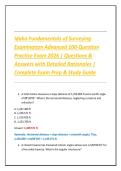
Idaho Fundamentals of Surveying
Examination Advanced 100-Question
Practice Exam 2026 | Questions &
Answers with Detailed Rationales |
Complete Exam Prep & Study Guide
1. A total station measures a slope distance of 1,250.000 ft and a zenith angle
of 88°30′00″. What is the horizontal distance, neglecting curvature and
refraction?
A. 1,247.400 ft
B. 1,249.571 ft
C. 1,250.429 ft
D. 1,253.700 ft
Answer: 1,249.571 ft
Rationale: Horizontal distance = slope distance × sin(zenith angle). Thus,
1,250.000 × sin(88°30′) ≈ 1,249.571 ft.
2. A closed traverse has measured interior angles whose sum is 540°00′24″ for
a five-sided traverse. What is the angular misclosure?
,A. 24″
B. 20″
C. 12″
D. 4″
Answer: 24″
Rationale: The theoretical interior-angle sum is (5 − 2) × 180° = 540°. The
measured sum exceeds this by 24″, so the angular misclosure is 24″.
3. In a differential leveling loop, the backsight readings total 18.624 ft and the
foresight readings total 19.013 ft. What is the elevation misclosure?
A. +0.389 ft
B. −0.389 ft
C. +37.637 ft
D. −37.637 ft
Answer: −0.389 ft
Rationale: Elevation change equals ΣBS − ΣFS = 18.624 − 19.013 = −0.389 ft.
4. A benchmark has an elevation of 4,825.63 ft. A backsight of 6.42 ft is taken
on the benchmark. What is the height of instrument?
A. 4,819.21 ft
B. 4,825.63 ft
C. 4,832.05 ft
D. 4,838.47 ft
Answer: 4,832.05 ft
Rationale: HI = benchmark elevation + backsight = 4,825.63 + 6.42 = 4,832.05 ft.
5. A foresight reading of 8.17 ft is then taken on a point from the instrument
in Question 4. What is the elevation of that point?
,A. 4,823.88 ft
B. 4,832.05 ft
C. 4,840.22 ft
D. 4,816.46 ft
Answer: 4,823.88 ft
Rationale: Elevation = HI − FS = 4,832.05 − 8.17 = 4,823.88 ft.
6. A 100-ft steel tape is standardized at 68°F, but field measurements are
made at 98°F. If the coefficient of thermal expansion is 6.45 × 10⁻⁶/°F, what
correction applies to a 100-ft taped distance?
A. +0.00194 ft
B. +0.01935 ft
C. −0.01935 ft
D. −0.19350 ft
Answer: +0.01935 ft
Rationale: Temperature correction = αLΔT = (6.45 × 10⁻⁶)(100)(30) = 0.01935 ft.
The tape is longer at the higher temperature, so the correction to the measured
length is positive when determining the true distance.
7. Which error is most effectively reduced in differential leveling by balancing
backsight and foresight distances?
A. Rod graduation error
B. Collimation error
C. Random pointing error
D. Benchmark elevation error
Answer: Collimation error
Rationale: Equal sight lengths cause collimation effects to cancel because the
instrument line-of-sight error affects both observations similarly.
, 8. A traverse line has a northing difference of +425.60 ft and an easting
difference of −318.40 ft. In which quadrant does the line lie?
A. Northeast
B. Southeast
C. Northwest
D. Southwest
Answer: Northwest
Rationale: Positive northing indicates north and negative easting indicates west,
placing the line in the northwest quadrant.
9. What is the approximate azimuth of a line having latitude +425.60 ft and
departure −318.40 ft?
A. 36°48′
B. 53°12′
C. 126°48′
D. 323°12′
Answer: 323°12′
Rationale: The line is northwest. The acute angle from north is
arctan(318.40/425.60) ≈ 36°48′. The azimuth is therefore 360° − 36°48′ ≈ 323°12′.
10.A line has a bearing of S 27°18′40″ E. What is its azimuth?
A. 27°18′40″
B. 152°41′20″
C. 207°18′40″
D. 332°41′20″
Answer: 152°41′20″
Rationale: For a southeast quadrant bearing S θ E, azimuth = 180° − θ. Thus,
180° − 27°18′40″ = 152°41′20″.
Examination Advanced 100-Question
Practice Exam 2026 | Questions &
Answers with Detailed Rationales |
Complete Exam Prep & Study Guide
1. A total station measures a slope distance of 1,250.000 ft and a zenith angle
of 88°30′00″. What is the horizontal distance, neglecting curvature and
refraction?
A. 1,247.400 ft
B. 1,249.571 ft
C. 1,250.429 ft
D. 1,253.700 ft
Answer: 1,249.571 ft
Rationale: Horizontal distance = slope distance × sin(zenith angle). Thus,
1,250.000 × sin(88°30′) ≈ 1,249.571 ft.
2. A closed traverse has measured interior angles whose sum is 540°00′24″ for
a five-sided traverse. What is the angular misclosure?
,A. 24″
B. 20″
C. 12″
D. 4″
Answer: 24″
Rationale: The theoretical interior-angle sum is (5 − 2) × 180° = 540°. The
measured sum exceeds this by 24″, so the angular misclosure is 24″.
3. In a differential leveling loop, the backsight readings total 18.624 ft and the
foresight readings total 19.013 ft. What is the elevation misclosure?
A. +0.389 ft
B. −0.389 ft
C. +37.637 ft
D. −37.637 ft
Answer: −0.389 ft
Rationale: Elevation change equals ΣBS − ΣFS = 18.624 − 19.013 = −0.389 ft.
4. A benchmark has an elevation of 4,825.63 ft. A backsight of 6.42 ft is taken
on the benchmark. What is the height of instrument?
A. 4,819.21 ft
B. 4,825.63 ft
C. 4,832.05 ft
D. 4,838.47 ft
Answer: 4,832.05 ft
Rationale: HI = benchmark elevation + backsight = 4,825.63 + 6.42 = 4,832.05 ft.
5. A foresight reading of 8.17 ft is then taken on a point from the instrument
in Question 4. What is the elevation of that point?
,A. 4,823.88 ft
B. 4,832.05 ft
C. 4,840.22 ft
D. 4,816.46 ft
Answer: 4,823.88 ft
Rationale: Elevation = HI − FS = 4,832.05 − 8.17 = 4,823.88 ft.
6. A 100-ft steel tape is standardized at 68°F, but field measurements are
made at 98°F. If the coefficient of thermal expansion is 6.45 × 10⁻⁶/°F, what
correction applies to a 100-ft taped distance?
A. +0.00194 ft
B. +0.01935 ft
C. −0.01935 ft
D. −0.19350 ft
Answer: +0.01935 ft
Rationale: Temperature correction = αLΔT = (6.45 × 10⁻⁶)(100)(30) = 0.01935 ft.
The tape is longer at the higher temperature, so the correction to the measured
length is positive when determining the true distance.
7. Which error is most effectively reduced in differential leveling by balancing
backsight and foresight distances?
A. Rod graduation error
B. Collimation error
C. Random pointing error
D. Benchmark elevation error
Answer: Collimation error
Rationale: Equal sight lengths cause collimation effects to cancel because the
instrument line-of-sight error affects both observations similarly.
, 8. A traverse line has a northing difference of +425.60 ft and an easting
difference of −318.40 ft. In which quadrant does the line lie?
A. Northeast
B. Southeast
C. Northwest
D. Southwest
Answer: Northwest
Rationale: Positive northing indicates north and negative easting indicates west,
placing the line in the northwest quadrant.
9. What is the approximate azimuth of a line having latitude +425.60 ft and
departure −318.40 ft?
A. 36°48′
B. 53°12′
C. 126°48′
D. 323°12′
Answer: 323°12′
Rationale: The line is northwest. The acute angle from north is
arctan(318.40/425.60) ≈ 36°48′. The azimuth is therefore 360° − 36°48′ ≈ 323°12′.
10.A line has a bearing of S 27°18′40″ E. What is its azimuth?
A. 27°18′40″
B. 152°41′20″
C. 207°18′40″
D. 332°41′20″
Answer: 152°41′20″
Rationale: For a southeast quadrant bearing S θ E, azimuth = 180° − θ. Thus,
180° − 27°18′40″ = 152°41′20″.


