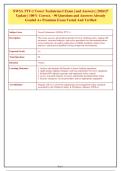
NWSA TTT-1 Tower Technician I Exam | and Answers | 2026/27
Update | 100% Correct. - 90 Questions and Answers Already
Graded A+ Premium Exam Tested And Verified
Subject Area Tower Technician I (NWSA TTT-1)
Description This exam assesses advanced knowledge of tower climbing safety, rigging, RF
awareness, structural integrity, and rescue procedures for telecommunications
tower technicians. It requires application of OSHA standards, industry best
practices, and practical problem-solving in high-risk environments.
Expected Grade A+
Total Questions 90
Duration 3 hours
Learning Outcomes 1. Analyze and mitigate fall hazards in tower climbing operations
2. Apply proper rigging techniques and load calculations for tower equipment
3. Evaluate RF radiation exposure and implement safety controls
4. Assess structural integrity of towers and identify potential failure points
5. Execute emergency rescue procedures and use appropriate equipment
Accreditation Aligned with U.S. university engineering and occupational safety standards,
accredited by the Northwest Safety & Workforce Alliance (NWSA).
Page 1
,1. A tower crew is preparing to hoist a 150-pound antenna using a gin pole. The gin
pole is angled 15 degrees from vertical. What is the approximate tension in the hoist
line if the load is static and friction is negligible?
A. 150 lbs
B. 155 lbs
C. 165 lbs
D. 180 lbs
Answer: B. 155 lbs
The tension increases by a factor of 1/cos() when the load is lifted at an angle. For 15
degrees, cos(15°) 0.966, so tension = .966 155 lbs. Other options incorrectly
assume no angle effect or overestimate the factor.
2. During a tower inspection, you notice galvanized steel members with white rust
and pitting. What is the most appropriate immediate action?
A. Apply a coat of zinc-rich paint to the affected areas and continue the inspection.
B. Document the condition and recommend a detailed structural assessment before any
climbing.
C. Wire brush the rust and apply a primer to prevent further corrosion.
D. Replace all corroded members immediately before proceeding with any work.
Answer: B. Document the condition and recommend a detailed structural
assessment before any climbing.
White rust indicates early corrosion of the zinc coating, but pitting suggests possible
structural compromise. The correct action is to document and have a structural
engineer evaluate the tower's integrity. Applying paint or brushing does not address
underlying structural damage, and immediate replacement is not always necessary or
feasible.
Page 2
,3. A technician must work on a tower with a transmitting antenna. The calculated
RF exposure at the work position is 1.2 mW/cm² averaged over 6 minutes. The
applicable limit for controlled environments is 1.0 mW/cm². What is the correct
course of action?
A. Proceed with work, as the exposure is only slightly above the limit.
B. Reduce transmit power to bring exposure below the limit, or use time averaging to stay
under.
C. Wear a personal RF monitor and work as quickly as possible.
D. Use a non-conductive ladder and avoid touching the antenna.
Answer: B. Reduce transmit power to bring exposure below the limit, or use time
averaging to stay under.
Exposure above the limit requires mitigation. Options include reducing power or using
administrative controls like time averaging. Proceeding despite exceeding the limit
violates safety standards. Wearing a monitor does not reduce exposure, and
non-conductive ladders do not affect RF absorption.
4. When performing a pre-climb inspection of a tower, which finding would require
immediate cessation of the climb?
A. Loose bolts on a secondary brace member
B. Cracked weld on a main structural leg
C. Minor rust on a ladder rung
D. Bird nest on a platform
Answer: B. Cracked weld on a main structural leg
A cracked weld on a main structural leg compromises the tower's integrity and poses
an imminent collapse risk. Loose bolts on secondary members and minor rust are
concerns but may not require immediate halt if documented and managed. Bird nests
are a biological hazard but not structural.
Page 3
, 5. You are using a load cell to weigh a load before lifting. The load cell reads 2,200
lbs. The rigging gear (slings, shackle) weighs 50 lbs. What is the net load that must
be considered for the lift plan?
A. 2,150 lbs
B. 2,200 lbs
C. 2,250 lbs
D. 2,500 lbs
Answer: C. 2,250 lbs
The load cell reading includes the weight of the rigging gear. The total load on the crane
or gin pole includes the actual equipment plus rigging. Therefore, the lift plan must use
2,200 + 50 = 2,250 lbs. Subtracting the rigging weight would be incorrect because the
rigging is part of the load being lifted.
6. A tower technician is using a vertical lifeline with a rope grab. The lifeline is
anchored at the top of the tower. What is the maximum allowable free fall distance?
A. 2 feet
B. 6 feet
C. 12 feet
D. 18 inches
Answer: B. 6 feet
OSHA requires that personal fall arrest systems limit free fall to 6 feet (1.8 m) or less.
The rope grab must engage quickly to prevent excessive free fall. Options A and D are
too restrictive, and 12 feet exceeds the permissible limit.
Page 4
Update | 100% Correct. - 90 Questions and Answers Already
Graded A+ Premium Exam Tested And Verified
Subject Area Tower Technician I (NWSA TTT-1)
Description This exam assesses advanced knowledge of tower climbing safety, rigging, RF
awareness, structural integrity, and rescue procedures for telecommunications
tower technicians. It requires application of OSHA standards, industry best
practices, and practical problem-solving in high-risk environments.
Expected Grade A+
Total Questions 90
Duration 3 hours
Learning Outcomes 1. Analyze and mitigate fall hazards in tower climbing operations
2. Apply proper rigging techniques and load calculations for tower equipment
3. Evaluate RF radiation exposure and implement safety controls
4. Assess structural integrity of towers and identify potential failure points
5. Execute emergency rescue procedures and use appropriate equipment
Accreditation Aligned with U.S. university engineering and occupational safety standards,
accredited by the Northwest Safety & Workforce Alliance (NWSA).
Page 1
,1. A tower crew is preparing to hoist a 150-pound antenna using a gin pole. The gin
pole is angled 15 degrees from vertical. What is the approximate tension in the hoist
line if the load is static and friction is negligible?
A. 150 lbs
B. 155 lbs
C. 165 lbs
D. 180 lbs
Answer: B. 155 lbs
The tension increases by a factor of 1/cos() when the load is lifted at an angle. For 15
degrees, cos(15°) 0.966, so tension = .966 155 lbs. Other options incorrectly
assume no angle effect or overestimate the factor.
2. During a tower inspection, you notice galvanized steel members with white rust
and pitting. What is the most appropriate immediate action?
A. Apply a coat of zinc-rich paint to the affected areas and continue the inspection.
B. Document the condition and recommend a detailed structural assessment before any
climbing.
C. Wire brush the rust and apply a primer to prevent further corrosion.
D. Replace all corroded members immediately before proceeding with any work.
Answer: B. Document the condition and recommend a detailed structural
assessment before any climbing.
White rust indicates early corrosion of the zinc coating, but pitting suggests possible
structural compromise. The correct action is to document and have a structural
engineer evaluate the tower's integrity. Applying paint or brushing does not address
underlying structural damage, and immediate replacement is not always necessary or
feasible.
Page 2
,3. A technician must work on a tower with a transmitting antenna. The calculated
RF exposure at the work position is 1.2 mW/cm² averaged over 6 minutes. The
applicable limit for controlled environments is 1.0 mW/cm². What is the correct
course of action?
A. Proceed with work, as the exposure is only slightly above the limit.
B. Reduce transmit power to bring exposure below the limit, or use time averaging to stay
under.
C. Wear a personal RF monitor and work as quickly as possible.
D. Use a non-conductive ladder and avoid touching the antenna.
Answer: B. Reduce transmit power to bring exposure below the limit, or use time
averaging to stay under.
Exposure above the limit requires mitigation. Options include reducing power or using
administrative controls like time averaging. Proceeding despite exceeding the limit
violates safety standards. Wearing a monitor does not reduce exposure, and
non-conductive ladders do not affect RF absorption.
4. When performing a pre-climb inspection of a tower, which finding would require
immediate cessation of the climb?
A. Loose bolts on a secondary brace member
B. Cracked weld on a main structural leg
C. Minor rust on a ladder rung
D. Bird nest on a platform
Answer: B. Cracked weld on a main structural leg
A cracked weld on a main structural leg compromises the tower's integrity and poses
an imminent collapse risk. Loose bolts on secondary members and minor rust are
concerns but may not require immediate halt if documented and managed. Bird nests
are a biological hazard but not structural.
Page 3
, 5. You are using a load cell to weigh a load before lifting. The load cell reads 2,200
lbs. The rigging gear (slings, shackle) weighs 50 lbs. What is the net load that must
be considered for the lift plan?
A. 2,150 lbs
B. 2,200 lbs
C. 2,250 lbs
D. 2,500 lbs
Answer: C. 2,250 lbs
The load cell reading includes the weight of the rigging gear. The total load on the crane
or gin pole includes the actual equipment plus rigging. Therefore, the lift plan must use
2,200 + 50 = 2,250 lbs. Subtracting the rigging weight would be incorrect because the
rigging is part of the load being lifted.
6. A tower technician is using a vertical lifeline with a rope grab. The lifeline is
anchored at the top of the tower. What is the maximum allowable free fall distance?
A. 2 feet
B. 6 feet
C. 12 feet
D. 18 inches
Answer: B. 6 feet
OSHA requires that personal fall arrest systems limit free fall to 6 feet (1.8 m) or less.
The rope grab must engage quickly to prevent excessive free fall. Options A and D are
too restrictive, and 12 feet exceeds the permissible limit.
Page 4