

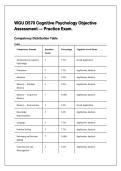
WGU D570 Cognitive Psychology Objective
Assessment — Practice Exam.
Competency Distribution Table
Table
Competency Domain Question Percentage Cognitive Level Focus
Count
Introduction to Cognitive 5 7.7% Recall, Application
Psychology
Perception 5 7.7% Application, Analysis
Attention 6 9.2% Application, Analysis
Memory — Working 6 9.2% Application, Analysis
Memory
Memory — Long-Term 7 10.8% Application, Analysis
Memory
Memory — Neuroscience 4 6.2% Recall, Application
Knowledge 4 6.2% Application, Analysis
Representation
Language 5 7.7% Application, Analysis
Problem Solving 5 7.7% Application, Analysis
Reasoning and Decision 7 10.8% Application, Analysis
Making
Consciousness and 4 6.2% Application, Analysis
Metacognition
, Competency Domain Question Percentage Cognitive Level Focus
Count
Cognitive Development 4 6.2% Recall, Application
and Aging
Applied Cognitive 3 4.6% Application, Analysis
Psychology
TOTAL 65 100% 15% Recall / 55%
Application / 30% Analysis
QUESTIONS
Q1: Which historical perspective in psychology emphasized the study of mental
processes through introspection, focusing on the basic elements of consciousness?
A. Functionalism
B. Behaviorism
C. Structuralism
D. Gestalt psychology
Correct Answer: C [CORRECT]
Rationale: Structuralism, founded by Wilhelm Wundt and advanced by Edward
Titchener, used introspection to identify the basic elements of conscious experience.
Functionalism studied the purpose of mental processes, behaviorism rejected the study
of internal mental states, and Gestalt psychology emphasized holistic perception rather
than elemental analysis.
,Q2: George Miller's influential 1956 paper "The Magical Number Seven, Plus or Minus
Two" primarily addressed which cognitive limitation?
A. The maximum duration of long-term memory storage
B. The capacity limits of short-term/working memory
C. The number of sensory modalities that can be processed simultaneously
D. The optimal number of study sessions for effective learning
Correct Answer: B [CORRECT]
Rationale: Miller's paper established that working memory capacity is limited to
approximately 7±2 chunks of information, a foundational finding in cognitive
psychology that influenced Baddeley's working memory model and subsequent research
by Cowan, who later refined this to about 4 chunks.
Q3: In the information processing approach to cognition, which component serves as
the initial temporary storage system that holds sensory input in relatively unprocessed
form?
A. Central executive
B. Sensory memory
C. Long-term memory
D. Episodic buffer
Correct Answer: B [CORRECT]
Rationale: Sensory memory briefly holds raw sensory information from each modality
(iconic for vision, echoic for audition) before it is either attended to and transferred to
short-term memory or decays. Atkinson and Shiffrin's multi-store model positioned
sensory memory as the first stage of information processing.
Q4: A researcher conducts an experiment to test whether sleep improves memory
consolidation. Participants learn a word list, then are randomly assigned to either sleep
, for 8 hours or stay awake. Memory is tested 12 hours later. In this design, the word list
recall score is the:
A. Independent variable
B. Control variable
C. Dependent variable
D. Confounding variable
Correct Answer: C [CORRECT]
Rationale: The dependent variable is the outcome measure that the researcher assesses
to determine the effect of the independent variable (sleep condition). Random
assignment helps control confounding variables, and the word list itself would be held
constant across conditions as a control variable.
Q5: [SELECT ALL THAT APPLY] Which of the following are key features of connectionist
or parallel distributed processing (PDP) models of cognition? Select all that apply.
A. Information is represented as patterns of activation across many interconnected
processing units
B. Knowledge is stored in a single, centralized location analogous to a computer hard
drive
C. Learning occurs through the adjustment of connection weights between units
D. Processing occurs simultaneously across multiple units rather than in a linear
sequence
E. The system is inherently resistant to damage and can exhibit graceful degradation
Correct Answers: A, C, D, E [CORRECT]
Rationale: Connectionist models represent knowledge as distributed patterns of
activation across networks of simple processing units, with learning occurring through
weight adjustments (e.g., backpropagation). They process information in parallel and
show graceful degradation when damaged. Option B describes a symbolic, localized
representation characteristic of classical computer architectures, not PDP models.
Assessment — Practice Exam.
Competency Distribution Table
Table
Competency Domain Question Percentage Cognitive Level Focus
Count
Introduction to Cognitive 5 7.7% Recall, Application
Psychology
Perception 5 7.7% Application, Analysis
Attention 6 9.2% Application, Analysis
Memory — Working 6 9.2% Application, Analysis
Memory
Memory — Long-Term 7 10.8% Application, Analysis
Memory
Memory — Neuroscience 4 6.2% Recall, Application
Knowledge 4 6.2% Application, Analysis
Representation
Language 5 7.7% Application, Analysis
Problem Solving 5 7.7% Application, Analysis
Reasoning and Decision 7 10.8% Application, Analysis
Making
Consciousness and 4 6.2% Application, Analysis
Metacognition
, Competency Domain Question Percentage Cognitive Level Focus
Count
Cognitive Development 4 6.2% Recall, Application
and Aging
Applied Cognitive 3 4.6% Application, Analysis
Psychology
TOTAL 65 100% 15% Recall / 55%
Application / 30% Analysis
QUESTIONS
Q1: Which historical perspective in psychology emphasized the study of mental
processes through introspection, focusing on the basic elements of consciousness?
A. Functionalism
B. Behaviorism
C. Structuralism
D. Gestalt psychology
Correct Answer: C [CORRECT]
Rationale: Structuralism, founded by Wilhelm Wundt and advanced by Edward
Titchener, used introspection to identify the basic elements of conscious experience.
Functionalism studied the purpose of mental processes, behaviorism rejected the study
of internal mental states, and Gestalt psychology emphasized holistic perception rather
than elemental analysis.
,Q2: George Miller's influential 1956 paper "The Magical Number Seven, Plus or Minus
Two" primarily addressed which cognitive limitation?
A. The maximum duration of long-term memory storage
B. The capacity limits of short-term/working memory
C. The number of sensory modalities that can be processed simultaneously
D. The optimal number of study sessions for effective learning
Correct Answer: B [CORRECT]
Rationale: Miller's paper established that working memory capacity is limited to
approximately 7±2 chunks of information, a foundational finding in cognitive
psychology that influenced Baddeley's working memory model and subsequent research
by Cowan, who later refined this to about 4 chunks.
Q3: In the information processing approach to cognition, which component serves as
the initial temporary storage system that holds sensory input in relatively unprocessed
form?
A. Central executive
B. Sensory memory
C. Long-term memory
D. Episodic buffer
Correct Answer: B [CORRECT]
Rationale: Sensory memory briefly holds raw sensory information from each modality
(iconic for vision, echoic for audition) before it is either attended to and transferred to
short-term memory or decays. Atkinson and Shiffrin's multi-store model positioned
sensory memory as the first stage of information processing.
Q4: A researcher conducts an experiment to test whether sleep improves memory
consolidation. Participants learn a word list, then are randomly assigned to either sleep
, for 8 hours or stay awake. Memory is tested 12 hours later. In this design, the word list
recall score is the:
A. Independent variable
B. Control variable
C. Dependent variable
D. Confounding variable
Correct Answer: C [CORRECT]
Rationale: The dependent variable is the outcome measure that the researcher assesses
to determine the effect of the independent variable (sleep condition). Random
assignment helps control confounding variables, and the word list itself would be held
constant across conditions as a control variable.
Q5: [SELECT ALL THAT APPLY] Which of the following are key features of connectionist
or parallel distributed processing (PDP) models of cognition? Select all that apply.
A. Information is represented as patterns of activation across many interconnected
processing units
B. Knowledge is stored in a single, centralized location analogous to a computer hard
drive
C. Learning occurs through the adjustment of connection weights between units
D. Processing occurs simultaneously across multiple units rather than in a linear
sequence
E. The system is inherently resistant to damage and can exhibit graceful degradation
Correct Answers: A, C, D, E [CORRECT]
Rationale: Connectionist models represent knowledge as distributed patterns of
activation across networks of simple processing units, with learning occurring through
weight adjustments (e.g., backpropagation). They process information in parallel and
show graceful degradation when damaged. Option B describes a symbolic, localized
representation characteristic of classical computer architectures, not PDP models.


