PACA101 | BRAIN SCIENCE QUIZ PRACTICE
WGU PACA101 OBJECTIVE ASSESSMENT 1
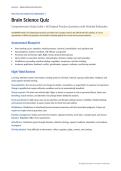
Brain Science Quiz
Comprehensive Study Guide + 60 Original Practice Questions with Detailed Rationales
ALIGNMENT NOTE This independent practice set follows the concepts named in the official PACA101 syllabus. It is not a
reproduction of WGU quiz questions and should be checked against the current learner-portal materials.
Assessment Blueprint
How learning occurs: attention, working memory, retrieval, consolidation, and cognitive load
Neuroplasticity, practice, feedback, self-efficacy, and growth
Perceived and real threats; fight, flight, freeze; physical bioresponses
Stress effects on executive function, interpretation, decision-making, and communication
Mindfulness, grounding, emotion labeling, regulation, acceptance, and fact-checking
Academic application: feedback, conflict, prioritization, support, resilience, and thriving mindset
High-Yield Review
Learning: Attention selects information; working memory is limited; retrieval, spacing, elaboration, feedback, and
sleep support durable learning.
Neuroplasticity: The nervous system can change its activity, connections, or organization in response to experience.
Change is possible but requires effective conditions and is not automatically beneficial.
Threat response: The brain can activate fight, flight, or freeze in response to real or perceived threat. Heart rate,
breathing, muscle tension, and attention may change before deliberate analysis.
Stress and decisions: High stress may narrow attention and disrupt working memory, inhibition, flexible thinking,
and nuanced communication. A pause creates time to check facts and options.
Mindfulness: Mindfulness is intentional present-moment awareness with less immediate judgment. It does not
require an empty mind or guarantee calm.
Emotion management: Notice and name the emotion, regulate intensity, check facts, consider goals, and choose
behavior. Regulation differs from suppression.
Self-efficacy: Confidence grows through attempts, effective strategy, support, feedback, adaptation, and evidence
of progress.
Thriving mindset: Treat difficulty as information: reflect, regulate, adapt, connect, and continue.
60 Original Questions • Answers • Rationales
, PACA101 | BRAIN SCIENCE QUIZ PRACTICE
Practice Questions
1. Brain and Learning Foundations
1. Which statement best describes learning from a brain-science perspective?
A. Learning stores facts in one permanent brain location.
B. Learning involves changes in neural activity and connections through experience.
C. Learning occurs only when a person feels no stress.
D. Learning depends entirely on natural intelligence.
Correct answer: B
Rationale: Learning is supported by experience-dependent changes in neural networks. It is not confined to one storage
location, does not require zero stress, and is not fixed by innate ability.
2. A student explains a new concept in their own words. Why can this strengthen learning?
A. It requires active retrieval and organization of meaning.
B. It prevents the brain from making new connections.
C. It replaces the need for practice.
D. It guarantees permanent recall after one attempt.
Correct answer: A
Rationale: Explaining requires retrieval, organization, and connection to prior knowledge. These active processes
strengthen learning more than passive exposure, but they do not eliminate the need for repetition.
3. Which study behavior most directly uses retrieval practice?
A. Rereading the same page repeatedly.
B. Highlighting every sentence.
C. Closing the notes and recalling the main ideas from memory.
D. Listening to music while the book is open.
Correct answer: C
Rationale: Retrieval practice means deliberately bringing information to mind without looking at the answer. Rereading
and highlighting may feel familiar but do not test recall as directly.
4. Why is focused attention important during learning?
A. Attention selects information for deeper processing.
B. Attention permanently removes all distractions.
C. Attention makes errors impossible.
D. Attention allows unlimited information to enter working memory.
Correct answer: A
Rationale: Attention prioritizes information for processing. It is limited, not unlimited, and it cannot guarantee perfect
performance or remove every distraction.
5. A learner connects a new theory to a workplace example. What learning process is being used?
A. Elaboration
B. Suppression
C. Avoidance
D. Habituation only
Correct answer: A
60 Original Questions • Answers • Rationales
WGU PACA101 OBJECTIVE ASSESSMENT 1
Brain Science Quiz
Comprehensive Study Guide + 60 Original Practice Questions with Detailed Rationales
ALIGNMENT NOTE This independent practice set follows the concepts named in the official PACA101 syllabus. It is not a
reproduction of WGU quiz questions and should be checked against the current learner-portal materials.
Assessment Blueprint
How learning occurs: attention, working memory, retrieval, consolidation, and cognitive load
Neuroplasticity, practice, feedback, self-efficacy, and growth
Perceived and real threats; fight, flight, freeze; physical bioresponses
Stress effects on executive function, interpretation, decision-making, and communication
Mindfulness, grounding, emotion labeling, regulation, acceptance, and fact-checking
Academic application: feedback, conflict, prioritization, support, resilience, and thriving mindset
High-Yield Review
Learning: Attention selects information; working memory is limited; retrieval, spacing, elaboration, feedback, and
sleep support durable learning.
Neuroplasticity: The nervous system can change its activity, connections, or organization in response to experience.
Change is possible but requires effective conditions and is not automatically beneficial.
Threat response: The brain can activate fight, flight, or freeze in response to real or perceived threat. Heart rate,
breathing, muscle tension, and attention may change before deliberate analysis.
Stress and decisions: High stress may narrow attention and disrupt working memory, inhibition, flexible thinking,
and nuanced communication. A pause creates time to check facts and options.
Mindfulness: Mindfulness is intentional present-moment awareness with less immediate judgment. It does not
require an empty mind or guarantee calm.
Emotion management: Notice and name the emotion, regulate intensity, check facts, consider goals, and choose
behavior. Regulation differs from suppression.
Self-efficacy: Confidence grows through attempts, effective strategy, support, feedback, adaptation, and evidence
of progress.
Thriving mindset: Treat difficulty as information: reflect, regulate, adapt, connect, and continue.
60 Original Questions • Answers • Rationales
, PACA101 | BRAIN SCIENCE QUIZ PRACTICE
Practice Questions
1. Brain and Learning Foundations
1. Which statement best describes learning from a brain-science perspective?
A. Learning stores facts in one permanent brain location.
B. Learning involves changes in neural activity and connections through experience.
C. Learning occurs only when a person feels no stress.
D. Learning depends entirely on natural intelligence.
Correct answer: B
Rationale: Learning is supported by experience-dependent changes in neural networks. It is not confined to one storage
location, does not require zero stress, and is not fixed by innate ability.
2. A student explains a new concept in their own words. Why can this strengthen learning?
A. It requires active retrieval and organization of meaning.
B. It prevents the brain from making new connections.
C. It replaces the need for practice.
D. It guarantees permanent recall after one attempt.
Correct answer: A
Rationale: Explaining requires retrieval, organization, and connection to prior knowledge. These active processes
strengthen learning more than passive exposure, but they do not eliminate the need for repetition.
3. Which study behavior most directly uses retrieval practice?
A. Rereading the same page repeatedly.
B. Highlighting every sentence.
C. Closing the notes and recalling the main ideas from memory.
D. Listening to music while the book is open.
Correct answer: C
Rationale: Retrieval practice means deliberately bringing information to mind without looking at the answer. Rereading
and highlighting may feel familiar but do not test recall as directly.
4. Why is focused attention important during learning?
A. Attention selects information for deeper processing.
B. Attention permanently removes all distractions.
C. Attention makes errors impossible.
D. Attention allows unlimited information to enter working memory.
Correct answer: A
Rationale: Attention prioritizes information for processing. It is limited, not unlimited, and it cannot guarantee perfect
performance or remove every distraction.
5. A learner connects a new theory to a workplace example. What learning process is being used?
A. Elaboration
B. Suppression
C. Avoidance
D. Habituation only
Correct answer: A
60 Original Questions • Answers • Rationales