

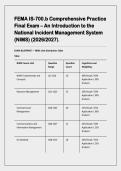
FEMA IS-700.b Comprehensive Practice
Final Exam – An Introduction to the
National Incident Management System
(NIMS) (2026/2027).
EXAM BLUEPRINT — NIMS Unit Distribution Table
Table
NIMS Course Unit Question Question Cognitive Level
Range Count Weighting
NIMS Fundamentals and Q1–Q10 10 40% Recall / 40%
Concepts Application / 20%
Analysis
Resource Management Q11–Q25 15 20% Recall / 50%
Application / 30%
Analysis
Command and Q26–Q45 20 15% Recall / 55%
Management Application / 30%
Analysis
Communications and Q46–Q57 12 25% Recall / 50%
Information Management Application / 25%
Analysis
ICS Detailed Q58–Q75 18 20% Recall / 55%
Application / 25%
Analysis
, NIMS Course Unit Question Question Cognitive Level
Range Count Weighting
Multiagency Coordination Q76–Q87 12 15% Recall / 55%
Application / 30%
Analysis
Preparedness and Planning Q88–Q95 8 30% Recall / 50%
Application / 20%
Analysis
Incident Management Q96–Q100 10* 20% Recall / 50%
Principles Application / 30%
Analysis
NIMS Implementation (Integrated) 5* 30% Recall / 40%
Application / 30%
Analysis
TOTAL Q1–Q100 100 25% Recall / 55%
Application / 20%
Analysis
*Note: Incident Management Principles and NIMS Implementation questions are integrated
within scenario sets and standard questions throughout the exam.
SECTION 1: NIMS FUNDAMENTALS AND CONCEPTS
Questions 1–10
Q1: Which Homeland Security Presidential Directive mandated the establishment of the
National Incident Management System (NIMS) to provide a consistent nationwide framework
for incident management?
,A. HSPD-3
B. HSPD-5
C. HSPD-7
D. HSPD-8
Correct Answer: B [CORRECT]
Rationale: Homeland Security Presidential Directive 5 (HSPD-5), issued February 28, 2003,
mandated the development and administration of NIMS to ensure all levels of government and
the private sector adopt a unified approach to incident management. HSPD-5 specifically
directed the Secretary of Homeland Security to develop NIMS.
Q2: A county emergency manager is explaining NIMS to newly elected officials. Which
statement best describes the relationship between NIMS and the Incident Command System
(ICS)?
A. NIMS and ICS are interchangeable terms describing the same incident management
structure.
B. ICS is a standardized on-scene management system that functions as one component within
the broader NIMS framework.
C. NIMS is a subcomponent of ICS used only for large-scale multi-jurisdictional incidents.
D. ICS applies only to federal agencies, while NIMS applies only to state and local agencies.
Correct Answer: B [CORRECT]
Rationale: NIMS is the comprehensive national framework for incident management, while ICS
is one of three NIMS components (along with Resource Management and
Communications/Information Management) focused specifically on on-scene incident
command and management. ICS operates within the NIMS structure.
Q3: During a regional flooding event, a tribal nation, two counties, a state agency, and federal
partners are all operating under NIMS. Which NIMS guiding principle ensures that all these
entities can integrate their efforts while maintaining their distinct authorities and
responsibilities?
A. Standardization
B. Flexibility
C. Unity of effort
D. Scalability
, Correct Answer: C [CORRECT]
Rationale: Unity of effort is a core NIMS guiding principle that ensures coordinated cooperation
among diverse organizations toward common objectives without requiring the loss of individual
authority, organizational identity, or autonomy. It enables seamless integration across federal,
state, tribal, and local levels.
Q4: The Whole Community approach to emergency management emphasizes which of the
following as essential elements of building national preparedness?
A. Federal oversight of all local emergency operations with minimal community input
B. Engaging individuals, families, communities, the private sector, and government in collective
preparedness
C. Restricting emergency planning to government agencies only to maintain operational security
D. Centralizing all emergency decisions at the federal level for consistency
Correct Answer: B [CORRECT]
Rationale: The Whole Community approach is a NIMS principle that recognizes the importance
of involving all segments of society—including individuals, families, community organizations,
the private sector, and non-governmental organizations—in preparedness, response, and
recovery activities to build collective resilience.
Q5: A state emergency management director needs to clarify the legal requirements for NIMS
adoption. Which statement accurately reflects NIMS mandates and applicability?
A. NIMS compliance is mandatory only for federal agencies responding to incidents outside their
jurisdiction.
B. NIMS adoption is required for federal departments and agencies, and federal preparedness
grants require state, tribal, and local adoption.
C. NIMS is a voluntary framework with no connection to federal funding or grant requirements.
D. NIMS applies exclusively to natural disasters and does not cover technological or human-
caused incidents.
Correct Answer: B [CORRECT]
Rationale: HSPD-5 mandates NIMS adoption for all federal departments and agencies.
Additionally, federal preparedness grant programs require state, tribal, and local entities to
adopt NIMS as a condition of receiving federal preparedness funding, ensuring nationwide
standardization.
Final Exam – An Introduction to the
National Incident Management System
(NIMS) (2026/2027).
EXAM BLUEPRINT — NIMS Unit Distribution Table
Table
NIMS Course Unit Question Question Cognitive Level
Range Count Weighting
NIMS Fundamentals and Q1–Q10 10 40% Recall / 40%
Concepts Application / 20%
Analysis
Resource Management Q11–Q25 15 20% Recall / 50%
Application / 30%
Analysis
Command and Q26–Q45 20 15% Recall / 55%
Management Application / 30%
Analysis
Communications and Q46–Q57 12 25% Recall / 50%
Information Management Application / 25%
Analysis
ICS Detailed Q58–Q75 18 20% Recall / 55%
Application / 25%
Analysis
, NIMS Course Unit Question Question Cognitive Level
Range Count Weighting
Multiagency Coordination Q76–Q87 12 15% Recall / 55%
Application / 30%
Analysis
Preparedness and Planning Q88–Q95 8 30% Recall / 50%
Application / 20%
Analysis
Incident Management Q96–Q100 10* 20% Recall / 50%
Principles Application / 30%
Analysis
NIMS Implementation (Integrated) 5* 30% Recall / 40%
Application / 30%
Analysis
TOTAL Q1–Q100 100 25% Recall / 55%
Application / 20%
Analysis
*Note: Incident Management Principles and NIMS Implementation questions are integrated
within scenario sets and standard questions throughout the exam.
SECTION 1: NIMS FUNDAMENTALS AND CONCEPTS
Questions 1–10
Q1: Which Homeland Security Presidential Directive mandated the establishment of the
National Incident Management System (NIMS) to provide a consistent nationwide framework
for incident management?
,A. HSPD-3
B. HSPD-5
C. HSPD-7
D. HSPD-8
Correct Answer: B [CORRECT]
Rationale: Homeland Security Presidential Directive 5 (HSPD-5), issued February 28, 2003,
mandated the development and administration of NIMS to ensure all levels of government and
the private sector adopt a unified approach to incident management. HSPD-5 specifically
directed the Secretary of Homeland Security to develop NIMS.
Q2: A county emergency manager is explaining NIMS to newly elected officials. Which
statement best describes the relationship between NIMS and the Incident Command System
(ICS)?
A. NIMS and ICS are interchangeable terms describing the same incident management
structure.
B. ICS is a standardized on-scene management system that functions as one component within
the broader NIMS framework.
C. NIMS is a subcomponent of ICS used only for large-scale multi-jurisdictional incidents.
D. ICS applies only to federal agencies, while NIMS applies only to state and local agencies.
Correct Answer: B [CORRECT]
Rationale: NIMS is the comprehensive national framework for incident management, while ICS
is one of three NIMS components (along with Resource Management and
Communications/Information Management) focused specifically on on-scene incident
command and management. ICS operates within the NIMS structure.
Q3: During a regional flooding event, a tribal nation, two counties, a state agency, and federal
partners are all operating under NIMS. Which NIMS guiding principle ensures that all these
entities can integrate their efforts while maintaining their distinct authorities and
responsibilities?
A. Standardization
B. Flexibility
C. Unity of effort
D. Scalability
, Correct Answer: C [CORRECT]
Rationale: Unity of effort is a core NIMS guiding principle that ensures coordinated cooperation
among diverse organizations toward common objectives without requiring the loss of individual
authority, organizational identity, or autonomy. It enables seamless integration across federal,
state, tribal, and local levels.
Q4: The Whole Community approach to emergency management emphasizes which of the
following as essential elements of building national preparedness?
A. Federal oversight of all local emergency operations with minimal community input
B. Engaging individuals, families, communities, the private sector, and government in collective
preparedness
C. Restricting emergency planning to government agencies only to maintain operational security
D. Centralizing all emergency decisions at the federal level for consistency
Correct Answer: B [CORRECT]
Rationale: The Whole Community approach is a NIMS principle that recognizes the importance
of involving all segments of society—including individuals, families, community organizations,
the private sector, and non-governmental organizations—in preparedness, response, and
recovery activities to build collective resilience.
Q5: A state emergency management director needs to clarify the legal requirements for NIMS
adoption. Which statement accurately reflects NIMS mandates and applicability?
A. NIMS compliance is mandatory only for federal agencies responding to incidents outside their
jurisdiction.
B. NIMS adoption is required for federal departments and agencies, and federal preparedness
grants require state, tribal, and local adoption.
C. NIMS is a voluntary framework with no connection to federal funding or grant requirements.
D. NIMS applies exclusively to natural disasters and does not cover technological or human-
caused incidents.
Correct Answer: B [CORRECT]
Rationale: HSPD-5 mandates NIMS adoption for all federal departments and agencies.
Additionally, federal preparedness grant programs require state, tribal, and local entities to
adopt NIMS as a condition of receiving federal preparedness funding, ensuring nationwide
standardization.


