

TAP Travel Exam (2026) —
Comprehensive Practice Examination
Prepared for: ASTA/The Travel Institute TAP Certification Candidates
Total Questions: 100 | Time Limit: 2 hours 30 minutes
Passing Score: 70% (typical benchmark)
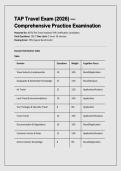
Domain Distribution Table
Table
Domain Questions Weight Cognitive Focus
Travel Industry Fundamentals 10 10% Recall/Application
Geography & Destination Knowledge 15 15% Recall/Analysis
Air Travel 12 12% Application/Analysis
Land Travel & Accommodations 10 10% Application
Tour Packages & Specialty Travel 8 8% Application
Cruise Travel 10 10% Application/Analysis
Documentation & Regulations 10 10% Recall/Application
Customer Service & Sales 12 12% Application/Analysis
Airline Industry Knowledge 8 8% Recall/Application
, Domain Questions Weight Cognitive Focus
Travel Technology 5 5% Recall
Cruise & Specialty Selling 10 10% Application/Analysis
TOTAL 100 100%
TRAVEL INDUSTRY FUNDAMENTALS (Questions 1–10)
Q1: Which organization serves as the primary trade association representing travel agencies and
travel advisors in the United States, advocating for industry standards and consumer
protection?
A. IATA (International Air Transport Association)
B. CLIA (Cruise Lines International Association)
C. ASTA (American Society of Travel Advisors) [CORRECT]
D. USTOA (United States Tour Operators Association)
Correct Answer: C
Rationale: ASTA is the leading trade association for travel agencies and advisors in the U.S.,
focusing on advocacy, education, and professional standards. IATA governs airline distribution,
CLIA represents cruise lines, and USTOA focuses on tour operators.
Q2: A travel advisor who operates under the umbrella of a larger established agency, using that
agency's ARC/IATA credentials and back-office support while maintaining their own client base,
is best described as:
A. An independent agency owner
B. A host agency affiliate [CORRECT]
C. A franchise operator
D. A consortium member
Correct Answer: B
Rationale: Host agency affiliates leverage the host's credentials, commission structures, and
operational support while running their own business. This differs from independent owners
who hold their own credentials, franchisees who pay for a branded system, and consortium
members who join for buying power.
,Q3: In the travel distribution channel, which system do traditional travel agencies primarily use
to access real-time airline inventory, fares, and booking capabilities?
A. OTA (Online Travel Agency) platform
B. GDS (Global Distribution System) [CORRECT]
C. NDC (New Distribution Capability) direct connect
D. Meta-search engine aggregator
Correct Answer: B
Rationale: GDS platforms (Amadeus, Sabre, Travelport) remain the primary booking tools for
traditional agencies, providing comprehensive access to airline, hotel, and car inventory. OTAs
are consumer-facing, NDC is an emerging direct-connect standard, and meta-search engines
compare prices without booking functionality.
Q4: A client traveling to visit friends and relatives in their home country, rather than for
business or traditional leisure purposes, represents which type of traveler segment?
A. Bleisure traveler
B. VFR (Visiting Friends and Relatives) traveler [CORRECT]
C. FIT (Foreign Independent Traveler)
D. MICE participant
Correct Answer: B
Rationale: VFR is a distinct and significant travel segment characterized by different booking
patterns, longer stays, and flexible dates. Bleisure combines business and leisure, FIT refers to
independent non-package travelers, and MICE covers meetings and events.
Q5: During which travel season would a Caribbean resort typically offer the lowest rates and
experience the highest probability of tropical weather systems?
A. Peak season (December–April)
B. Shoulder season (May, November)
C. Off-peak/Hurricane season (June–October) [CORRECT]
D. Holiday season (Christmas/New Year)
Correct Answer: C
Rationale: Caribbean off-peak season coincides with the Atlantic hurricane season (June–
November), bringing lower rates but increased weather risk. Peak season offers ideal weather at
premium prices, while shoulder seasons provide moderate rates with transitional weather.
Q6: A travel advisor earns 10% commission on a $3,500 cruise booking. If the advisor works
under a host agency that retains 30% of the gross commission, what is the advisor's net
commission?
Calculation: $3,500 × 10% = $350 gross commission; $350 × 70% = $245 net commission
[CORRECT]
, A. $350
B. $245 [CORRECT]
C. $105
D. $280
Correct Answer: B
Rationale: First calculate gross commission ($3,500 × 10% = $350), then apply the advisor's split
(100% − 30% host retention = 70%). $350 × 0.70 = $245. This reflects standard host agency
commission splits in the industry.
Q7: Which business model describes a group of independent travel agencies that join together
to increase their collective buying power, marketing resources, and supplier negotiating
leverage?
A. Franchise system
B. Host agency network
C. Consortium [CORRECT]
D. Online travel agency
Correct Answer: C
Rationale: Travel agency consortia (e.g., Virtuoso, Signature, Travel Leaders Network) unite
independent agencies for enhanced commissions, marketing support, and supplier
relationships. Franchises require brand standardization, host agencies provide back-office
support, and OTAs are direct-to-consumer.
Q8: Sustainable tourism practices in travel advising primarily focus on:
A. Maximizing commission revenue through high-volume bookings
B. Minimizing negative environmental and social impacts while supporting local communities
[CORRECT]
C. Booking only luxury properties regardless of their environmental policies
D. Encouraging clients to travel exclusively during off-peak seasons
Correct Answer: B
Rationale: Sustainable tourism emphasizes environmental conservation, cultural respect, and
economic benefits for local communities. It involves recommending eco-certified properties,
supporting local guides, and educating clients about responsible travel behaviors.
Q9: A "consolidator" in the airline distribution system primarily functions as:
A. An airline-owned customer service center
B. A wholesaler that negotiates discounted fares for resale to travel agencies [CORRECT]
C. A government agency regulating international airfares
D. A GDS system used exclusively by corporate travel departments
Correct Answer: B
Comprehensive Practice Examination
Prepared for: ASTA/The Travel Institute TAP Certification Candidates
Total Questions: 100 | Time Limit: 2 hours 30 minutes
Passing Score: 70% (typical benchmark)
Domain Distribution Table
Table
Domain Questions Weight Cognitive Focus
Travel Industry Fundamentals 10 10% Recall/Application
Geography & Destination Knowledge 15 15% Recall/Analysis
Air Travel 12 12% Application/Analysis
Land Travel & Accommodations 10 10% Application
Tour Packages & Specialty Travel 8 8% Application
Cruise Travel 10 10% Application/Analysis
Documentation & Regulations 10 10% Recall/Application
Customer Service & Sales 12 12% Application/Analysis
Airline Industry Knowledge 8 8% Recall/Application
, Domain Questions Weight Cognitive Focus
Travel Technology 5 5% Recall
Cruise & Specialty Selling 10 10% Application/Analysis
TOTAL 100 100%
TRAVEL INDUSTRY FUNDAMENTALS (Questions 1–10)
Q1: Which organization serves as the primary trade association representing travel agencies and
travel advisors in the United States, advocating for industry standards and consumer
protection?
A. IATA (International Air Transport Association)
B. CLIA (Cruise Lines International Association)
C. ASTA (American Society of Travel Advisors) [CORRECT]
D. USTOA (United States Tour Operators Association)
Correct Answer: C
Rationale: ASTA is the leading trade association for travel agencies and advisors in the U.S.,
focusing on advocacy, education, and professional standards. IATA governs airline distribution,
CLIA represents cruise lines, and USTOA focuses on tour operators.
Q2: A travel advisor who operates under the umbrella of a larger established agency, using that
agency's ARC/IATA credentials and back-office support while maintaining their own client base,
is best described as:
A. An independent agency owner
B. A host agency affiliate [CORRECT]
C. A franchise operator
D. A consortium member
Correct Answer: B
Rationale: Host agency affiliates leverage the host's credentials, commission structures, and
operational support while running their own business. This differs from independent owners
who hold their own credentials, franchisees who pay for a branded system, and consortium
members who join for buying power.
,Q3: In the travel distribution channel, which system do traditional travel agencies primarily use
to access real-time airline inventory, fares, and booking capabilities?
A. OTA (Online Travel Agency) platform
B. GDS (Global Distribution System) [CORRECT]
C. NDC (New Distribution Capability) direct connect
D. Meta-search engine aggregator
Correct Answer: B
Rationale: GDS platforms (Amadeus, Sabre, Travelport) remain the primary booking tools for
traditional agencies, providing comprehensive access to airline, hotel, and car inventory. OTAs
are consumer-facing, NDC is an emerging direct-connect standard, and meta-search engines
compare prices without booking functionality.
Q4: A client traveling to visit friends and relatives in their home country, rather than for
business or traditional leisure purposes, represents which type of traveler segment?
A. Bleisure traveler
B. VFR (Visiting Friends and Relatives) traveler [CORRECT]
C. FIT (Foreign Independent Traveler)
D. MICE participant
Correct Answer: B
Rationale: VFR is a distinct and significant travel segment characterized by different booking
patterns, longer stays, and flexible dates. Bleisure combines business and leisure, FIT refers to
independent non-package travelers, and MICE covers meetings and events.
Q5: During which travel season would a Caribbean resort typically offer the lowest rates and
experience the highest probability of tropical weather systems?
A. Peak season (December–April)
B. Shoulder season (May, November)
C. Off-peak/Hurricane season (June–October) [CORRECT]
D. Holiday season (Christmas/New Year)
Correct Answer: C
Rationale: Caribbean off-peak season coincides with the Atlantic hurricane season (June–
November), bringing lower rates but increased weather risk. Peak season offers ideal weather at
premium prices, while shoulder seasons provide moderate rates with transitional weather.
Q6: A travel advisor earns 10% commission on a $3,500 cruise booking. If the advisor works
under a host agency that retains 30% of the gross commission, what is the advisor's net
commission?
Calculation: $3,500 × 10% = $350 gross commission; $350 × 70% = $245 net commission
[CORRECT]
, A. $350
B. $245 [CORRECT]
C. $105
D. $280
Correct Answer: B
Rationale: First calculate gross commission ($3,500 × 10% = $350), then apply the advisor's split
(100% − 30% host retention = 70%). $350 × 0.70 = $245. This reflects standard host agency
commission splits in the industry.
Q7: Which business model describes a group of independent travel agencies that join together
to increase their collective buying power, marketing resources, and supplier negotiating
leverage?
A. Franchise system
B. Host agency network
C. Consortium [CORRECT]
D. Online travel agency
Correct Answer: C
Rationale: Travel agency consortia (e.g., Virtuoso, Signature, Travel Leaders Network) unite
independent agencies for enhanced commissions, marketing support, and supplier
relationships. Franchises require brand standardization, host agencies provide back-office
support, and OTAs are direct-to-consumer.
Q8: Sustainable tourism practices in travel advising primarily focus on:
A. Maximizing commission revenue through high-volume bookings
B. Minimizing negative environmental and social impacts while supporting local communities
[CORRECT]
C. Booking only luxury properties regardless of their environmental policies
D. Encouraging clients to travel exclusively during off-peak seasons
Correct Answer: B
Rationale: Sustainable tourism emphasizes environmental conservation, cultural respect, and
economic benefits for local communities. It involves recommending eco-certified properties,
supporting local guides, and educating clients about responsible travel behaviors.
Q9: A "consolidator" in the airline distribution system primarily functions as:
A. An airline-owned customer service center
B. A wholesaler that negotiates discounted fares for resale to travel agencies [CORRECT]
C. A government agency regulating international airfares
D. A GDS system used exclusively by corporate travel departments
Correct Answer: B


