

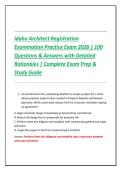
Idaho Architect Registration
Examination Practice Exam 2026 | 100
Questions & Answers with Detailed
Rationales | Complete Exam Prep &
Study Guide
1. An architecture firm is evaluating whether to accept a project for a client
whose previous projects have resulted in frequent disputes and delayed
payments. Which action best reduces the firm's business risk before signing
an agreement?
A. Begin schematic design immediately to demonstrate commitment
B. Reduce the design fee to compensate for potential risk
C. Perform client due diligence and establish clear contractual payment and scope
provisions
D. Assign the project to the firm's newest project architect
Answer: Perform client due diligence and establish clear contractual payment
and scope provisions
,Rationale: Evaluating the client's history and establishing explicit scope,
compensation, payment terms, responsibilities, and dispute procedures are
fundamental risk-management practices.
2. A firm wants to determine whether it has sufficient capacity to accept three
new projects beginning simultaneously. Which metric is most useful?
A. Number of registered architects in the firm
B. Available staff hours compared with projected project workload
C. Total square footage of projects completed last year
D. Firm's annual marketing expenditure
Answer: Available staff hours compared with projected project workload
Rationale: Resource planning requires comparing forecasted workload against
available staff capacity, including expected hours, skills, and timing.
3. A principal discovers that a project is consistently exceeding its budgeted
design hours. What is the most appropriate first step?
A. Immediately terminate the project
B. Determine the cause of the variance by comparing actual and planned labor
C. Increase the client's fee without discussion
D. Stop documenting the project
Answer: Determine the cause of the variance by comparing actual and planned
labor
Rationale: Variance analysis identifies whether overruns result from scope
changes, inefficient processes, staffing, coordination problems, or inaccurate
initial assumptions.
4. Which financial indicator most directly measures whether a project is
generating the expected profit?
A. Accounts payable
B. Project profitability
,C. Current ratio
D. Debt-to-equity ratio
Answer: Project profitability
Rationale: Project profitability compares project revenue with associated direct
and allocated costs and is therefore directly relevant to project performance.
5. A firm has substantial accounts receivable that are more than 120 days
overdue. What is the greatest immediate business concern?
A. Increased construction duration
B. Reduced cash flow
C. Increased design quality
D. Higher consultant coordination
Answer: Reduced cash flow
Rationale: Delayed collection of receivables reduces available cash even when
the firm has recognized revenue on its financial statements.
6. An architect is considering delegating a technical task to an employee.
Which factor should be considered most important?
A. Whether the employee has the lowest salary
B. Whether the employee has appropriate competence and supervision
C. Whether the employee has worked at the firm longest
D. Whether the employee prefers the assignment
Answer: Whether the employee has appropriate competence and supervision
Rationale: Delegation must account for qualifications, competence,
responsibility, and appropriate oversight.
7. A firm's workload forecast shows that several projects will require
structural expertise that its current staff does not possess. Which approach
is most appropriate?
, A. Assign structural design to an unqualified intern
B. Eliminate structural coordination
C. Obtain qualified internal or external structural expertise
D. Delay all projects indefinitely
Answer: Obtain qualified internal or external structural expertise
Rationale: Professional services must be performed by individuals with
appropriate knowledge and competence, with qualified consultants engaged
when necessary.
8. What is the primary purpose of a firm's quality assurance program?
A. Eliminate all project costs
B. Establish procedures that reduce errors and improve consistency
C. Replace professional judgment
D. Transfer all liability to consultants
Answer: Establish procedures that reduce errors and improve consistency
Rationale: Quality assurance establishes organizational processes for reviewing
work, coordinating information, and reducing preventable errors.
9. A project manager notices repeated drawing errors originating from the
same production process. Which action is most effective?
A. Correct every error individually without changing the process
B. Identify the root cause and improve the workflow
C. Assign blame to the drafter
D. Ignore minor errors
Answer: Identify the root cause and improve the workflow
Rationale: Corrective action is most effective when it addresses the systemic
cause rather than repeatedly treating individual symptoms.
10.Which business document most clearly defines the professional services
the architect has agreed to provide?
Examination Practice Exam 2026 | 100
Questions & Answers with Detailed
Rationales | Complete Exam Prep &
Study Guide
1. An architecture firm is evaluating whether to accept a project for a client
whose previous projects have resulted in frequent disputes and delayed
payments. Which action best reduces the firm's business risk before signing
an agreement?
A. Begin schematic design immediately to demonstrate commitment
B. Reduce the design fee to compensate for potential risk
C. Perform client due diligence and establish clear contractual payment and scope
provisions
D. Assign the project to the firm's newest project architect
Answer: Perform client due diligence and establish clear contractual payment
and scope provisions
,Rationale: Evaluating the client's history and establishing explicit scope,
compensation, payment terms, responsibilities, and dispute procedures are
fundamental risk-management practices.
2. A firm wants to determine whether it has sufficient capacity to accept three
new projects beginning simultaneously. Which metric is most useful?
A. Number of registered architects in the firm
B. Available staff hours compared with projected project workload
C. Total square footage of projects completed last year
D. Firm's annual marketing expenditure
Answer: Available staff hours compared with projected project workload
Rationale: Resource planning requires comparing forecasted workload against
available staff capacity, including expected hours, skills, and timing.
3. A principal discovers that a project is consistently exceeding its budgeted
design hours. What is the most appropriate first step?
A. Immediately terminate the project
B. Determine the cause of the variance by comparing actual and planned labor
C. Increase the client's fee without discussion
D. Stop documenting the project
Answer: Determine the cause of the variance by comparing actual and planned
labor
Rationale: Variance analysis identifies whether overruns result from scope
changes, inefficient processes, staffing, coordination problems, or inaccurate
initial assumptions.
4. Which financial indicator most directly measures whether a project is
generating the expected profit?
A. Accounts payable
B. Project profitability
,C. Current ratio
D. Debt-to-equity ratio
Answer: Project profitability
Rationale: Project profitability compares project revenue with associated direct
and allocated costs and is therefore directly relevant to project performance.
5. A firm has substantial accounts receivable that are more than 120 days
overdue. What is the greatest immediate business concern?
A. Increased construction duration
B. Reduced cash flow
C. Increased design quality
D. Higher consultant coordination
Answer: Reduced cash flow
Rationale: Delayed collection of receivables reduces available cash even when
the firm has recognized revenue on its financial statements.
6. An architect is considering delegating a technical task to an employee.
Which factor should be considered most important?
A. Whether the employee has the lowest salary
B. Whether the employee has appropriate competence and supervision
C. Whether the employee has worked at the firm longest
D. Whether the employee prefers the assignment
Answer: Whether the employee has appropriate competence and supervision
Rationale: Delegation must account for qualifications, competence,
responsibility, and appropriate oversight.
7. A firm's workload forecast shows that several projects will require
structural expertise that its current staff does not possess. Which approach
is most appropriate?
, A. Assign structural design to an unqualified intern
B. Eliminate structural coordination
C. Obtain qualified internal or external structural expertise
D. Delay all projects indefinitely
Answer: Obtain qualified internal or external structural expertise
Rationale: Professional services must be performed by individuals with
appropriate knowledge and competence, with qualified consultants engaged
when necessary.
8. What is the primary purpose of a firm's quality assurance program?
A. Eliminate all project costs
B. Establish procedures that reduce errors and improve consistency
C. Replace professional judgment
D. Transfer all liability to consultants
Answer: Establish procedures that reduce errors and improve consistency
Rationale: Quality assurance establishes organizational processes for reviewing
work, coordinating information, and reducing preventable errors.
9. A project manager notices repeated drawing errors originating from the
same production process. Which action is most effective?
A. Correct every error individually without changing the process
B. Identify the root cause and improve the workflow
C. Assign blame to the drafter
D. Ignore minor errors
Answer: Identify the root cause and improve the workflow
Rationale: Corrective action is most effective when it addresses the systemic
cause rather than repeatedly treating individual symptoms.
10.Which business document most clearly defines the professional services
the architect has agreed to provide?


