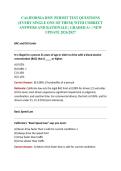
CALIFORNIA DMV PERMIT TEST QUESTIONS
(EVERY SINGLE ONE OF THEM) WITH CORRECT
ANSWERS AND RATIONALE | GRADED A+ | NEW
UPDATE 2026/2027
BAC and DUI Limits
It is illegal for a person 21 years of age or older to drive with a blood alcohol
concentration (BAC) that is ____ or higher.
A) 0.05%
B) 0.08% ✓
C) 0.10%
D) 0.15%
Correct Answer: B) 0.08%, 8 hundredths of a percent
Rationale: California law sets the legal BAC limit at 0.08% for drivers 21 and older.
At this level, most drivers experience significant impairment in judgment,
coordination, and reaction time. For commercial drivers, the limit is 0.04%, and for
drivers under 21, it's 0.01% (zero tolerance).
Basic Speed Law
California's "Basic Speed Law" says you must:
A) Never drive faster than is safe for current conditions ✓
B) Always drive the speed limit
C) Drive faster than traffic
D) Drive slower than traffic
Correct Answer: A) Never drive faster than is safe for current conditions
,Rationale: The Basic Speed Law requires driving at a speed safe for conditions—
not exceeding the speed limit, but also not driving too fast for weather, traffic, or
road conditions. Speed limits are maximums for ideal conditions. You can be cited
for speeding even at the posted limit if conditions require slower speeds.
Medication and Driving
Driving under the influence of any medication which impairs your driving is
permitted:
A) If prescribed by a doctor
B) Under no circumstances ✓
C) If you feel okay
D) During daytime only
Correct Answer: B) Under no circumstances
Rationale: Any medication that impairs driving ability makes it illegal to drive. This
includes prescription, over-the-counter, and illegal drugs. Check warnings before
taking medication and never drive if it makes you drowsy or impaired. The law
applies equally to all impairing substances.
Bike Lane Use
You may drive a motor vehicle in a bike lane:
A) At any time
B) No more than 200 feet before making a right turn ✓
C) Only in emergencies
D) To pass another vehicle
Correct Answer: B) No more than 200 feet before making a right turn
,Rationale: You may enter a bike lane only within 200 feet of making a right turn.
This allows you to position for the turn without endangering cyclists. Always yield
to cyclists before entering a bike lane. Driving in bike lanes for any other reason is
illegal.
Cell Phone Use
If your cell phone rings while you are driving and you do not have a hands-free
device you should:
A) Answer it quickly
B) Let the call go to voicemail ✓
C) Hold it to your ear
D) Pull over only if it's important
Correct Answer: B) Let the call go to voicemail
Rationale: Without a hands-free device, you cannot legally use your phone while
driving. Let calls go to voice mail and return them when parked. Distracted driving
is one of the leading causes of collisions. Even with hands-free, cognitive
distraction remains a concern.
Yellow Line Rules
A solid yellow line next to a broken yellow line means that vehicles:
A) Next to the broken line may pass ✓
B) Next to the solid line may pass
C) In either direction may pass
D) In neither direction may pass
Correct Answer: A) Next to the broken line may pass
, Rationale: When one line is solid and the other is broken, only the side with the
broken line may pass. The solid line side cannot pass. This often occurs on hills or
curves where visibility is limited for one direction. Always obey these markings for
safety.
Uphill Parking (No Curb)
You want to park uphill on a two-way road and there is no curb. Which direction
do you turn your front wheels?
A) Left, away from the side of the road
B) Right, toward the side of the road ✓
C) Straight ahead
D) It doesn't matter
Correct Answer: B) Right, toward the side of the road
Rationale: Without a curb, turn your wheels to the right when parking uphill. This
directs the vehicle off the road if it rolls backward. Always set the parking brake.
The right turn directs the vehicle away from traffic and onto the shoulder.
Minor Collision Procedure
You are involved in a minor collision at an intersection. There are no injuries and
there is very little vehicle damage. You should:
A) Leave the vehicles where they are
B) Move your vehicle out of the traffic lane, if possible ✓
C) Exchange insurance information only
D) Wait for the police to arrive
Correct Answer: B) Move your vehicle out of the traffic lane, if possible
(EVERY SINGLE ONE OF THEM) WITH CORRECT
ANSWERS AND RATIONALE | GRADED A+ | NEW
UPDATE 2026/2027
BAC and DUI Limits
It is illegal for a person 21 years of age or older to drive with a blood alcohol
concentration (BAC) that is ____ or higher.
A) 0.05%
B) 0.08% ✓
C) 0.10%
D) 0.15%
Correct Answer: B) 0.08%, 8 hundredths of a percent
Rationale: California law sets the legal BAC limit at 0.08% for drivers 21 and older.
At this level, most drivers experience significant impairment in judgment,
coordination, and reaction time. For commercial drivers, the limit is 0.04%, and for
drivers under 21, it's 0.01% (zero tolerance).
Basic Speed Law
California's "Basic Speed Law" says you must:
A) Never drive faster than is safe for current conditions ✓
B) Always drive the speed limit
C) Drive faster than traffic
D) Drive slower than traffic
Correct Answer: A) Never drive faster than is safe for current conditions
,Rationale: The Basic Speed Law requires driving at a speed safe for conditions—
not exceeding the speed limit, but also not driving too fast for weather, traffic, or
road conditions. Speed limits are maximums for ideal conditions. You can be cited
for speeding even at the posted limit if conditions require slower speeds.
Medication and Driving
Driving under the influence of any medication which impairs your driving is
permitted:
A) If prescribed by a doctor
B) Under no circumstances ✓
C) If you feel okay
D) During daytime only
Correct Answer: B) Under no circumstances
Rationale: Any medication that impairs driving ability makes it illegal to drive. This
includes prescription, over-the-counter, and illegal drugs. Check warnings before
taking medication and never drive if it makes you drowsy or impaired. The law
applies equally to all impairing substances.
Bike Lane Use
You may drive a motor vehicle in a bike lane:
A) At any time
B) No more than 200 feet before making a right turn ✓
C) Only in emergencies
D) To pass another vehicle
Correct Answer: B) No more than 200 feet before making a right turn
,Rationale: You may enter a bike lane only within 200 feet of making a right turn.
This allows you to position for the turn without endangering cyclists. Always yield
to cyclists before entering a bike lane. Driving in bike lanes for any other reason is
illegal.
Cell Phone Use
If your cell phone rings while you are driving and you do not have a hands-free
device you should:
A) Answer it quickly
B) Let the call go to voicemail ✓
C) Hold it to your ear
D) Pull over only if it's important
Correct Answer: B) Let the call go to voicemail
Rationale: Without a hands-free device, you cannot legally use your phone while
driving. Let calls go to voice mail and return them when parked. Distracted driving
is one of the leading causes of collisions. Even with hands-free, cognitive
distraction remains a concern.
Yellow Line Rules
A solid yellow line next to a broken yellow line means that vehicles:
A) Next to the broken line may pass ✓
B) Next to the solid line may pass
C) In either direction may pass
D) In neither direction may pass
Correct Answer: A) Next to the broken line may pass
, Rationale: When one line is solid and the other is broken, only the side with the
broken line may pass. The solid line side cannot pass. This often occurs on hills or
curves where visibility is limited for one direction. Always obey these markings for
safety.
Uphill Parking (No Curb)
You want to park uphill on a two-way road and there is no curb. Which direction
do you turn your front wheels?
A) Left, away from the side of the road
B) Right, toward the side of the road ✓
C) Straight ahead
D) It doesn't matter
Correct Answer: B) Right, toward the side of the road
Rationale: Without a curb, turn your wheels to the right when parking uphill. This
directs the vehicle off the road if it rolls backward. Always set the parking brake.
The right turn directs the vehicle away from traffic and onto the shoulder.
Minor Collision Procedure
You are involved in a minor collision at an intersection. There are no injuries and
there is very little vehicle damage. You should:
A) Leave the vehicles where they are
B) Move your vehicle out of the traffic lane, if possible ✓
C) Exchange insurance information only
D) Wait for the police to arrive
Correct Answer: B) Move your vehicle out of the traffic lane, if possible