

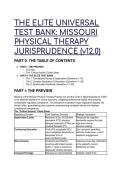
THE ELITE UNIVERSAL
TEST BANK: MISSOURI
PHYSICAL THERAPY
JURISPRUDENCE (v12.0)
PART 0: THE TABLE OF CONTENTS
● PART I: THE PREVIEW
○ The Intro
○ The "Critical Axioms" Cheat Sheet
● PART II: THE ELITE TEST BANK
○ Tier 1: Foundational Syntax & Application (Questions 1–10)
○ Tier 2: Complex Application & Simulation (Questions 11–20)
○ Tier 3: Grandmaster Synthesis (Questions 21–30)
PART I: THE PREVIEW
Mastery of the Missouri Physical Therapy Practice Act and the Code of State Regulations (CSR)
is the absolute baseline for clinical autonomy, mitigating professional liability, and ensuring
unassailable regulatory compliance. This exhaustive evaluation forges legislative statutes into
clinical reflex, guaranteeing that academic understanding translates directly into flawless
jurisdictional competence.
The "Critical Axioms" Cheat Sheet
Regulatory Domain Core Statutory Directive Strategic Implication
Supervision Limits Maximum of four (4) full-time Preserves the cognitive
equivalent (FTE) physical bandwidth required for safe,
therapist assistants (PTAs) per high-level clinical
physical therapist (PT). decision-making.
Continuing Education Thirty (30) acceptable CEU Zero carryover permitted;
hours completed biennially by enforces continuous, current
December 31st of academic engagement.
even-numbered years.
Direct Access Treatment permitted for Requires seven-day notification
recurring self-limited injuries to the patient's current
(within 1 year) or previously healthcare provider.
diagnosed chronic illnesses.
Compact Privilege Requires an unencumbered Instantly voided if the
,Regulatory Domain Core Statutory Directive Strategic Implication
home state license for two practitioner changes their
years and a passing score on permanent residency/driver's
the local jurisprudence exam. license.
Temporary Licensure Valid only until the first attempt Immediate invalidation upon
at the National Physical exam failure; further practice is
Therapy Examination (NPTE) is a Class B misdemeanor.
scored.
PART II: THE ELITE TEST BANK
Tier 1: Foundational Syntax & Application
Q1: A licensed physical therapist in Missouri is finalizing their administrative compliance for
license renewal. Regarding the mandatory continuing education (CE) requirements dictated by
20 CSR 2150-3.201, which schedule and hourly mandate is MOST ACCURATE? A)
Twenty-four (24) hours of continuing education must be completed annually by January 31st,
allowing a maximum of five (5) hours to carry over to the next cycle. B) Thirty (30) hours of
continuing education must be completed biennially by December 31st of odd-numbered years to
qualify for January renewal. C) Thirty (30) hours of acceptable continuing education must be
completed biennially by December 31st of each even-numbered year, with no carryover
permitted. D) Fifty (50) hours of acceptable continuing education must be completed every two
years, specifically verified by submitting paper certificates directly to the Board prior to renewal.
● Answer: C (Thirty (30) hours of acceptable continuing education must be completed
biennially by December 31st of each even-numbered year, with no carryover permitted.)
● Distractor Analysis:
○ A is incorrect: The State of Missouri requires thirty (30) hours biennially, not
twenty-four (24) hours annually, and the administrative code strictly forbids the
carryover of excess CEU hours to subsequent reporting periods.
○ B is incorrect: While the actual license expiration occurs on January 31st of
odd-numbered years, the CEU completion deadline is strictly mandated as
December 31st of the preceding even-numbered year to allow for processing.
○ D is incorrect: The statutory requirement is thirty (30) hours, not fifty (50).
Furthermore, licensees certify compliance by attestation on the renewal form;
physical certificates are only submitted if the practitioner is formally audited by the
Board.
The Mentor's Analysis: Regulatory deadlines within the Missouri Board of Registration for the
Healing Arts are inflexible. The mandate to complete thirty (30) CEU hours by the end of
even-numbered years ensures administrative synchronization prior to the January 31st
expiration date in odd-numbered years. By utilizing attestation at renewal, the Board places the
burden of proof—and the requirement for a four-year record retention—entirely on the
professional. Professional/Academic Intuition: The practitioner must never confuse the
CEU completion deadline (December 31st, even years) with the license expiration date
(January 31st, odd years).
Q2: A clinical director is designing the staffing matrix for a high-volume outpatient rehabilitation
facility. To maintain strict compliance with Missouri delegation parameters, which staffing ratio
represents the MAXIMUM allowable limit for a single supervising physical therapist? A) Five (5)
physical therapist assistants, provided two are part-time and the total combined clinical hours do
, not exceed 100 hours per week. B) Four (4) physical therapist assistants and two (2) physical
therapy technicians, provided the technicians only perform non-clinical administrative tasks. C)
Four (4) full-time equivalent physical therapist assistants, predicated on the complexity and
acuity of the patients' needs and proximity to the supervising PT. D) Three (3) full-time
equivalent physical therapist assistants and two (2) entry-level CAPTE-approved physical
therapy students.
● Answer: C (Four (4) full-time equivalent physical therapist assistants, predicated on the
complexity and acuity of the patients' needs and proximity to the supervising PT.)
● Distractor Analysis:
○ A is incorrect: The absolute legal ceiling established by 20 CSR 2150-3.090 is four
(4) full-time equivalents (FTEs). Structuring split shifts to manage five individuals
while remaining under an arbitrary hour limit still requires the PT to assume liability
for an excessive number of clinical licenses, though the FTE math determines
compliance.
○ B is incorrect: While unlicensed technicians can perform non-clinical tasks, the
statute specifically dictates the supervision of licensed assistants to four FTEs
without explicitly bundling technicians into the statutory language, making this a
distorted, convoluted interpretation of the core delegation law.
○ D is incorrect: This option arbitrarily limits the PTA ratio to three (3) and incorrectly
conflates the supervision laws governing PTAs with the distinct, separate
supervision parameters established for clinical education students.
The Mentor's Analysis: Safe clinical delegation requires manageable cognitive bandwidth.
Missouri law caps a PT's supervisory span at four full-time equivalent PTAs to prevent the
dilution of clinical oversight and to maintain patient safety. By utilizing full-time equivalents rather
than a strict headcount, the legislation provides operational flexibility for part-time staffing while
establishing a hard, unyielding ceiling on total supervised clinical hours.
Professional/Academic Intuition: Supervisory caps constitute absolute legal boundaries;
surpassing four (4) FTE PTAs constitutes immediate disciplinary grounds for both the
directing physical therapist and the facility.
Q3: A recent graduate applies for a temporary license in Missouri while awaiting their scheduled
National Physical Therapy Examination (NPTE). Under which specific circumstance does this
temporary license IMMEDIATELY become invalid under 20 CSR 2150-3.150? A) The temporary
licensee accepts employment in a rural healthcare facility located more than fifty miles from the
supervising physical therapist's primary residence. B) The temporary licensee completes ninety
(90) days of practice without taking the examination, regardless of the scheduled testing dates.
C) The temporary licensee fails the national licensure examination on their first attempt. D) The
supervising physical therapist delegates the review of the temporary licensee's clinical
documentation to a highly experienced physical therapist assistant.
● Answer: C (The temporary licensee fails the national licensure examination on their first
attempt.)
● Distractor Analysis:
○ A is incorrect: Geographic distance is not a statutory disqualifier for temporary
licensure provided standard supervision protocols and communication accessibility
are maintained.
○ B is incorrect: If the licensee passes the exam within 90 days, the license remains
valid until the permanent license is formally issued. While delaying the exam past
90 days introduces administrative hurdles, failure is the explicit trigger for
automatic, instantaneous invalidation.
TEST BANK: MISSOURI
PHYSICAL THERAPY
JURISPRUDENCE (v12.0)
PART 0: THE TABLE OF CONTENTS
● PART I: THE PREVIEW
○ The Intro
○ The "Critical Axioms" Cheat Sheet
● PART II: THE ELITE TEST BANK
○ Tier 1: Foundational Syntax & Application (Questions 1–10)
○ Tier 2: Complex Application & Simulation (Questions 11–20)
○ Tier 3: Grandmaster Synthesis (Questions 21–30)
PART I: THE PREVIEW
Mastery of the Missouri Physical Therapy Practice Act and the Code of State Regulations (CSR)
is the absolute baseline for clinical autonomy, mitigating professional liability, and ensuring
unassailable regulatory compliance. This exhaustive evaluation forges legislative statutes into
clinical reflex, guaranteeing that academic understanding translates directly into flawless
jurisdictional competence.
The "Critical Axioms" Cheat Sheet
Regulatory Domain Core Statutory Directive Strategic Implication
Supervision Limits Maximum of four (4) full-time Preserves the cognitive
equivalent (FTE) physical bandwidth required for safe,
therapist assistants (PTAs) per high-level clinical
physical therapist (PT). decision-making.
Continuing Education Thirty (30) acceptable CEU Zero carryover permitted;
hours completed biennially by enforces continuous, current
December 31st of academic engagement.
even-numbered years.
Direct Access Treatment permitted for Requires seven-day notification
recurring self-limited injuries to the patient's current
(within 1 year) or previously healthcare provider.
diagnosed chronic illnesses.
Compact Privilege Requires an unencumbered Instantly voided if the
,Regulatory Domain Core Statutory Directive Strategic Implication
home state license for two practitioner changes their
years and a passing score on permanent residency/driver's
the local jurisprudence exam. license.
Temporary Licensure Valid only until the first attempt Immediate invalidation upon
at the National Physical exam failure; further practice is
Therapy Examination (NPTE) is a Class B misdemeanor.
scored.
PART II: THE ELITE TEST BANK
Tier 1: Foundational Syntax & Application
Q1: A licensed physical therapist in Missouri is finalizing their administrative compliance for
license renewal. Regarding the mandatory continuing education (CE) requirements dictated by
20 CSR 2150-3.201, which schedule and hourly mandate is MOST ACCURATE? A)
Twenty-four (24) hours of continuing education must be completed annually by January 31st,
allowing a maximum of five (5) hours to carry over to the next cycle. B) Thirty (30) hours of
continuing education must be completed biennially by December 31st of odd-numbered years to
qualify for January renewal. C) Thirty (30) hours of acceptable continuing education must be
completed biennially by December 31st of each even-numbered year, with no carryover
permitted. D) Fifty (50) hours of acceptable continuing education must be completed every two
years, specifically verified by submitting paper certificates directly to the Board prior to renewal.
● Answer: C (Thirty (30) hours of acceptable continuing education must be completed
biennially by December 31st of each even-numbered year, with no carryover permitted.)
● Distractor Analysis:
○ A is incorrect: The State of Missouri requires thirty (30) hours biennially, not
twenty-four (24) hours annually, and the administrative code strictly forbids the
carryover of excess CEU hours to subsequent reporting periods.
○ B is incorrect: While the actual license expiration occurs on January 31st of
odd-numbered years, the CEU completion deadline is strictly mandated as
December 31st of the preceding even-numbered year to allow for processing.
○ D is incorrect: The statutory requirement is thirty (30) hours, not fifty (50).
Furthermore, licensees certify compliance by attestation on the renewal form;
physical certificates are only submitted if the practitioner is formally audited by the
Board.
The Mentor's Analysis: Regulatory deadlines within the Missouri Board of Registration for the
Healing Arts are inflexible. The mandate to complete thirty (30) CEU hours by the end of
even-numbered years ensures administrative synchronization prior to the January 31st
expiration date in odd-numbered years. By utilizing attestation at renewal, the Board places the
burden of proof—and the requirement for a four-year record retention—entirely on the
professional. Professional/Academic Intuition: The practitioner must never confuse the
CEU completion deadline (December 31st, even years) with the license expiration date
(January 31st, odd years).
Q2: A clinical director is designing the staffing matrix for a high-volume outpatient rehabilitation
facility. To maintain strict compliance with Missouri delegation parameters, which staffing ratio
represents the MAXIMUM allowable limit for a single supervising physical therapist? A) Five (5)
physical therapist assistants, provided two are part-time and the total combined clinical hours do
, not exceed 100 hours per week. B) Four (4) physical therapist assistants and two (2) physical
therapy technicians, provided the technicians only perform non-clinical administrative tasks. C)
Four (4) full-time equivalent physical therapist assistants, predicated on the complexity and
acuity of the patients' needs and proximity to the supervising PT. D) Three (3) full-time
equivalent physical therapist assistants and two (2) entry-level CAPTE-approved physical
therapy students.
● Answer: C (Four (4) full-time equivalent physical therapist assistants, predicated on the
complexity and acuity of the patients' needs and proximity to the supervising PT.)
● Distractor Analysis:
○ A is incorrect: The absolute legal ceiling established by 20 CSR 2150-3.090 is four
(4) full-time equivalents (FTEs). Structuring split shifts to manage five individuals
while remaining under an arbitrary hour limit still requires the PT to assume liability
for an excessive number of clinical licenses, though the FTE math determines
compliance.
○ B is incorrect: While unlicensed technicians can perform non-clinical tasks, the
statute specifically dictates the supervision of licensed assistants to four FTEs
without explicitly bundling technicians into the statutory language, making this a
distorted, convoluted interpretation of the core delegation law.
○ D is incorrect: This option arbitrarily limits the PTA ratio to three (3) and incorrectly
conflates the supervision laws governing PTAs with the distinct, separate
supervision parameters established for clinical education students.
The Mentor's Analysis: Safe clinical delegation requires manageable cognitive bandwidth.
Missouri law caps a PT's supervisory span at four full-time equivalent PTAs to prevent the
dilution of clinical oversight and to maintain patient safety. By utilizing full-time equivalents rather
than a strict headcount, the legislation provides operational flexibility for part-time staffing while
establishing a hard, unyielding ceiling on total supervised clinical hours.
Professional/Academic Intuition: Supervisory caps constitute absolute legal boundaries;
surpassing four (4) FTE PTAs constitutes immediate disciplinary grounds for both the
directing physical therapist and the facility.
Q3: A recent graduate applies for a temporary license in Missouri while awaiting their scheduled
National Physical Therapy Examination (NPTE). Under which specific circumstance does this
temporary license IMMEDIATELY become invalid under 20 CSR 2150-3.150? A) The temporary
licensee accepts employment in a rural healthcare facility located more than fifty miles from the
supervising physical therapist's primary residence. B) The temporary licensee completes ninety
(90) days of practice without taking the examination, regardless of the scheduled testing dates.
C) The temporary licensee fails the national licensure examination on their first attempt. D) The
supervising physical therapist delegates the review of the temporary licensee's clinical
documentation to a highly experienced physical therapist assistant.
● Answer: C (The temporary licensee fails the national licensure examination on their first
attempt.)
● Distractor Analysis:
○ A is incorrect: Geographic distance is not a statutory disqualifier for temporary
licensure provided standard supervision protocols and communication accessibility
are maintained.
○ B is incorrect: If the licensee passes the exam within 90 days, the license remains
valid until the permanent license is formally issued. While delaying the exam past
90 days introduces administrative hurdles, failure is the explicit trigger for
automatic, instantaneous invalidation.


