

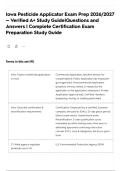
Iowa Pesticide Applicator Exam Prep 2026/2027
— Verified A+ Study Guide|Questions and
Answers | Complete Certification Exam
Preparation Study Guide
Terms in this set (91)
Intro: Types of pesticide applicators Commercial Applicators (another person for
in Iowa compensation); Public Applicators (as employee
govt agencies); Noncommercial Applicators
(property owned, rented, or leased by the
applicator or the applicator's employer); Private
Applicators (agricultural); Certified Handlers
(preparing, mixing, or loading pesticides)
Intro: Describe certification & Certification: Employed by a certified, licensed
recertification requirements company; fee paid to IDALS; 21-day grace period
(direct supervision); closed-book exam.
Recertification: 3-year qualification cycle;
renewable by either testing every third year or
attending approved continuing instruction
courses (CIC); core & categories; fee & you get a
form.
C1: What agency regulates U.S. Environmental Protection Agency (EPA)
pesticide use in US
,C1: Summarize pesticide FIFRA requires the EPA to regulate the sale & use
registration & re-registration & they do this through registration & labeling of
pesticide products; human health & the
environment. Re-registration FIFRA requires EPA
to conduct comprehensive reviews of older
pesticides human health & environmental effects
C1: Understand the penalties for Violations of the legal provisions established in
violations of FIFRA FIFRA civil penalties as much as $6,500 for each
offense; violation of the law also may subject you
to criminal penalties up to $25,000 or one year in
prison, or both.
C1: FIFRA Federal Insecticide, Fungicide, and Rodenticide
Act (1947) regulates the production,
transportation, sale, use, & disposal of all
pesticides
C1: FFDCA Federal Food, Drug, and Cosmetic Act sets
allowable residue levels to ensure the safety of
the food supply
C1: FQPA Food Quality Protection Act amended both
FIFRA & FFDCA & set a tougher standard for
pesticides on food.
C1: Residues & Tolerances Residues: Small amounts of pesticides on fruits,
vegetables, grains, other foods, & animal feeds.
Tolerances: the EPA sets allowable residue levels
under FFDCA regs, safe tolerances "a reasonable
certainty of no harm".
, C1: How does the ESA relate to The Endangered Species Act (ESA): Pesticides
pesticides use may directly or indirectly, through drift and
runoff, affect endangered or threatened species
& their habitat.
C1: Summarize RCRA Resource Conservation and Recovery Act (RCRA)
gives EPA the authority to control hazardous
waste from the "cradle-to-grave", rinsates &
hazardous waste; become solid wastes when you
want to discard.
C1: Who is protected by the WPS Worker Protection Standard (WPS) helps protect
employees on farms, forests, nurseries, &
greenhouses from occupational exposure.
C2: List the requirements of 1) Name & certification number of licensee; 2)
pesticide applicator records Name & address of landowner or customer; 3)
Address of the place of application of pesticide;
4) Date of application; 5) Trade name of
pesticide;
6) Quantity of pesticide used & the concentration
or rate of application; 7) Temperature and
direction & velocity of wind; 8) the use of
"restricted use" pesticides; 9) Time pesticide
application begins & ends.
— Verified A+ Study Guide|Questions and
Answers | Complete Certification Exam
Preparation Study Guide
Terms in this set (91)
Intro: Types of pesticide applicators Commercial Applicators (another person for
in Iowa compensation); Public Applicators (as employee
govt agencies); Noncommercial Applicators
(property owned, rented, or leased by the
applicator or the applicator's employer); Private
Applicators (agricultural); Certified Handlers
(preparing, mixing, or loading pesticides)
Intro: Describe certification & Certification: Employed by a certified, licensed
recertification requirements company; fee paid to IDALS; 21-day grace period
(direct supervision); closed-book exam.
Recertification: 3-year qualification cycle;
renewable by either testing every third year or
attending approved continuing instruction
courses (CIC); core & categories; fee & you get a
form.
C1: What agency regulates U.S. Environmental Protection Agency (EPA)
pesticide use in US
,C1: Summarize pesticide FIFRA requires the EPA to regulate the sale & use
registration & re-registration & they do this through registration & labeling of
pesticide products; human health & the
environment. Re-registration FIFRA requires EPA
to conduct comprehensive reviews of older
pesticides human health & environmental effects
C1: Understand the penalties for Violations of the legal provisions established in
violations of FIFRA FIFRA civil penalties as much as $6,500 for each
offense; violation of the law also may subject you
to criminal penalties up to $25,000 or one year in
prison, or both.
C1: FIFRA Federal Insecticide, Fungicide, and Rodenticide
Act (1947) regulates the production,
transportation, sale, use, & disposal of all
pesticides
C1: FFDCA Federal Food, Drug, and Cosmetic Act sets
allowable residue levels to ensure the safety of
the food supply
C1: FQPA Food Quality Protection Act amended both
FIFRA & FFDCA & set a tougher standard for
pesticides on food.
C1: Residues & Tolerances Residues: Small amounts of pesticides on fruits,
vegetables, grains, other foods, & animal feeds.
Tolerances: the EPA sets allowable residue levels
under FFDCA regs, safe tolerances "a reasonable
certainty of no harm".
, C1: How does the ESA relate to The Endangered Species Act (ESA): Pesticides
pesticides use may directly or indirectly, through drift and
runoff, affect endangered or threatened species
& their habitat.
C1: Summarize RCRA Resource Conservation and Recovery Act (RCRA)
gives EPA the authority to control hazardous
waste from the "cradle-to-grave", rinsates &
hazardous waste; become solid wastes when you
want to discard.
C1: Who is protected by the WPS Worker Protection Standard (WPS) helps protect
employees on farms, forests, nurseries, &
greenhouses from occupational exposure.
C2: List the requirements of 1) Name & certification number of licensee; 2)
pesticide applicator records Name & address of landowner or customer; 3)
Address of the place of application of pesticide;
4) Date of application; 5) Trade name of
pesticide;
6) Quantity of pesticide used & the concentration
or rate of application; 7) Temperature and
direction & velocity of wind; 8) the use of
"restricted use" pesticides; 9) Time pesticide
application begins & ends.


