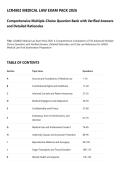
LCR4802 MEDICAL LAW EXAM PACK 2026
Comprehensive Multiple-Choice Question Bank with Verified Answers
and Detailed Rationales
Title: LCR4802 Medical Law Exam Pack 2026: A Comprehensive Compilation of 150 Advanced Multiple-
Choice Questions with Verified Answers, Detailed Rationales, and Case Law References for UNISA
Medical Law Final Examination Preparation
TABLE OF CONTENTS
Section Topic Area Questions
A Sources and Foundations of Medical Law 1–10
B Constitutional Rights and Healthcare 11–20
C Informed Consent and Patient Autonomy 21–35
D Medical Negligence and Malpractice 36–50
E Confidentiality and Privacy 51–60
Euthanasia, End-of-Life Decisions, and
F 61–75
Abortion
G Medical Fees and Professional Conduct 76–85
H Indemnity Clauses and Consumer Protection 86–95
I Reproductive Medicine and Surrogacy 96–105
J Organ Transplants and Tissue Donation 106–115
K Mental Health and Capacity 116–125
,Section Topic Area Questions
Professional Regulation and Disciplinary
L 126–135
Proceedings
M Emergency Medical Treatment 136–140
N Mixed Scenario-Based Questions 141–150
SECTION A: SOURCES AND FOUNDATIONS OF MEDICAL LAW
• Question 1
Which of the following is NOT a binding source of South African medical law?
A) The Constitution of the Republic of South Africa, 1996
B) Legislation enacted by Parliament
C) Judicial precedent from South African courts
D) Foreign judgments from the United Kingdom
🔴🔴 Correct Answer: D
Rationale: Foreign judgments are merely persuasive and do not constitute binding sources of South
African law. The primary binding sources are the Constitution, legislation, common law, customary law,
and judicial precedent from South African courts.
• Question 2
In South African medical law, the foundational case that established that medical treatment without
informed consent constitutes assault or iniuria is:
A) Clarke v Hurst NO 1992 (4) SA 630 (D)
B) Stoffberg v Elliott 1923 CPD 148
C) Afrox Healthcare Bpk v Strydom 2002 (6) SA 21 (SCA)
D) S v Hartmann 1975 (3) SA 532 (C)
🔴🔴 Correct Answer: B
Rationale: In Stoffberg v Elliott 1923 CPD 148, the court established that medical treatment without
informed consent is prima facie wrongful and amounts to assault or iniuria.
,• Question 3
The right to privacy in the context of medical law is recognised in which section of the Constitution?
A) Section 10
B) Section 12
C) Section 14
D) Section 28
🔴🔴 Correct Answer: C
Rationale: Section 14 of the Constitution recognises the right to privacy, which in the medical law
context protects the confidentiality of medical information.
• Question 4
Which case confirmed that the National Health Act criminalises breaches of medical confidentiality?
A) NM v Smith
B) Tshabalala-Msimang v Makhanya
C) Government of the Republic of South Africa v Grootboom
D) Minister of Health v Treatment Action Campaign
🔴🔴 Correct Answer: B
Rationale: In Tshabalala-Msimang v Makhanya, Jajbhay J confirmed that the National Health Act
criminalises breaches of confidentiality.
• Question 5
The common law ground of justification that may be relied upon by a medical practitioner to defend
against a claim of assault is:
A) Self-defence
B) Necessity
C) Consent (volenti non fit iniuria)
D) Official capacity
🔴🔴 Correct Answer: C
Rationale: Consent, specifically informed consent, operates as a common-law ground of justification
that renders medical treatment lawful despite the physical interference with the patient's bodily
integrity.
, • Question 6
Which of the following best describes the relationship between the Constitution and medical law in
South Africa?
A) The Constitution has no application to medical law
B) The Constitution applies only to public healthcare institutions
C) The Constitution is the supreme law and all medical law must be consistent with it
D) The Constitution applies only to criminal aspects of medical practice
🔴🔴 Correct Answer: C
Rationale: Section 2 of the Constitution establishes it as the supreme law of the Republic, and all law,
including medical law, must be consistent with it.
• Question 7
In South African law, customary law:
A) Has no relevance to medical law
B) Is a binding source of law only in traditional courts
C) Is a recognised source of South African law and may influence medical law
D) Has been abolished by the Constitution
🔴🔴 Correct Answer: C
Rationale: Customary law is recognised as a source of South African law under section 211 of the
Constitution and may have relevance to medical law in appropriate contexts.
• Question 8
The primary legislation governing the practice of healthcare professionals in South Africa is:
A) The National Health Act 61 of 2003
B) The Health Professions Act 56 of 1974
C) The Consumer Protection Act 68 of 2008
D) The Medicines and Related Substances Act 101 of 1965
🔴🔴 Correct Answer: B
Rationale: The Health Professions Act 56 of 1974 is the primary legislation regulating the conduct and
practice of healthcare professionals in South Africa.
Comprehensive Multiple-Choice Question Bank with Verified Answers
and Detailed Rationales
Title: LCR4802 Medical Law Exam Pack 2026: A Comprehensive Compilation of 150 Advanced Multiple-
Choice Questions with Verified Answers, Detailed Rationales, and Case Law References for UNISA
Medical Law Final Examination Preparation
TABLE OF CONTENTS
Section Topic Area Questions
A Sources and Foundations of Medical Law 1–10
B Constitutional Rights and Healthcare 11–20
C Informed Consent and Patient Autonomy 21–35
D Medical Negligence and Malpractice 36–50
E Confidentiality and Privacy 51–60
Euthanasia, End-of-Life Decisions, and
F 61–75
Abortion
G Medical Fees and Professional Conduct 76–85
H Indemnity Clauses and Consumer Protection 86–95
I Reproductive Medicine and Surrogacy 96–105
J Organ Transplants and Tissue Donation 106–115
K Mental Health and Capacity 116–125
,Section Topic Area Questions
Professional Regulation and Disciplinary
L 126–135
Proceedings
M Emergency Medical Treatment 136–140
N Mixed Scenario-Based Questions 141–150
SECTION A: SOURCES AND FOUNDATIONS OF MEDICAL LAW
• Question 1
Which of the following is NOT a binding source of South African medical law?
A) The Constitution of the Republic of South Africa, 1996
B) Legislation enacted by Parliament
C) Judicial precedent from South African courts
D) Foreign judgments from the United Kingdom
🔴🔴 Correct Answer: D
Rationale: Foreign judgments are merely persuasive and do not constitute binding sources of South
African law. The primary binding sources are the Constitution, legislation, common law, customary law,
and judicial precedent from South African courts.
• Question 2
In South African medical law, the foundational case that established that medical treatment without
informed consent constitutes assault or iniuria is:
A) Clarke v Hurst NO 1992 (4) SA 630 (D)
B) Stoffberg v Elliott 1923 CPD 148
C) Afrox Healthcare Bpk v Strydom 2002 (6) SA 21 (SCA)
D) S v Hartmann 1975 (3) SA 532 (C)
🔴🔴 Correct Answer: B
Rationale: In Stoffberg v Elliott 1923 CPD 148, the court established that medical treatment without
informed consent is prima facie wrongful and amounts to assault or iniuria.
,• Question 3
The right to privacy in the context of medical law is recognised in which section of the Constitution?
A) Section 10
B) Section 12
C) Section 14
D) Section 28
🔴🔴 Correct Answer: C
Rationale: Section 14 of the Constitution recognises the right to privacy, which in the medical law
context protects the confidentiality of medical information.
• Question 4
Which case confirmed that the National Health Act criminalises breaches of medical confidentiality?
A) NM v Smith
B) Tshabalala-Msimang v Makhanya
C) Government of the Republic of South Africa v Grootboom
D) Minister of Health v Treatment Action Campaign
🔴🔴 Correct Answer: B
Rationale: In Tshabalala-Msimang v Makhanya, Jajbhay J confirmed that the National Health Act
criminalises breaches of confidentiality.
• Question 5
The common law ground of justification that may be relied upon by a medical practitioner to defend
against a claim of assault is:
A) Self-defence
B) Necessity
C) Consent (volenti non fit iniuria)
D) Official capacity
🔴🔴 Correct Answer: C
Rationale: Consent, specifically informed consent, operates as a common-law ground of justification
that renders medical treatment lawful despite the physical interference with the patient's bodily
integrity.
, • Question 6
Which of the following best describes the relationship between the Constitution and medical law in
South Africa?
A) The Constitution has no application to medical law
B) The Constitution applies only to public healthcare institutions
C) The Constitution is the supreme law and all medical law must be consistent with it
D) The Constitution applies only to criminal aspects of medical practice
🔴🔴 Correct Answer: C
Rationale: Section 2 of the Constitution establishes it as the supreme law of the Republic, and all law,
including medical law, must be consistent with it.
• Question 7
In South African law, customary law:
A) Has no relevance to medical law
B) Is a binding source of law only in traditional courts
C) Is a recognised source of South African law and may influence medical law
D) Has been abolished by the Constitution
🔴🔴 Correct Answer: C
Rationale: Customary law is recognised as a source of South African law under section 211 of the
Constitution and may have relevance to medical law in appropriate contexts.
• Question 8
The primary legislation governing the practice of healthcare professionals in South Africa is:
A) The National Health Act 61 of 2003
B) The Health Professions Act 56 of 1974
C) The Consumer Protection Act 68 of 2008
D) The Medicines and Related Substances Act 101 of 1965
🔴🔴 Correct Answer: B
Rationale: The Health Professions Act 56 of 1974 is the primary legislation regulating the conduct and
practice of healthcare professionals in South Africa.