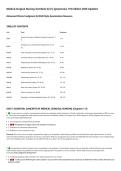
Medical-Surgical Nursing Test Bank V2.0 | Ignatavicius 11th Edition 2026 Updated
Advanced Clinical Judgment & NGN-Style Examination Resource
TABLE OF CONTENTS
Unit Topic Questions
Essential Concepts of Medical-Surgical Nursing (Ch. 1-
Unit I 1-15
9)
Emergency Care and Disaster Preparedness (Ch. 10-
Unit II 16-25
12)
Unit III Fluid, Electrolyte, and Acid-Base Balance (Ch. 13-15) 26-40
Unit IV Immunity, Infection, and Inflammation (Ch. 16-19) 41-55
Unit V Integumentary and Wound Management (Ch. 20-21) 56-65
Unit VI Respiratory System (Ch. 22-26) 66-80
Unit VII Cardiovascular System (Ch. 27-32) 81-100
Unit VIII Hematologic System (Ch. 33-35) 101-110
Unit IX Gastrointestinal System (Ch. 36-41) 111-125
Unit X Renal and Urinary System (Ch. 42-45) 126-135
Unit XI Endocrine System (Ch. 46-49) 136-145
Unit XII Neurologic and Musculoskeletal Systems (Ch. 50-54) 146-150
UNIT I: ESSENTIAL CONCEPTS OF MEDICAL-SURGICAL NURSING (Chapters 1-9)
1. 🟢 A novice nurse is caring for a postoperative patient who develops sudden shortness of breath, tachycardia, and oxygen desaturation to 88% on room
air. The novice nurse pages the rapid response team and then immediately notifies the charge nurse. Which aspect of clinical judgment did the novice
nurse demonstrate most effectively?
A. Cue recognition and hypothesis generation
B. 🔴🔴 Prioritization of urgent action and activation of resources
C. Evaluation of intervention effectiveness
D. Reflection on the outcomes of care
Rationale: The novice nurse correctly recognized the urgency of the patient's deteriorating condition and activated the rapid response team—a critical
action that demonstrates prioritization and resource activation. While cue recognition (A) occurred, the most effective demonstration was translating those
cues into immediate action. Evaluation (C) and reflection (D) occur later in the clinical judgment process.
2. 🟢 An experienced medical-surgical nurse is precepting a new graduate. The preceptor observes the new graduate carefully following every standing
order without questioning whether the orders remain appropriate for the patient's current condition. Which statement by the preceptor best
promotes clinical judgment development?
A. "Following standing orders precisely is the safest approach for new nurses."
B. 🔴🔴 "I notice you're following the orders exactly—can you tell me what assessments you would use to determine if these orders still match your
patient's needs?"
, C. "You should always ask the provider before implementing any standing order."
D. "Standing orders are designed to be followed without modification in all situations."
Rationale: Clinical judgment requires ongoing assessment and critical thinking, not rote adherence to orders. The preceptor's question (B) promotes
reflection and clinical reasoning by encouraging the new graduate to connect orders to current patient assessment. Option A reinforces passive
compliance. Option C is impractical and does not promote independent thinking. Option D is incorrect because standing orders should be evaluated for
ongoing appropriateness.
3. 🟢 The nurse is caring for a 78-year-old patient with multiple chronic conditions including heart failure, chronic kidney disease stage 3, and type 2
diabetes. The patient's blood pressure is 148/92 mm Hg, heart rate 82 bpm, and respiratory rate 18 breaths/min. The patient reports mild ankle swelling
and occasional dizziness when standing. Which action best demonstrates systems thinking in planning this patient's care?
A. Administer the prescribed antihypertensive medication and document the vital signs
B. Consult the cardiology service for blood pressure management and the nephrology service for kidney function
C. 🔴🔴 Assess the patient's medication regimen, dietary sodium intake, fluid status, blood glucose trends, and orthostatic blood pressure changes
to identify interconnections among the patient's conditions
D. Instruct the patient to restrict all fluids to 1,000 mL per day and increase daily walking
Rationale: Systems thinking requires understanding how multiple factors—medications, diet, fluid status, glucose control, and orthostatic changes—
interact to affect health outcomes. Option C demonstrates comprehensive, interconnected assessment. Option A is fragmented. Option B delegates
without synthesizing information. Option D implements interventions without complete assessment.
4. 🟢 A patient with end-stage chronic obstructive pulmonary disease (COPD) is admitted with acute respiratory failure. The patient has a do-not-
resuscitate (DNR) order but is requesting aggressive treatment "to live as long as possible." The family members are requesting that the nurse "do
everything possible" but are also expressing concerns about the patient's suffering. Which action best demonstrates patient-centered care in this ethical
dilemma?
A. Follow the DNR order strictly and provide only comfort measures
B. 🔴🔴 Facilitate a family conference with the interprofessional team to clarify the patient's goals, values, and preferences while respecting the
DNR order
C. Honor the family's request for aggressive treatment while continuing comfort measures
D. Contact the hospital ethics committee to override the DNR order
Rationale: Patient-centered care requires incorporating the patient's values, preferences, and goals into care decisions. Option B respects the DNR order
while ensuring the patient's voice is heard through clarification of goals. Option A disregards the patient's request for aggressive treatment. Option C may
conflict with the DNR order. Option D is premature without first clarifying goals.
5. 🟢 The nurse is evaluating a patient's understanding of discharge instructions following a new diagnosis of heart failure. The patient states, "I know I
need to watch my weight, but I don't really understand why I have to weigh myself every day—I feel fine right now." Which response by the nurse best
promotes patient engagement and self-management?
A. "Daily weights are a standard part of heart failure management that all patients must follow."
B. 🔴🔴 "Daily weights help us detect fluid retention early, before you develop symptoms like shortness of breath. Would you like me to explain
how to track your weights and what changes to report?"
C. "If you don't weigh yourself daily, you could end up back in the hospital with fluid overload."
D. "Your provider prescribed daily weights—it's important to follow all prescribed instructions."
Rationale: Patient engagement requires explaining the "why" behind instructions and inviting questions (Option B). This approach builds understanding
and promotes self-management. Option A is authoritarian and does not address the patient's question. Option C uses fear-based messaging. Option D
appeals to authority without explanation.
6. 🟢 A patient who is postoperative day 3 after a total hip replacement suddenly develops chest pain, shortness of breath, and tachycardia. The nurse's
immediate assessment reveals oxygen saturation of 89% on room air, blood pressure 100/68 mm Hg, and respiratory rate 28 breaths/min. The patient is
anxious and diaphoretic. Which action should the nurse take first?
A. Administer the prescribed PRN analgesic for chest pain
B. 🔴🔴 Apply high-flow oxygen and notify the rapid response team
C. Reposition the patient to the left side and encourage deep breathing
D. Obtain a stat electrocardiogram (ECG) and cardiac enzyme panel
,Rationale: The patient's presentation is concerning for a pulmonary embolism, a life-threatening emergency. The priority is to stabilize the patient with
high-flow oxygen and activate the rapid response team (Option B). Administering analgesia (A) without addressing oxygenation is unsafe. Repositioning
and deep breathing (C) are insufficient. Obtaining an ECG (D) is important but should not delay oxygenation and emergency response.
7. 🟢 The nurse is developing a plan of care for a patient with chronic pain related to osteoarthritis. The patient reports pain rated 6 on a 0-10 scale and
states, "I don't want to take more pain medication because I'm afraid of becoming addicted." Which intervention best addresses the patient's concern while
managing pain effectively?
A. Administer the prescribed opioid analgesic as scheduled and document the patient's refusal
B. 🔴🔴 Discuss non-pharmacological pain management strategies (heat, cold, relaxation) and explain the difference between physical dependence
and addiction
C. Contact the provider to request a non-opioid analgesic alternative
D. Reassure the patient that addiction is rare and encourage acceptance of the medication
Rationale: The patient's fear of addiction is a valid concern that requires education and exploration of alternatives. Option B addresses the concern directly
by offering non-pharmacological options and providing education about addiction versus physical dependence. Option A dismisses the patient's concern.
Option C may be appropriate but does not address the patient's fear. Option D minimizes the patient's concern.
8. 🟢 A nurse is caring for a patient with a new ileostomy. The patient is tearful and states, "I can't believe this happened to me. How am I supposed to live
like this? My husband will never find me attractive again." Which nursing response best demonstrates therapeutic communication?
A. "You'll get used to it—many patients adapt well to their ostomy over time."
B. 🔴🔴 "I can hear how overwhelmed you're feeling right now. This is a significant change, and it's normal to have these concerns. Would you like
to talk more about what's troubling you?"
C. "Your husband loves you—I'm sure he will support you through this."
D. "Let me show you how to care for your ostomy so you can feel more in control."
Rationale: Therapeutic communication involves acknowledging the patient's feelings, validating their experience, and inviting further discussion (Option B).
Option A minimizes the patient's distress. Option C offers reassurance without exploring the patient's concerns. Option D changes the subject to task-
focused teaching before addressing the emotional impact.
9. 🟢 The nurse is preparing to administer a high-alert medication to a patient. Which action is most critical to prevent medication errors?
A. Verify the patient's identity using two patient identifiers
B. 🔴🔴 Perform independent double-check verification with another licensed nurse
C. Review the medication administration record (MAR) for allergies
D. Assess the patient's vital signs before administration
Rationale: For high-alert medications, independent double-check verification by two licensed nurses (Option B) is a critical safety strategy to prevent errors.
While identity verification (A), allergy review (C), and vital sign assessment (D) are important, the double-check is specifically recommended for high-alert
medications to catch potential errors before administration.
10. 🟢 A patient with heart failure is being discharged. The nurse notes that the patient lives alone, has limited mobility, and has difficulty preparing meals.
Which action best demonstrates collaborative care in discharge planning?
A. Provide the patient with written dietary instructions and a list of low-sodium foods
B. 🔴🔴 Consult with the social worker, physical therapist, and dietitian to arrange home health services, meal delivery, and a home safety
evaluation
C. Refer the patient to a cardiologist for follow-up care
D. Instruct the patient to ask family members to help with meal preparation
Rationale: Collaborative care involves working with the interprofessional team—including social work, physical therapy, and dietetics—to address the
patient's comprehensive needs (Option B). Option A provides information but does not address the patient's functional limitations. Option C is a single
referral. Option D assumes family availability without assessment.
11. 🟢 The nurse is assessing an older adult patient who is recovering from pneumonia. The patient is oriented to person but is confused about place and
time, has poor appetite, and is refusing to participate in physical therapy. Which action should the nurse take first?
, A. Notify the primary health care provider of the patient's confusion and refusal to participate
B. 🔴🔴 Perform a comprehensive assessment to rule out delirium, including review of medications, vital signs, oxygen saturation, and laboratory
values
C. Encourage the patient to eat by offering favorite foods and assist with meals
D. Document the patient's confusion and refusal and continue to monitor
Rationale: In older adults, acute confusion (delirium) is often caused by underlying medical issues such as infection, hypoxia, electrolyte imbalances, or
medication effects. The priority is to assess for these causes (Option B). Notifying the provider (A) should occur after assessment. Encouraging eating (C)
and documenting (D) are not the first priority.
12. 🟢 A patient with a history of falls is admitted to the medical-surgical unit. The nurse implements a fall prevention protocol that includes keeping the
bed in the lowest position, ensuring the call light is within reach, and placing a fall risk alert on the patient's door. Which additional intervention is most
important for this patient?
A. Apply wrist restraints to prevent the patient from getting out of bed unassisted
B. 🔴🔴 Conduct a medication review to identify medications that may increase fall risk (e.g., sedatives, antihypertensives)
C. Keep the patient's room dark to promote rest and reduce agitation
D. Encourage the patient to remain in bed at all times
Rationale: Medication review is a critical component of fall prevention because many medications—including sedatives, antihypertensives, diuretics, and
hypoglycemics—increase fall risk. Restraints (A) should be avoided. Dark rooms (C) increase fall risk. Encouraging bed rest (D) is not appropriate and can
lead to deconditioning.
13. 🟢 The nurse is providing education to a patient who is scheduled for surgery. The patient asks, "Why do I need to sign this advance directive form? I'm
not that old and I'm not dying." Which response by the nurse is most appropriate?
A. "Advance directives are required for all patients having surgery, regardless of age or health status."
B. 🔴🔴 "An advance directive allows you to document your healthcare preferences in case you are unable to communicate during or after surgery.
It's a way to ensure your wishes are known, regardless of your age."
C. "You don't have to sign it if you don't want to—it's completely optional."
D. "Advance directives are mainly for older adults, but the hospital requires everyone to have one."
Rationale: Advance directives are for all adults, not just older adults, and allow patients to specify their healthcare preferences if they become unable to
communicate. Option B provides accurate, non-judgmental education. Option A is true but does not explain the purpose. Option C is true but does not
provide education. Option D is inaccurate.
14. 🟢 A patient with chronic pain is prescribed a long-acting opioid and a short-acting opioid for breakthrough pain. The patient reports that the long-
acting medication "doesn't seem to work" and that they have been taking extra doses of the short-acting medication. Which nursing action is most
appropriate?
A. Administer an additional dose of the long-acting opioid as requested
B. 🔴🔴 Perform a comprehensive pain assessment, including pain characteristics, timing, and effectiveness of current regimen, and notify the
provider of the patient's concerns
C. Instruct the patient to take the short-acting medication only as prescribed
D. Document the patient's report and continue the current plan
Rationale: The patient's report requires a comprehensive pain assessment to determine whether the current regimen is inadequate, whether there are side
effects, or whether there are other factors affecting pain control (Option B). Administering additional medication (A) without assessment is unsafe.
Instructing the patient (C) does not address the underlying issue. Documentation alone (D) is insufficient.
15. 🟢 A newly licensed nurse is caring for a patient with a complex wound. The nurse is unsure how to perform the prescribed wound care. Which action
best demonstrates professional accountability and patient safety?
A. Perform the wound care to the best of the nurse's ability and ask for feedback afterward
B. 🔴🔴 Seek guidance from the charge nurse or wound care specialist before performing the procedure
C. Delegate the wound care to an experienced unlicensed assistive personnel
D. Review the procedure in a textbook and then perform the wound care
Advanced Clinical Judgment & NGN-Style Examination Resource
TABLE OF CONTENTS
Unit Topic Questions
Essential Concepts of Medical-Surgical Nursing (Ch. 1-
Unit I 1-15
9)
Emergency Care and Disaster Preparedness (Ch. 10-
Unit II 16-25
12)
Unit III Fluid, Electrolyte, and Acid-Base Balance (Ch. 13-15) 26-40
Unit IV Immunity, Infection, and Inflammation (Ch. 16-19) 41-55
Unit V Integumentary and Wound Management (Ch. 20-21) 56-65
Unit VI Respiratory System (Ch. 22-26) 66-80
Unit VII Cardiovascular System (Ch. 27-32) 81-100
Unit VIII Hematologic System (Ch. 33-35) 101-110
Unit IX Gastrointestinal System (Ch. 36-41) 111-125
Unit X Renal and Urinary System (Ch. 42-45) 126-135
Unit XI Endocrine System (Ch. 46-49) 136-145
Unit XII Neurologic and Musculoskeletal Systems (Ch. 50-54) 146-150
UNIT I: ESSENTIAL CONCEPTS OF MEDICAL-SURGICAL NURSING (Chapters 1-9)
1. 🟢 A novice nurse is caring for a postoperative patient who develops sudden shortness of breath, tachycardia, and oxygen desaturation to 88% on room
air. The novice nurse pages the rapid response team and then immediately notifies the charge nurse. Which aspect of clinical judgment did the novice
nurse demonstrate most effectively?
A. Cue recognition and hypothesis generation
B. 🔴🔴 Prioritization of urgent action and activation of resources
C. Evaluation of intervention effectiveness
D. Reflection on the outcomes of care
Rationale: The novice nurse correctly recognized the urgency of the patient's deteriorating condition and activated the rapid response team—a critical
action that demonstrates prioritization and resource activation. While cue recognition (A) occurred, the most effective demonstration was translating those
cues into immediate action. Evaluation (C) and reflection (D) occur later in the clinical judgment process.
2. 🟢 An experienced medical-surgical nurse is precepting a new graduate. The preceptor observes the new graduate carefully following every standing
order without questioning whether the orders remain appropriate for the patient's current condition. Which statement by the preceptor best
promotes clinical judgment development?
A. "Following standing orders precisely is the safest approach for new nurses."
B. 🔴🔴 "I notice you're following the orders exactly—can you tell me what assessments you would use to determine if these orders still match your
patient's needs?"
, C. "You should always ask the provider before implementing any standing order."
D. "Standing orders are designed to be followed without modification in all situations."
Rationale: Clinical judgment requires ongoing assessment and critical thinking, not rote adherence to orders. The preceptor's question (B) promotes
reflection and clinical reasoning by encouraging the new graduate to connect orders to current patient assessment. Option A reinforces passive
compliance. Option C is impractical and does not promote independent thinking. Option D is incorrect because standing orders should be evaluated for
ongoing appropriateness.
3. 🟢 The nurse is caring for a 78-year-old patient with multiple chronic conditions including heart failure, chronic kidney disease stage 3, and type 2
diabetes. The patient's blood pressure is 148/92 mm Hg, heart rate 82 bpm, and respiratory rate 18 breaths/min. The patient reports mild ankle swelling
and occasional dizziness when standing. Which action best demonstrates systems thinking in planning this patient's care?
A. Administer the prescribed antihypertensive medication and document the vital signs
B. Consult the cardiology service for blood pressure management and the nephrology service for kidney function
C. 🔴🔴 Assess the patient's medication regimen, dietary sodium intake, fluid status, blood glucose trends, and orthostatic blood pressure changes
to identify interconnections among the patient's conditions
D. Instruct the patient to restrict all fluids to 1,000 mL per day and increase daily walking
Rationale: Systems thinking requires understanding how multiple factors—medications, diet, fluid status, glucose control, and orthostatic changes—
interact to affect health outcomes. Option C demonstrates comprehensive, interconnected assessment. Option A is fragmented. Option B delegates
without synthesizing information. Option D implements interventions without complete assessment.
4. 🟢 A patient with end-stage chronic obstructive pulmonary disease (COPD) is admitted with acute respiratory failure. The patient has a do-not-
resuscitate (DNR) order but is requesting aggressive treatment "to live as long as possible." The family members are requesting that the nurse "do
everything possible" but are also expressing concerns about the patient's suffering. Which action best demonstrates patient-centered care in this ethical
dilemma?
A. Follow the DNR order strictly and provide only comfort measures
B. 🔴🔴 Facilitate a family conference with the interprofessional team to clarify the patient's goals, values, and preferences while respecting the
DNR order
C. Honor the family's request for aggressive treatment while continuing comfort measures
D. Contact the hospital ethics committee to override the DNR order
Rationale: Patient-centered care requires incorporating the patient's values, preferences, and goals into care decisions. Option B respects the DNR order
while ensuring the patient's voice is heard through clarification of goals. Option A disregards the patient's request for aggressive treatment. Option C may
conflict with the DNR order. Option D is premature without first clarifying goals.
5. 🟢 The nurse is evaluating a patient's understanding of discharge instructions following a new diagnosis of heart failure. The patient states, "I know I
need to watch my weight, but I don't really understand why I have to weigh myself every day—I feel fine right now." Which response by the nurse best
promotes patient engagement and self-management?
A. "Daily weights are a standard part of heart failure management that all patients must follow."
B. 🔴🔴 "Daily weights help us detect fluid retention early, before you develop symptoms like shortness of breath. Would you like me to explain
how to track your weights and what changes to report?"
C. "If you don't weigh yourself daily, you could end up back in the hospital with fluid overload."
D. "Your provider prescribed daily weights—it's important to follow all prescribed instructions."
Rationale: Patient engagement requires explaining the "why" behind instructions and inviting questions (Option B). This approach builds understanding
and promotes self-management. Option A is authoritarian and does not address the patient's question. Option C uses fear-based messaging. Option D
appeals to authority without explanation.
6. 🟢 A patient who is postoperative day 3 after a total hip replacement suddenly develops chest pain, shortness of breath, and tachycardia. The nurse's
immediate assessment reveals oxygen saturation of 89% on room air, blood pressure 100/68 mm Hg, and respiratory rate 28 breaths/min. The patient is
anxious and diaphoretic. Which action should the nurse take first?
A. Administer the prescribed PRN analgesic for chest pain
B. 🔴🔴 Apply high-flow oxygen and notify the rapid response team
C. Reposition the patient to the left side and encourage deep breathing
D. Obtain a stat electrocardiogram (ECG) and cardiac enzyme panel
,Rationale: The patient's presentation is concerning for a pulmonary embolism, a life-threatening emergency. The priority is to stabilize the patient with
high-flow oxygen and activate the rapid response team (Option B). Administering analgesia (A) without addressing oxygenation is unsafe. Repositioning
and deep breathing (C) are insufficient. Obtaining an ECG (D) is important but should not delay oxygenation and emergency response.
7. 🟢 The nurse is developing a plan of care for a patient with chronic pain related to osteoarthritis. The patient reports pain rated 6 on a 0-10 scale and
states, "I don't want to take more pain medication because I'm afraid of becoming addicted." Which intervention best addresses the patient's concern while
managing pain effectively?
A. Administer the prescribed opioid analgesic as scheduled and document the patient's refusal
B. 🔴🔴 Discuss non-pharmacological pain management strategies (heat, cold, relaxation) and explain the difference between physical dependence
and addiction
C. Contact the provider to request a non-opioid analgesic alternative
D. Reassure the patient that addiction is rare and encourage acceptance of the medication
Rationale: The patient's fear of addiction is a valid concern that requires education and exploration of alternatives. Option B addresses the concern directly
by offering non-pharmacological options and providing education about addiction versus physical dependence. Option A dismisses the patient's concern.
Option C may be appropriate but does not address the patient's fear. Option D minimizes the patient's concern.
8. 🟢 A nurse is caring for a patient with a new ileostomy. The patient is tearful and states, "I can't believe this happened to me. How am I supposed to live
like this? My husband will never find me attractive again." Which nursing response best demonstrates therapeutic communication?
A. "You'll get used to it—many patients adapt well to their ostomy over time."
B. 🔴🔴 "I can hear how overwhelmed you're feeling right now. This is a significant change, and it's normal to have these concerns. Would you like
to talk more about what's troubling you?"
C. "Your husband loves you—I'm sure he will support you through this."
D. "Let me show you how to care for your ostomy so you can feel more in control."
Rationale: Therapeutic communication involves acknowledging the patient's feelings, validating their experience, and inviting further discussion (Option B).
Option A minimizes the patient's distress. Option C offers reassurance without exploring the patient's concerns. Option D changes the subject to task-
focused teaching before addressing the emotional impact.
9. 🟢 The nurse is preparing to administer a high-alert medication to a patient. Which action is most critical to prevent medication errors?
A. Verify the patient's identity using two patient identifiers
B. 🔴🔴 Perform independent double-check verification with another licensed nurse
C. Review the medication administration record (MAR) for allergies
D. Assess the patient's vital signs before administration
Rationale: For high-alert medications, independent double-check verification by two licensed nurses (Option B) is a critical safety strategy to prevent errors.
While identity verification (A), allergy review (C), and vital sign assessment (D) are important, the double-check is specifically recommended for high-alert
medications to catch potential errors before administration.
10. 🟢 A patient with heart failure is being discharged. The nurse notes that the patient lives alone, has limited mobility, and has difficulty preparing meals.
Which action best demonstrates collaborative care in discharge planning?
A. Provide the patient with written dietary instructions and a list of low-sodium foods
B. 🔴🔴 Consult with the social worker, physical therapist, and dietitian to arrange home health services, meal delivery, and a home safety
evaluation
C. Refer the patient to a cardiologist for follow-up care
D. Instruct the patient to ask family members to help with meal preparation
Rationale: Collaborative care involves working with the interprofessional team—including social work, physical therapy, and dietetics—to address the
patient's comprehensive needs (Option B). Option A provides information but does not address the patient's functional limitations. Option C is a single
referral. Option D assumes family availability without assessment.
11. 🟢 The nurse is assessing an older adult patient who is recovering from pneumonia. The patient is oriented to person but is confused about place and
time, has poor appetite, and is refusing to participate in physical therapy. Which action should the nurse take first?
, A. Notify the primary health care provider of the patient's confusion and refusal to participate
B. 🔴🔴 Perform a comprehensive assessment to rule out delirium, including review of medications, vital signs, oxygen saturation, and laboratory
values
C. Encourage the patient to eat by offering favorite foods and assist with meals
D. Document the patient's confusion and refusal and continue to monitor
Rationale: In older adults, acute confusion (delirium) is often caused by underlying medical issues such as infection, hypoxia, electrolyte imbalances, or
medication effects. The priority is to assess for these causes (Option B). Notifying the provider (A) should occur after assessment. Encouraging eating (C)
and documenting (D) are not the first priority.
12. 🟢 A patient with a history of falls is admitted to the medical-surgical unit. The nurse implements a fall prevention protocol that includes keeping the
bed in the lowest position, ensuring the call light is within reach, and placing a fall risk alert on the patient's door. Which additional intervention is most
important for this patient?
A. Apply wrist restraints to prevent the patient from getting out of bed unassisted
B. 🔴🔴 Conduct a medication review to identify medications that may increase fall risk (e.g., sedatives, antihypertensives)
C. Keep the patient's room dark to promote rest and reduce agitation
D. Encourage the patient to remain in bed at all times
Rationale: Medication review is a critical component of fall prevention because many medications—including sedatives, antihypertensives, diuretics, and
hypoglycemics—increase fall risk. Restraints (A) should be avoided. Dark rooms (C) increase fall risk. Encouraging bed rest (D) is not appropriate and can
lead to deconditioning.
13. 🟢 The nurse is providing education to a patient who is scheduled for surgery. The patient asks, "Why do I need to sign this advance directive form? I'm
not that old and I'm not dying." Which response by the nurse is most appropriate?
A. "Advance directives are required for all patients having surgery, regardless of age or health status."
B. 🔴🔴 "An advance directive allows you to document your healthcare preferences in case you are unable to communicate during or after surgery.
It's a way to ensure your wishes are known, regardless of your age."
C. "You don't have to sign it if you don't want to—it's completely optional."
D. "Advance directives are mainly for older adults, but the hospital requires everyone to have one."
Rationale: Advance directives are for all adults, not just older adults, and allow patients to specify their healthcare preferences if they become unable to
communicate. Option B provides accurate, non-judgmental education. Option A is true but does not explain the purpose. Option C is true but does not
provide education. Option D is inaccurate.
14. 🟢 A patient with chronic pain is prescribed a long-acting opioid and a short-acting opioid for breakthrough pain. The patient reports that the long-
acting medication "doesn't seem to work" and that they have been taking extra doses of the short-acting medication. Which nursing action is most
appropriate?
A. Administer an additional dose of the long-acting opioid as requested
B. 🔴🔴 Perform a comprehensive pain assessment, including pain characteristics, timing, and effectiveness of current regimen, and notify the
provider of the patient's concerns
C. Instruct the patient to take the short-acting medication only as prescribed
D. Document the patient's report and continue the current plan
Rationale: The patient's report requires a comprehensive pain assessment to determine whether the current regimen is inadequate, whether there are side
effects, or whether there are other factors affecting pain control (Option B). Administering additional medication (A) without assessment is unsafe.
Instructing the patient (C) does not address the underlying issue. Documentation alone (D) is insufficient.
15. 🟢 A newly licensed nurse is caring for a patient with a complex wound. The nurse is unsure how to perform the prescribed wound care. Which action
best demonstrates professional accountability and patient safety?
A. Perform the wound care to the best of the nurse's ability and ask for feedback afterward
B. 🔴🔴 Seek guidance from the charge nurse or wound care specialist before performing the procedure
C. Delegate the wound care to an experienced unlicensed assistive personnel
D. Review the procedure in a textbook and then perform the wound care