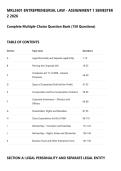
MRL2601 ENTREPRENEURIAL LAW - ASSIGNMENT 1 SEMESTER
2 2026
Complete Multiple-Choice Question Bank (150 Questions)
TABLE OF CONTENTS
Section Topic Area Questions
A Legal Personality and Separate Legal Entity 1-15
B Piercing the Corporate Veil 16-25
Companies Act 71 of 2008 – General
C 26-40
Provisions
D Types of Companies (Profit & Non-Profit) 41-55
E Incorporation and Pre-Incorporation Contracts 56-65
Corporate Governance – Directors and
F 66-80
Officers
G Shareholders' Rights and Remedies 81-95
H Close Corporations Act 69 of 1984 96-110
I Partnerships – Formation and Essentials 111-125
J Partnerships – Rights, Duties and Dissolution 126-140
K Business Trusts and Other Enterprise Forms 141-150
SECTION A: LEGAL PERSONALITY AND SEPARATE LEGAL ENTITY
,Questions 1-15
• Question 1
Which of the following BEST describes the legal nature of a company upon incorporation under South
African law?
A. The company is an extension of its shareholders and directors
B. The company acquires separate legal personality distinct from its shareholders and directors
C. The company exists only as a contractual arrangement between its members
D. The company has no rights or duties until it commences trading
🔴🔴 Correct Answer: B
Rationale: Section 19(1)(b) of the Companies Act 71 of 2008 recognises a company as a separate legal
person, meaning it has its own legal identity, distinct from its directors and shareholders, can own
property in its own name, and can sue or be sued in its own name.
• Question 2
In the landmark English case that firmly established the principle of separate legal personality, which
case served as the foundation for this principle in South African law?
A. Botha v Van Niekerk
B. Salomon v Salomon & Co Ltd
C. Cape Pacific Ltd v Lubner Controlling Investments (Pty) Ltd
D. Ex Parte Gore and others NNO
🔴🔴 Correct Answer: B
Rationale: Salomon v Salomon & Co Ltd established the principle that a company is a separate legal
entity distinct from its shareholders, even if one person controls the company. This principle is
followed in South African law and is recognised in section 19(1)(b) of the Companies Act.
• Question 3
Which of the following is NOT a consequence of a company having separate legal personality?
A. The company can acquire assets in its own name
B. The company can sue and be sued in its own name
C. Members are personally liable for all debts of the company
D. The company enjoys perpetual succession
🔴🔴 Correct Answer: C
,Rationale: Separate legal personality means the company exists independently of its members.
Members are not personally liable for debts (subject to exceptions such as piercing the corporate veil),
the company enjoys perpetual succession, and members have membership interests, not proprietary
rights to assets.
• Question 4
A company attains legal personality upon:
A. Registration of its name with the Companies and Intellectual Property Commission (CIPC)
B. Incorporation and the issuance of a certificate of incorporation
C. Commencement of its business operations
D. Appointment of its first directors
🔴🔴 Correct Answer: B
Rationale: A company attains legal personality upon incorporation. The certificate of incorporation is
conclusive evidence that all requirements for incorporation have been complied with and that the
company is incorporated from the date stated in the certificate.
• Question 5
The concept of "limited liability" in the context of a company means that:
A. Shareholders are liable for all debts of the company
B. Directors are personally liable for all company debts
C. Shareholders' liability is limited to the amount unpaid on their shares
D. The company has no liability for its debts
🔴🔴 Correct Answer: C
Rationale: Limited liability is a consequence of separate legal personality. Shareholders are not liable
for the company's debts; their liability is limited to the amount unpaid on their shares. This is a
fundamental distinction between companies and partnerships.
• Question 6
When a company is wronged, who must seek legal redress?
A. The shareholders collectively
B. The directors in their personal capacities
C. The company itself
D. The creditors of the company
🔴🔴 Correct Answer: C
, Rationale: Where a company is wronged, the company must itself seek redress. This is a consequence
of separate legal personality – the company is the legal person that has suffered the wrong and must
institute proceedings in its own name.
• Question 7
Managerial and executive powers of a company are exercised by:
A. Shareholders
B. Directors
C. Creditors
D. The Companies and Intellectual Property Commission
🔴🔴 Correct Answer: B
Rationale: Managerial and executive powers are to be exercised by directors. Shareholders do not
manage the company directly; they exercise their powers through voting at general meetings and
appointing directors to manage the company.
• Question 8
Which of the following statements regarding the assets of a company is CORRECT?
A. The assets of the company are owned jointly by the shareholders
B. The assets of the company are its exclusive property
C. Directors have personal ownership of company assets
D. Creditors have a proprietary interest in company assets
🔴🔴 Correct Answer: B
Rationale: The assets of the company are its exclusive property. This flows from the principle of
separate legal personality – the company, not its shareholders or directors, owns the assets.
• Question 9
A company's separate legal personality means that it:
A. Ceases to exist upon a change in its membership
B. Exists independently of its members
C. Is identical to its shareholders
D. Cannot own immovable property
🔴🔴 Correct Answer: B
2 2026
Complete Multiple-Choice Question Bank (150 Questions)
TABLE OF CONTENTS
Section Topic Area Questions
A Legal Personality and Separate Legal Entity 1-15
B Piercing the Corporate Veil 16-25
Companies Act 71 of 2008 – General
C 26-40
Provisions
D Types of Companies (Profit & Non-Profit) 41-55
E Incorporation and Pre-Incorporation Contracts 56-65
Corporate Governance – Directors and
F 66-80
Officers
G Shareholders' Rights and Remedies 81-95
H Close Corporations Act 69 of 1984 96-110
I Partnerships – Formation and Essentials 111-125
J Partnerships – Rights, Duties and Dissolution 126-140
K Business Trusts and Other Enterprise Forms 141-150
SECTION A: LEGAL PERSONALITY AND SEPARATE LEGAL ENTITY
,Questions 1-15
• Question 1
Which of the following BEST describes the legal nature of a company upon incorporation under South
African law?
A. The company is an extension of its shareholders and directors
B. The company acquires separate legal personality distinct from its shareholders and directors
C. The company exists only as a contractual arrangement between its members
D. The company has no rights or duties until it commences trading
🔴🔴 Correct Answer: B
Rationale: Section 19(1)(b) of the Companies Act 71 of 2008 recognises a company as a separate legal
person, meaning it has its own legal identity, distinct from its directors and shareholders, can own
property in its own name, and can sue or be sued in its own name.
• Question 2
In the landmark English case that firmly established the principle of separate legal personality, which
case served as the foundation for this principle in South African law?
A. Botha v Van Niekerk
B. Salomon v Salomon & Co Ltd
C. Cape Pacific Ltd v Lubner Controlling Investments (Pty) Ltd
D. Ex Parte Gore and others NNO
🔴🔴 Correct Answer: B
Rationale: Salomon v Salomon & Co Ltd established the principle that a company is a separate legal
entity distinct from its shareholders, even if one person controls the company. This principle is
followed in South African law and is recognised in section 19(1)(b) of the Companies Act.
• Question 3
Which of the following is NOT a consequence of a company having separate legal personality?
A. The company can acquire assets in its own name
B. The company can sue and be sued in its own name
C. Members are personally liable for all debts of the company
D. The company enjoys perpetual succession
🔴🔴 Correct Answer: C
,Rationale: Separate legal personality means the company exists independently of its members.
Members are not personally liable for debts (subject to exceptions such as piercing the corporate veil),
the company enjoys perpetual succession, and members have membership interests, not proprietary
rights to assets.
• Question 4
A company attains legal personality upon:
A. Registration of its name with the Companies and Intellectual Property Commission (CIPC)
B. Incorporation and the issuance of a certificate of incorporation
C. Commencement of its business operations
D. Appointment of its first directors
🔴🔴 Correct Answer: B
Rationale: A company attains legal personality upon incorporation. The certificate of incorporation is
conclusive evidence that all requirements for incorporation have been complied with and that the
company is incorporated from the date stated in the certificate.
• Question 5
The concept of "limited liability" in the context of a company means that:
A. Shareholders are liable for all debts of the company
B. Directors are personally liable for all company debts
C. Shareholders' liability is limited to the amount unpaid on their shares
D. The company has no liability for its debts
🔴🔴 Correct Answer: C
Rationale: Limited liability is a consequence of separate legal personality. Shareholders are not liable
for the company's debts; their liability is limited to the amount unpaid on their shares. This is a
fundamental distinction between companies and partnerships.
• Question 6
When a company is wronged, who must seek legal redress?
A. The shareholders collectively
B. The directors in their personal capacities
C. The company itself
D. The creditors of the company
🔴🔴 Correct Answer: C
, Rationale: Where a company is wronged, the company must itself seek redress. This is a consequence
of separate legal personality – the company is the legal person that has suffered the wrong and must
institute proceedings in its own name.
• Question 7
Managerial and executive powers of a company are exercised by:
A. Shareholders
B. Directors
C. Creditors
D. The Companies and Intellectual Property Commission
🔴🔴 Correct Answer: B
Rationale: Managerial and executive powers are to be exercised by directors. Shareholders do not
manage the company directly; they exercise their powers through voting at general meetings and
appointing directors to manage the company.
• Question 8
Which of the following statements regarding the assets of a company is CORRECT?
A. The assets of the company are owned jointly by the shareholders
B. The assets of the company are its exclusive property
C. Directors have personal ownership of company assets
D. Creditors have a proprietary interest in company assets
🔴🔴 Correct Answer: B
Rationale: The assets of the company are its exclusive property. This flows from the principle of
separate legal personality – the company, not its shareholders or directors, owns the assets.
• Question 9
A company's separate legal personality means that it:
A. Ceases to exist upon a change in its membership
B. Exists independently of its members
C. Is identical to its shareholders
D. Cannot own immovable property
🔴🔴 Correct Answer: B