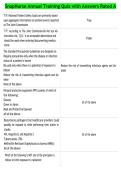
SnapNurse Annual Training Quiz with Answers Rated A
T/F: National Patient Safety Goals are primarily based
upon aggregate information on sentinel events reported True
to The Joint Commission
T/F: According to The Joint Commission-Do Not Use Ab-
breviation List, "Q.D." is an acceptable abbreviation and
False
should be used when ordering/documenting medica-
tions
The Standard Precautions Guidelines are designed to:
Require precautions only when the disease or infection
status of a patient is known
Be used only when there is a potential of exposure to Reduce the risk of transmitting infectious agents and dis-
blood ease
Reduce the risk of transmitting infectious agents and dis-
ease
None of the above
Personal protective equipment (PPE) consists of which of
the following:
Gloves
All of the above
Gown or Apron
Mask and Protective Eyewear
All of the Above
Blood-borne pathogens that healthcare providers could
possibly be exposed to while performing their duties in-
clude:
HIV, Hepatitis B, and Hepatitis C All of the above
Tuberculosis (TB)
Methicillin Resistant Staphylococcus Aureus (MRSA)
All of the Above
Which of the following is NOT one of the principles to
follow to limit exposure to radiation:
1/5
, SnapNurse Annual Training Quiz with Answers Rated A
Reporting
Time
Reporting
Distance
Shielding
T/F: Wearing a respirator mask (such as a N95) that has
been fitted and tested will maximize protection from My-
cobacterium tuberculosis (TB). OSHA requires re-evalua- True
tion by a physician and fit testing annually for these types
of respirator masks
The "RACE" acronym stands for the following: Rescue, Alarm, Confine and Extinguish or Evacuate
Which of the following is NOT an example of damaged
equipment:
A cardiac monitor that has been turned ott
Frayed or cut cords or cords where the insulation has A cardiac monitor that has been turned ott
pulled away
Broken cover on light switches and electrical outlets
Cracked cases or housings
Which of the following is the leading cause of injury and
sick time for health professionals:
Head injuries
lower back problems
Lower back problems
Colds and viruses
Assaults
Which of the following is NOT an important rule of good
body mechanics:
Have weight evenly balanced on both feet It is better to lift something alone then bother another
It is better to push, pull or roll than to carry something coworker to help you
heavy
It is better to lift something alone then bother another
2/5
T/F: National Patient Safety Goals are primarily based
upon aggregate information on sentinel events reported True
to The Joint Commission
T/F: According to The Joint Commission-Do Not Use Ab-
breviation List, "Q.D." is an acceptable abbreviation and
False
should be used when ordering/documenting medica-
tions
The Standard Precautions Guidelines are designed to:
Require precautions only when the disease or infection
status of a patient is known
Be used only when there is a potential of exposure to Reduce the risk of transmitting infectious agents and dis-
blood ease
Reduce the risk of transmitting infectious agents and dis-
ease
None of the above
Personal protective equipment (PPE) consists of which of
the following:
Gloves
All of the above
Gown or Apron
Mask and Protective Eyewear
All of the Above
Blood-borne pathogens that healthcare providers could
possibly be exposed to while performing their duties in-
clude:
HIV, Hepatitis B, and Hepatitis C All of the above
Tuberculosis (TB)
Methicillin Resistant Staphylococcus Aureus (MRSA)
All of the Above
Which of the following is NOT one of the principles to
follow to limit exposure to radiation:
1/5
, SnapNurse Annual Training Quiz with Answers Rated A
Reporting
Time
Reporting
Distance
Shielding
T/F: Wearing a respirator mask (such as a N95) that has
been fitted and tested will maximize protection from My-
cobacterium tuberculosis (TB). OSHA requires re-evalua- True
tion by a physician and fit testing annually for these types
of respirator masks
The "RACE" acronym stands for the following: Rescue, Alarm, Confine and Extinguish or Evacuate
Which of the following is NOT an example of damaged
equipment:
A cardiac monitor that has been turned ott
Frayed or cut cords or cords where the insulation has A cardiac monitor that has been turned ott
pulled away
Broken cover on light switches and electrical outlets
Cracked cases or housings
Which of the following is the leading cause of injury and
sick time for health professionals:
Head injuries
lower back problems
Lower back problems
Colds and viruses
Assaults
Which of the following is NOT an important rule of good
body mechanics:
Have weight evenly balanced on both feet It is better to lift something alone then bother another
It is better to push, pull or roll than to carry something coworker to help you
heavy
It is better to lift something alone then bother another
2/5