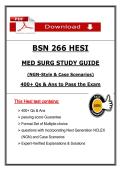
BSN 266 HESI
MED SURG STUDY GUIDE
(NGN-Style & Case Scenarios)
400+ Qs & Ans to Pass the Exam
This Hesi test contains:
➢ 400+ Qs & Ans
➢ passing score Guarantee
➢ Format Set of Multiple-choice
➢ questions with incorporating Next Generation NCLEX
(NGN) and Case Scenarios
➢ Expert-Verified Explanations & Solutions
,PREVIEW QUESTIONS BELOW
Get the Complete PDF After Purchase
"If you require further clarification or in need of any study
resources, feel free to Message me."
,### 1.
A client who underwent cardiac stent placement 4 days ago arrives to
the emergency department reporting sudden onset chest pressure
and shortness of breath.
Which action should the nurse take next?
Answer Choices:
a. Administer prescribed nitroglycerin sublingually.
b. Obtain a 12-lead electrocardiogram (ECG) and begin continuous cardiac
monitoring.
c. Give oxygen at 2 liters per minute via nasal cannula.
d. Prepare the client for immediate cardiac catheterization.
Correct Answer:
b. Obtain a 12-lead electrocardiogram (ECG) and begin continuous cardiac
monitoring.
Expert Rationale:
A client with sudden chest pressure and shortness of breath after recent
stenting is at high risk for acute stent thrombosis or myocardial infarction
(MI). Immediate acquisition of a 12-lead ECG is critical to assess for
ischemic changes and to prioritize timely reperfusion therapy if needed.
Continuous cardiac monitoring is essential to detect arrhythmias. Although
oxygen and nitroglycerin may be administered per protocol, assessment
data guides further interventions. Immediate preparation for catheterization
is premature before diagnostic confirmation.
,---
### 2.
While completing a health assessment for a client with migraine
headaches, the nurse identifies bilateral weakness in the client’s hand
grips. The client reports joint pain and difficulty twisting a door knob
due to weakness.
Which action should the nurse take next?
Answer Choices:
a. Teach the client relaxation techniques to manage migraine pain.
b. Document the findings and continue with the neurological assessment.
c. Gather additional assessment data about the pain and weakness.
d. Refer the client immediately to a neurologist.
Correct Answer:
c. Gather additional assessment data about the pain and weakness.
Expert Rationale:
Bilateral hand weakness and joint pain suggest possible systemic or
neurological disease beyond migraines (e.g., rheumatoid arthritis,
neuropathy). Further assessment to clarify onset, duration, associated
symptoms, and functional impact is needed before specialist referral.
Immediate referral without data may delay appropriate care; documenting
without further inquiry risks missing early diagnostic clues.
---
,### 3.
The nurse is caring for a client diagnosed with psoriasis vulgaris
receiving psoralen and ultraviolet A light (PUVA) treatment.
Which assessment finding indicates overexposure to treatment?
Answer Choices:
a. Increased thickening and scaling of plaques.
b. Tenderness upon palpation and generalized erythema.
c. Development of vesicular lesions on treated skin.
d. Mild tanning of treated areas.
Correct Answer:
b. Tenderness upon palpation and generalized erythema.
Expert Rationale:
PUVA therapy carries a risk of phototoxic reactions causing erythema,
tenderness, and burning which signal overexposure. Tenderness with
generalized erythema suggests a burn-like reaction requiring treatment
modification. Vesicular lesions are rare but possible. Mild tanning is
expected, while increased plaque scaling indicates disease progression,
not treatment toxicity.
---
### 4.
,An adult client who had gastric bypass surgery 2 weeks ago presents
with abdominal tenderness and vital signs: temp 101°F (38.3°C), HR
130 bpm, RR 26, BP 100/50 mmHg.
Which intervention is most important for the nurse to include in the
care plan?
Answer Choices:
a. Encourage oral fluids as tolerated.
b. Administer analgesics as prescribed.
c. Initiate strict IV fluid replacement.
d. Prepare the client for abdominal imaging studies.
Correct Answer:
c. Initiate strict IV fluid replacement.
Expert Rationale:
Signs of possible anastomotic leak and sepsis include tenderness, fever,
tachycardia, tachypnea, and hypotension. Hypovolemia and potential septic
shock risk demand aggressive IV fluid resuscitation to restore circulatory
volume and perfusion. Oral fluids are contraindicated in suspected leaks.
Though analgesics and imaging are important, they do not address the
critical hemodynamic instability.
---
### 5.
,A client recently diagnosed with Raynaud's disease is concerned
about pain management.
Which instruction should the nurse provide?
Answer Choices:
a. Avoid all physical activities that increase circulation to hands.
b. Apply warm packs to hands during acute pain episodes.
c. Use nonsteroidal anti-inflammatory drugs (NSAIDs) daily.
d. Wear gloves when handling cold items to prevent spasms.
Correct Answer:
d. Wear gloves when handling cold items to prevent spasms.
Expert Rationale:
Cold exposure triggers arterial spasms in Raynaud’s disease causing pain
and ischemia. Protective measures such as wearing gloves reduce cold-
induced attacks. NSAIDs are not first-line for this vasospastic disorder.
Warm packs alleviate acute episodes but prevention by cold avoidance is
prioritized. Restricting all activity is unnecessary and counterproductive.
---
### 6.
A client with newly diagnosed Crohn’s disease asks about dietary
restrictions.
How should the nurse respond?
,Answer Choices:
a. Avoid all dairy products completely.
b. Follow a high-fiber diet to promote bowel health.
c. Eliminate gluten-containing foods.
d. Use an elimination diet to identify trigger foods.
Correct Answer:
d. Use an elimination diet to identify trigger foods.
Expert Rationale:
Crohn’s disease triggers vary individually; an elimination diet helps identify
specific foods exacerbating symptoms. Universal avoidance (e.g., dairy or
gluten) is unnecessary. High-fiber diets may worsen symptoms during
active flare-ups. Tailored dietary management improves symptom control
and nutritional status.
---
### 7.
During a history, a client with kidney stones reports eating a
vegetarian diet with cheese 2-3 times daily.
Which statement indicates increased risk for renal calculi?
Answer Choices:
a. Drinks 8 glasses of water daily.
b. Eats a vegetarian diet with cheese 2 to 3 times a day.
c. Avoids high-oxalate foods like spinach.
,d. Performs daily moderate exercise.
Correct Answer:
b. Eats a vegetarian diet with cheese 2 to 3 times a day.
Expert Rationale:
High dietary calcium from cheese combined with a vegetarian diet can
increase oxalate and calcium in urine, promoting calculi formation.
Consuming sufficient fluids reduces risk. Avoidance of high-oxalate foods
protects against certain stone types. Exercise does not significantly impact
stone formation risk.
---
### 8.
An older male complains of nocturia, difficulty initiating urination, and
incomplete bladder emptying sensations.
Which nursing intervention is appropriate?
Answer Choices:
a. Insert a Foley catheter to measure residual.
b. Encourage increased fluid intake during the day.
c. Palpate the bladder above the symphysis pubis.
d. Refer the client immediately for prostate ultrasound.
Correct Answer:
c. Palpate the bladder above the symphysis pubis.
, Expert Rationale:
Palpation can detect bladder distention indicating urinary retention,
common with benign prostatic hyperplasia (BPH). This non-invasive
assessment guides further interventions. Immediate catheterization or
specialty referral is premature before assessment. Fluid intake counseling
is supportive but not diagnostic.
---
### 9.
A client with chronic kidney disease needs to start dialysis. Which
condition contraindicates peritoneal dialysis?
Answer Choices:
a. Diabetes mellitus type 2
b. Severe hypertension
c. Crohn’s disease with colectomy
d. Peripheral vascular disease
Correct Answer:
c. Crohn’s disease with colectomy
Expert Rationale:
Inflammatory bowel disease and extensive abdominal surgeries (e.g.,
colectomy) increase risk for peritoneal membrane failure, infection, or
adhesions, making peritoneal dialysis unsafe. Diabetes and hypertension
MED SURG STUDY GUIDE
(NGN-Style & Case Scenarios)
400+ Qs & Ans to Pass the Exam
This Hesi test contains:
➢ 400+ Qs & Ans
➢ passing score Guarantee
➢ Format Set of Multiple-choice
➢ questions with incorporating Next Generation NCLEX
(NGN) and Case Scenarios
➢ Expert-Verified Explanations & Solutions
,PREVIEW QUESTIONS BELOW
Get the Complete PDF After Purchase
"If you require further clarification or in need of any study
resources, feel free to Message me."
,### 1.
A client who underwent cardiac stent placement 4 days ago arrives to
the emergency department reporting sudden onset chest pressure
and shortness of breath.
Which action should the nurse take next?
Answer Choices:
a. Administer prescribed nitroglycerin sublingually.
b. Obtain a 12-lead electrocardiogram (ECG) and begin continuous cardiac
monitoring.
c. Give oxygen at 2 liters per minute via nasal cannula.
d. Prepare the client for immediate cardiac catheterization.
Correct Answer:
b. Obtain a 12-lead electrocardiogram (ECG) and begin continuous cardiac
monitoring.
Expert Rationale:
A client with sudden chest pressure and shortness of breath after recent
stenting is at high risk for acute stent thrombosis or myocardial infarction
(MI). Immediate acquisition of a 12-lead ECG is critical to assess for
ischemic changes and to prioritize timely reperfusion therapy if needed.
Continuous cardiac monitoring is essential to detect arrhythmias. Although
oxygen and nitroglycerin may be administered per protocol, assessment
data guides further interventions. Immediate preparation for catheterization
is premature before diagnostic confirmation.
,---
### 2.
While completing a health assessment for a client with migraine
headaches, the nurse identifies bilateral weakness in the client’s hand
grips. The client reports joint pain and difficulty twisting a door knob
due to weakness.
Which action should the nurse take next?
Answer Choices:
a. Teach the client relaxation techniques to manage migraine pain.
b. Document the findings and continue with the neurological assessment.
c. Gather additional assessment data about the pain and weakness.
d. Refer the client immediately to a neurologist.
Correct Answer:
c. Gather additional assessment data about the pain and weakness.
Expert Rationale:
Bilateral hand weakness and joint pain suggest possible systemic or
neurological disease beyond migraines (e.g., rheumatoid arthritis,
neuropathy). Further assessment to clarify onset, duration, associated
symptoms, and functional impact is needed before specialist referral.
Immediate referral without data may delay appropriate care; documenting
without further inquiry risks missing early diagnostic clues.
---
,### 3.
The nurse is caring for a client diagnosed with psoriasis vulgaris
receiving psoralen and ultraviolet A light (PUVA) treatment.
Which assessment finding indicates overexposure to treatment?
Answer Choices:
a. Increased thickening and scaling of plaques.
b. Tenderness upon palpation and generalized erythema.
c. Development of vesicular lesions on treated skin.
d. Mild tanning of treated areas.
Correct Answer:
b. Tenderness upon palpation and generalized erythema.
Expert Rationale:
PUVA therapy carries a risk of phototoxic reactions causing erythema,
tenderness, and burning which signal overexposure. Tenderness with
generalized erythema suggests a burn-like reaction requiring treatment
modification. Vesicular lesions are rare but possible. Mild tanning is
expected, while increased plaque scaling indicates disease progression,
not treatment toxicity.
---
### 4.
,An adult client who had gastric bypass surgery 2 weeks ago presents
with abdominal tenderness and vital signs: temp 101°F (38.3°C), HR
130 bpm, RR 26, BP 100/50 mmHg.
Which intervention is most important for the nurse to include in the
care plan?
Answer Choices:
a. Encourage oral fluids as tolerated.
b. Administer analgesics as prescribed.
c. Initiate strict IV fluid replacement.
d. Prepare the client for abdominal imaging studies.
Correct Answer:
c. Initiate strict IV fluid replacement.
Expert Rationale:
Signs of possible anastomotic leak and sepsis include tenderness, fever,
tachycardia, tachypnea, and hypotension. Hypovolemia and potential septic
shock risk demand aggressive IV fluid resuscitation to restore circulatory
volume and perfusion. Oral fluids are contraindicated in suspected leaks.
Though analgesics and imaging are important, they do not address the
critical hemodynamic instability.
---
### 5.
,A client recently diagnosed with Raynaud's disease is concerned
about pain management.
Which instruction should the nurse provide?
Answer Choices:
a. Avoid all physical activities that increase circulation to hands.
b. Apply warm packs to hands during acute pain episodes.
c. Use nonsteroidal anti-inflammatory drugs (NSAIDs) daily.
d. Wear gloves when handling cold items to prevent spasms.
Correct Answer:
d. Wear gloves when handling cold items to prevent spasms.
Expert Rationale:
Cold exposure triggers arterial spasms in Raynaud’s disease causing pain
and ischemia. Protective measures such as wearing gloves reduce cold-
induced attacks. NSAIDs are not first-line for this vasospastic disorder.
Warm packs alleviate acute episodes but prevention by cold avoidance is
prioritized. Restricting all activity is unnecessary and counterproductive.
---
### 6.
A client with newly diagnosed Crohn’s disease asks about dietary
restrictions.
How should the nurse respond?
,Answer Choices:
a. Avoid all dairy products completely.
b. Follow a high-fiber diet to promote bowel health.
c. Eliminate gluten-containing foods.
d. Use an elimination diet to identify trigger foods.
Correct Answer:
d. Use an elimination diet to identify trigger foods.
Expert Rationale:
Crohn’s disease triggers vary individually; an elimination diet helps identify
specific foods exacerbating symptoms. Universal avoidance (e.g., dairy or
gluten) is unnecessary. High-fiber diets may worsen symptoms during
active flare-ups. Tailored dietary management improves symptom control
and nutritional status.
---
### 7.
During a history, a client with kidney stones reports eating a
vegetarian diet with cheese 2-3 times daily.
Which statement indicates increased risk for renal calculi?
Answer Choices:
a. Drinks 8 glasses of water daily.
b. Eats a vegetarian diet with cheese 2 to 3 times a day.
c. Avoids high-oxalate foods like spinach.
,d. Performs daily moderate exercise.
Correct Answer:
b. Eats a vegetarian diet with cheese 2 to 3 times a day.
Expert Rationale:
High dietary calcium from cheese combined with a vegetarian diet can
increase oxalate and calcium in urine, promoting calculi formation.
Consuming sufficient fluids reduces risk. Avoidance of high-oxalate foods
protects against certain stone types. Exercise does not significantly impact
stone formation risk.
---
### 8.
An older male complains of nocturia, difficulty initiating urination, and
incomplete bladder emptying sensations.
Which nursing intervention is appropriate?
Answer Choices:
a. Insert a Foley catheter to measure residual.
b. Encourage increased fluid intake during the day.
c. Palpate the bladder above the symphysis pubis.
d. Refer the client immediately for prostate ultrasound.
Correct Answer:
c. Palpate the bladder above the symphysis pubis.
, Expert Rationale:
Palpation can detect bladder distention indicating urinary retention,
common with benign prostatic hyperplasia (BPH). This non-invasive
assessment guides further interventions. Immediate catheterization or
specialty referral is premature before assessment. Fluid intake counseling
is supportive but not diagnostic.
---
### 9.
A client with chronic kidney disease needs to start dialysis. Which
condition contraindicates peritoneal dialysis?
Answer Choices:
a. Diabetes mellitus type 2
b. Severe hypertension
c. Crohn’s disease with colectomy
d. Peripheral vascular disease
Correct Answer:
c. Crohn’s disease with colectomy
Expert Rationale:
Inflammatory bowel disease and extensive abdominal surgeries (e.g.,
colectomy) increase risk for peritoneal membrane failure, infection, or
adhesions, making peritoneal dialysis unsafe. Diabetes and hypertension