

Written by students who passed Immediately available after payment Read online or as PDF Wrong document? Swap it for free 4.6 TrustPilot
logo-home
Document preview thumbnail
Preview 4 out of 123 pages
Exam (elaborations)

NHA CCMA Study Guide 2026/2027 – 500+ Questions & Answers, EKG, Phlebotomy, Vital Signs, Infection Control & Urinalysis

Document preview thumbnail
Preview 4 out of 123 pages

This comprehensive NHA CCMA Study Guide 2026/2027 provides 500+ questions, answers, definitions, clinical concepts, and exam-review points across 123 pages for candidates preparing for the Certified Clinical Medical Assistant (CCMA) certification exam. The material covers a broad range of clinical medical assisting competencies, including patient history and documentation, vital signs, anthropometric measurements, physical examinations, patient positioning, OSHA safety, medical law and ethics, emergency procedures, infection control, cardiovascular anatomy and physiology, EKG, phlebotomy, laboratory testing, microbiology, urinalysis, and specimen collection. The opening chapters review chief complaint (CC), history of present illness (HPI), past/family/social history (PFSH), review of systems (ROS), temperature, pulse, respiration, blood pressure, and the four principles of physical examination: inspection, palpation, percussion, and auscultation. The patient-care and clinical-assessment material provides extensive preparation for everyday CCMA responsibilities. Candidates review temperature measurement using oral, rectal, axillary, and tympanic sites; normal adult pulse and respiratory ranges; radial and apical pulse assessment; respiratory patterns such as apnea, tachypnea, bradypnea, orthopnea, hypoventilation, and hyperventilation; and correct blood-pressure measurement. The study guide also explains anthropometric measurements and examination positions including horizontal recumbent, dorsal recumbent, Fowler's, dorsal lithotomy, prone, Sims, knee-chest, and Trendelenburg positions, helping students connect examination techniques with appropriate patient preparation. A substantial section focuses on infection prevention, OSHA standards, bloodborne pathogens, asepsis, sterilization, and patient safety. Topics include the chain of infection, infectious agents, portals of entry and exit, susceptible hosts, contact, droplet, airborne, common-vehicle and vector-borne transmission, medical versus surgical asepsis, disinfection, steam sterilization, chemical sterilization, dry heat and gas sterilization. Candidates also review Standard Precautions, Transmission-Based Precautions, PPE, hand hygiene, sharps injury documentation, latex sensitivity, electrical and chemical hazards, and OSHA workplace-safety principles. Medical law and ethics content includes torts, battery, invasion of privacy, defamation, negligence, informed consent, confidentiality, Good Samaritan law, patient rights and the four elements of negligence. The guide contains especially detailed cardiovascular anatomy, physiology and electrocardiography (EKG/ECG) preparation. Students review the chambers, valves and layers of the heart; pulmonary and systemic circulation; coronary arteries; systole and diastole; cardiac output; stroke volume; vascular resistance; autonomic regulation; and the cardiac conduction system. EKG coverage extends from SA node, AV node, Bundle of His and Purkinje fibers to Leads I, II, III, aVR, aVL, aVF and V1–V6 placement. Candidates study the P wave, QRS complex, T and U waves, PR and QT intervals, ST segment, RR intervals, EKG paper calibration and several heart-rate calculation methods. The cardiovascular material progresses into sinus rhythms, dysrhythmias, EKG artifacts, stress testing and ambulatory monitoring. The document discusses normal sinus rhythm, sinus bradycardia, sinus tachycardia, sinus arrhythmia, atrial tachycardia, atrial flutter, atrial fibrillation, premature ventricular complexes and ventricular tachycardia. It also covers wandering-baseline and electrical interference artifacts, exercise and pharmacologic stress testing, and Holter monitoring, including electrode placement and causes of recording artifacts. These topics provide useful review for the electrocardiography portion of clinical medical assisting. Another major portion is devoted to phlebotomy, venipuncture, blood collection and laboratory procedures. Candidates review blood-collection tubes and additives, the standard order of draw, capillary order of draw, dermal puncture sites, blood cultures, fasting specimens, therapeutic drug monitoring, peak and trough levels, and specimen-handling requirements. The guide specifically reviews common venipuncture complications such as hematoma, hemoconcentration, phlebitis, petechiae, thrombus, thrombophlebitis, septicemia and trauma. It also identifies specimens that require chilling or protection from light and reviews collection requirements for coagulation testing, CBCs and other laboratory studies. Laboratory science is expanded through sections on hematology, chemistry, microbiology, immunology, blood banking and quality control. Students encounter ABO and Rh blood groups, electrophoresis, toxicology, immunochemistry, bacteriology, parasitology, mycology, virology, microscopy, Gram staining, arterial blood gases and metric measurements. Blood-tube review includes green, gray, red, red/gray and sterile yellow tubes, together with examples of common tests associated with them. The study guide also emphasizes quality control as a means of improving the accuracy and reliability of laboratory test results. The urinalysis and specimen-collection content covers the urinary system, first-morning and midstream specimens, clean-catch collection, urine output, anuria, oliguria, polyuria, hematuria, proteinuria and glycosuria. Students review the physical, chemical and microscopic components of routine urinalysis, including specific gravity, pH, glucose, ketones, protein, blood, bilirubin, urobilinogen, nitrites and leukocyte esterase. The broader specimen section also addresses pregnancy testing using hCG, fecal occult blood testing, throat cultures and sputum collection. For deeper academic preparation, this resource is best supplemented with the current NHA CCMA exam test plan and official candidate materials so candidates can confirm which competencies are currently assessed. Established medical-assisting references such as Kinn's The Medical Assistant: An Applied Learning Approach provide additional academic coverage of patient care, clinical procedures, phlebotomy, EKG, laboratory testing and medical law. Current CDC infection-control guidance, OSHA Bloodborne Pathogens standards and CLSI blood-collection standards are also appropriate authoritative references for infection prevention, occupational safety and specimen collection. Because the uploaded guide contains some legacy terminology, numerical values and procedural statements, students should verify clinical details against current standards rather than treating every study-guide answer as current clinical guidance. Relevant Students: NHA CCMA exam candidates, Certified Clinical Medical Assistant students, medical assistant students, clinical medical assisting students, allied health students, healthcare certification candidates, phlebotomy students, EKG technician students, medical laboratory students, medical office clinical students, patient-care students, vocational healthcare students, community college medical assisting students, students preparing for NHA certification Keywords: NHA CCMA Study Guide , NHA CCMA exam questions and answers, Certified Clinical Medical Assistant exam, CCMA certification study guide, NHA CCMA practice questions, CCMA exam preparation, medical assistant certification exam, CCMA vital signs, physical examination techniques, patient positioning, infection control, standard precautions, transmission based precautions, OSHA medical assistant, bloodborne pathogens, medical asepsis, surgical asepsis, sterilization methods, medical law and ethics, informed consent, patient confidentiality, cardiovascular anatomy, EKG study guide, ECG interpretation, EKG lead placement, V1 V2 V3 V4 V5 V6 placement, cardiac conduction system, EKG rhythms, EKG artifacts, Holter monitor, phlebotomy study guide, venipuncture, order of draw, blood collection tubes, capillary puncture, specimen collection, hematology, microbiology, urinalysis, urine specific gravity, laboratory procedures, medical assistant clinical procedures, NHA certification 2026

Content preview

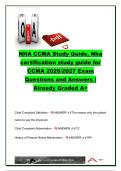
NHA CCMA Study Guide, Nha
certification study guide for
CCMA 2026/2027 Exam
Questions and Answers |
Already Graded A+


Chief Complaint Definition - ANSWER ✔✔The reason why the patient

came to see the physician.


Chief Complaint Abbreviation - ANSWER ✔✔CC


History of Present Illness Abbreviation - ANSWER ✔✔HPI

,History of Present Illness Definition - ANSWER ✔✔This is an

explanation of the CC to determine the onset of the illness; associated

symptoms; what the patient has done to treat the condition, etc.


Past, Family and Social History Abbreviation - ANSWER ✔✔PFSH


Past Medical History Definition - ANSWER ✔✔Includes all health

problems, major illnesses, surgeries the patient has had, current

medications complete with reasons for taking them, and allergies.


Family History Definition - ANSWER ✔✔Summary of health problems

of siblings, parents, and other blood relatives that could alert the

physician to hereditary and/or familial disease.


Social History Definition - ANSWER ✔✔Includes marital status,

occupation, educational attainment, hobbies, use of alcohol, tobacco,

drugs, and lifestyles.


Review of Systems Abbreviation - ANSWER ✔✔ROS


Review of Systems Definition - ANSWER ✔✔This is an orderly and

systematic check of each organ and system of the body by questions.

Both positive and pertinent negative findings are documented.


3 Body Processes Necessary for life are: - ANSWER ✔✔Body

Temperature, Respiration, Heart Function

,4 Vital Signs of Body Function are: - ANSWER ✔✔Temperature,

Pulse, Respiration, Blood Pressure


Define Body Temperature - ANSWER ✔✔Is a balance between heart

production and heart loss in conjunction with each other, maintained and

regulated by the hypothalamus.


Thermometers - ANSWER ✔✔Are used to measure temperature

using the Fahrenheit and Centigrade or Celsius scale.


Temperature Sites - ANSWER ✔✔Mouth, Rectum, Ear (Tympanic

Membrane), and the axilla (underarm).


Normal Temperature Range for Rectal - ANSWER ✔✔98.6F to

100.6F

37.0C to 38.1C


Normal Temperature Range for Oral - ANSWER ✔✔97.6F to 99.6F


36.5C to 37.5C


Normal Temperature Range for Axillary - ANSWER ✔✔96.6F to

98.6F

35.9C to 37.0C


3
COPYRIGHT©JOSHCLAY 2025/2026. YEAR PUBLISHED 2026. COMPANY REGISTRATION NUMBER: 619652435. TERMS OF USE. PRIVACY
STATEMENT. ALL RIGHTS RESERVED

, Normal Temperature Range for Tympanic Membrane - ANSWER

✔✔98.6 F


37 C


Define Febrile - ANSWER ✔✔Presence of Fever


Define Afebrile - ANSWER ✔✔Absence of Fever


Define Fever - ANSWER ✔✔Elevated body temperature beyond

normal range.


Intermittent Fever - ANSWER ✔✔Fluctuating fever that returns to or

below baseline then rises again.


Remittent Fever - ANSWER ✔✔Fluctuating fever that remains

elevated; it does not return to baseline temperature.


Continuous Fever - ANSWER ✔✔A fever that remains constant

above the baseline; it does not fluctuate.


Oral Temperature - ANSWER ✔✔Is the most common method of

measurement.


Oral Temperature is not taken from what patients: - ANSWER ✔✔-

infants and children less than six years old

-patients who has had surgery or facial, neck, nose, or mouth injury

Document information

Uploaded on
August 12, 2026
Number of pages
123
Written in
2026/2027
Type
Exam (elaborations)
Contains
Questions & answers
$18.99

Wrong document? Swap it for free Within 14 days of purchase and before downloading, you can choose a different document. You can simply spend the amount again.
Written by students who passed
Immediately available after payment
Read online or as PDF

Seller avatar
Reputation scores are based on the amount of documents a seller has sold for a fee and the reviews they have received for those documents. There are three levels: Bronze, Silver and Gold. The better the reputation, the more your can rely on the quality of the sellers work.
JOSHCLAY
3.5
(82)
Sold
383
Followers
16
Items
20324
Last sold
2 days ago


Why students choose Stuvia

Created by fellow students, verified by reviews

Quality you can trust: written by students who passed their tests and reviewed by others who've used these notes.

Didn't get what you expected? Choose another document

No worries! You can instantly pick a different document that better fits what you're looking for.

Pay as you like, start learning right away

No subscription, no commitments. Pay the way you're used to via credit card and download your PDF document instantly.

Student with book image

“Bought, downloaded, and aced it. It really can be that simple.”

Alisha Student

Working on your references?

Create accurate citations in APA, MLA and Harvard with our free citation generator.

Working on your references?

Frequently asked questions

